Parama Ekadashi: The Sacred Fast of Faith, Discipline & Divine Grace
Some sacred days invite celebration.
Others invite transformation.
Parama Ekadashi belongs to the latter.
Observed during the Krishna Paksha of Purushottam Maas, also known as Adhik Maas, Parama Ekadashi is regarded as one of the most spiritually significant Ekadashis in the Hindu calendar. Dedicated to Lord Vishnu, this sacred observance is not merely about fasting from food. It is an opportunity to cultivate devotion, strengthen self-discipline, purify the mind, and reconnect with deeper spiritual values.
Parama Ekadashi is observed during the Krishna Paksha of Purushottam Maas (Adhik Maas). Dedicated to Lord Vishnu, it is traditionally observed through fasting, prayer, mantra chanting, charity, and spiritual reflection.
For centuries, devotees have observed Parama Ekadashi through fasting, prayer, mantra chanting, charity, and reflection. Yet its deeper message remains remarkably relevant today. In a world filled with constant noise, endless distractions, and emotional overload, Parama Ekadashi offers something increasingly rare: a chance to pause, simplify, and return to what truly matters.
- What Is Parama Ekadashi?
- Why Parama Ekadashi Is Considered So Powerful
- The Sacred Significance of Purushottam Maas
- The Spiritual Meaning of Parama Ekadashi
- Lord Vishnu and the Energy of Preservation
- The Power of Self-Discipline
- The Sacred Story Behind Parama Ekadashi
- Lessons from the Parama Ekadashi Vrat Katha
- Spiritual Benefits of Observing Parama Ekadashi
- Preparing Your Mind for Parama Ekadashi
- Why Parama Ekadashi Matters in Modern Life
- Common Mistakes People Make While Observing Ekadashi
- Frequently Asked Questions About Parama Ekadashi
- A Sacred Invitation to Inner Transformation
Quick Answer
Parama Ekadashi is observed during the Krishna Paksha of Purushottam Maas (Adhik Maas) and is dedicated to Lord Vishnu. It is considered one of the most spiritually powerful Ekadashis and is traditionally observed through fasting, Vishnu worship, mantra chanting, charity, and self-discipline.
What Is Parama Ekadashi?
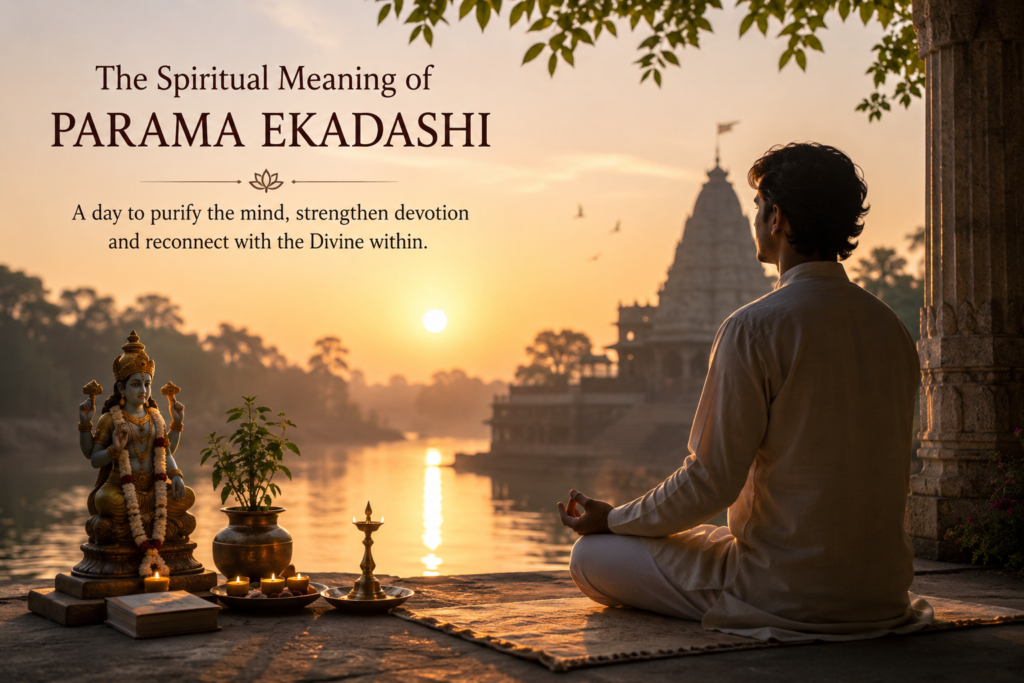
Parama Ekadashi falls on the eleventh lunar day of the waning phase of the Moon during Purushottam Maas, the sacred extra month periodically added to the Hindu lunar calendar.
The word Parama means supreme, highest, or ultimate. The observance is considered especially auspicious because it occurs during a month that Hindu traditions dedicate entirely to Lord Vishnu.
Unlike many religious observances that focus primarily on external rituals, Parama Ekadashi encourages both outward worship and inward transformation. The day serves as an invitation to examine one’s thoughts, habits, intentions, and relationship with Dharma.
Many devotees use this sacred occasion to deepen their spiritual practice through prayer, mantra chanting, scriptural study, acts of charity, and conscious self-discipline.
Parama Ekadashi occurs during Purushottam Maas, the sacred month dedicated entirely to Lord Vishnu, making it one of the most spiritually significant Ekadashis in the Hindu calendar.
Why Parama Ekadashi Is Considered So Powerful
Every Ekadashi holds spiritual significance within Sanatan Dharma, but Parama Ekadashi is often regarded as especially powerful because it combines the sanctity of Ekadashi with the sacred energy of Purushottam Maas.
Ekadashi itself is traditionally associated with purification, devotion, self-restraint, and spiritual awareness. When these practices are observed during the month dedicated to Lord Vishnu, many devotees believe their spiritual impact becomes even more meaningful.
The observance encourages people to temporarily step away from routine distractions and create space for prayer, reflection, and conscious living. Rather than focusing solely on worldly concerns, Parama Ekadashi invites devotees to strengthen their connection with Dharma and cultivate greater awareness of their inner life.
For many people, this day becomes a spiritual reset, an opportunity to slow down, reconnect with faith, and bring greater intention into everyday living.
The Sacred Significance of Purushottam Maas
To understand Parama Ekadashi fully, it is important to understand the sacred nature of Purushottam Maas.
Adhik Maas occurs approximately every thirty-two months to harmonize the lunar and solar calendars. While this additional month serves an astronomical purpose, Hindu tradition views it as far more than a calendrical adjustment.
According to sacred traditions, this month was blessed by Lord Vishnu and became known as Purushottam Maas, the month of the Supreme Being.
Because of this association, Purushottam Maas is regarded as a highly favorable period for spiritual growth. Many devotees intensify their spiritual practices during this month by increasing prayer, meditation, scripture reading, charity, pilgrimage, and devotional observances.
Purushottam Maas reminds us that spiritual growth is not always about doing more. Sometimes growth begins by slowing down, becoming aware of our habits, and consciously choosing a higher path.
For this reason, Parama Ekadashi is often seen as one of the most meaningful opportunities within the entire Purushottam Maas period.
The Spiritual Meaning of Parama Ekadashi
The deeper significance of Parama Ekadashi extends far beyond fasting.
At its heart, this observance is about purification of consciousness.
Modern life often leaves little room for stillness. People move from one task to another, constantly connected to information, notifications, responsibilities, and expectations. Over time, this continuous stimulation can leave the mind exhausted and disconnected from deeper spiritual awareness.
Parama Ekadashi creates a sacred pause.
It encourages devotees to temporarily step away from habitual patterns and become more aware of their thoughts, actions, and intentions. Fasting becomes more than avoiding food. It becomes an exercise in mindfulness and self-observation.
The observance gently invites devotees to examine:
- What truly nourishes them
- Which habits create suffering
- Where attachment has become excessive
- How faith can provide inner stability
The deepest fast is not always from food. Sometimes it is from anger, negativity, gossip, distraction, excessive consumption, and unconscious habits.
This is where the transformative power of Parama Ekadashi begins.
Lord Vishnu and the Energy of Preservation
Parama Ekadashi is dedicated to Lord Vishnu, the divine preserver who sustains balance, harmony, and order within creation.
🪷Vishnuविष्णुIn Sanatan Dharma, Lord Vishnu represents stability amidst change, wisdom amidst confusion, and Dharma amidst chaos.
When devotees worship Lord Vishnu on Parama Ekadashi, they seek to cultivate those same qualities within themselves.
Through prayer, mantra chanting, and remembrance, devotees aspire to strengthen:
- Inner balance
- Emotional stability
- Spiritual wisdom
- Compassion
- Faith
- Commitment to Dharma
The observance reminds us that outer harmony often begins with inner alignment.
The Power of Self-Discipline
One of the most enduring teachings of Ekadashi is self-mastery.
In a culture that often celebrates instant gratification, fasting teaches patience, restraint, and awareness. It demonstrates that true freedom does not necessarily come from satisfying every desire, but from learning to govern those desires wisely.
This discipline extends beyond food.
Parama Ekadashi encourages devotees to become mindful of their words, actions, emotions, and reactions. The self-control cultivated during the observance often influences many other aspects of life, including relationships, decision-making, emotional wellbeing, and spiritual growth.
✓ Awareness before action
✓ Discipline before desire
✓ Faith during uncertainty
✓ Gratitude during abundance
✓ Dharma over impulse
✓ Devotion over distraction
The Sacred Story Behind Parama Ekadashi
The spiritual significance of Parama Ekadashi becomes even more meaningful when understood through the traditional Vrat Katha associated with this observance.
Preserved within Hindu tradition for generations, this story is far more than a tale about divine blessings. It is a powerful lesson in faith, patience, humility, perseverance, and the transformative power of sincere devotion.
The Parama Ekadashi Vrat Katha is not merely a story about the removal of hardship. It is a story about maintaining faith when circumstances seem difficult and trusting that sincere devotion never goes unnoticed.
A Life Marked by Hardship
In ancient times, there lived a learned Brahmin named Sumedha in the city of Kampilya.
Although Sumedha was virtuous, knowledgeable, and deeply devoted to Dharma, he suffered from extreme poverty. Daily life was filled with hardship, and even basic necessities were often difficult to obtain.
Yet despite these challenges, his wife remained unwavering in her faith.
She never complained about their circumstances.
She never abandoned Dharma.
She continued serving her husband, guests, and spiritual duties with humility and gratitude.
Her character reflected one of the most important teachings of Sanatan Dharma: external wealth may come and go, but inner virtue remains a person’s greatest treasure.
The Arrival of Sage Kaundinya
As years passed, Sumedha became increasingly distressed by their difficult circumstances and considered leaving home in search of a better life elsewhere.
His wife, however, reminded him that faith, patience, and righteous conduct often produce results that cannot be measured immediately.
One day, the revered Sage Kaundinya arrived at their humble home.
Despite possessing very little, the couple welcomed the sage with sincerity, hospitality, and respect.
Moved by their devotion and character, Sage Kaundinya accepted their service and offered to guide them.
A Sacred Path Is Revealed
When asked about their greatest concern, Sumedha’s wife explained the hardships they faced.
Rather than asking for wealth directly, she sought spiritual guidance.
She wished to know whether there existed a sacred observance capable of helping them overcome suffering while remaining aligned with Dharma.
Sage Kaundinya advised them to observe Parama Ekadashi during Purushottam Maas.
He explained that this sacred observance possessed immense spiritual merit and could help purify karmas, remove obstacles, strengthen devotion, and attract divine grace.
He instructed them to observe the fast with sincerity, worship Lord Vishnu, chant sacred mantras, remain disciplined, and continue performing acts of charity whenever possible.
Faith, Devotion and Transformation
Following the sage’s guidance, Sumedha and his wife observed Parama Ekadashi with complete sincerity.
Their focus was not solely on material gain.
Instead, they dedicated themselves wholeheartedly to devotion, prayer, discipline, and spiritual practice.
They trusted the process.
They remained patient.
They continued walking the path of Dharma.
Over time, their circumstances gradually improved. Prosperity entered their lives, and their hardships began to ease.
Yet the greatest blessing was not material wealth.
It was inner transformation.
Faith became stronger.
Awareness deepened.
Character became refined.
Their connection with the Divine grew more profound.
“The greatest miracle in the Parama Ekadashi story is not the arrival of wealth. It is the unwavering faith that survived hardship.
— Sanatan Reflection
Lessons from the Parama Ekadashi Vrat Katha
Ancient spiritual stories continue to resonate because they speak to universal human experiences. The Parama Ekadashi Vrat Katha is not merely a tale about overcoming poverty. It is a reflection on how faith, patience, and righteous conduct can guide us through life’s uncertainties.
Faith During Difficult Times
Anyone can remain hopeful when circumstances are favorable. The true test of faith often appears when life becomes challenging.
The story of Sumedha and his wife reminds us that spiritual strength is not measured by how we act during comfort, but by how we respond during hardship. Their unwavering devotion demonstrates that faith is not passive optimism. It is the courage to continue walking the path of Dharma even when immediate results are not visible.
The Power of Contentment
Contentment does not mean abandoning ambition or refusing to improve one’s circumstances.
Instead, it means maintaining inner balance while continuing to make sincere efforts. Sumedha’s wife exemplifies this beautifully. Despite facing hardship, she remained grateful, devoted, and grounded in her values.
Her example teaches that gratitude and aspiration can coexist. We can work toward a better future without losing appreciation for what we already possess.
Why Spiritual Discipline Matters
Meaningful transformation rarely happens overnight.
Parama Ekadashi reminds us that lasting change often emerges through consistent effort, self-discipline, and devotion. Whether one seeks spiritual growth, emotional balance, or personal improvement, progress is usually built through small actions repeated with sincerity.
The Importance of Right Guidance
The arrival of Sage Kaundinya symbolizes the role of wisdom in spiritual growth.
Throughout life, guidance may come through scriptures, teachers, mentors, life experiences, or moments of deep reflection. Remaining open to wisdom often becomes the first step toward transformation.
The deeper message of the Parama Ekadashi Vrat Katha is not the removal of hardship. It is the reminder that sincere effort, faith, and devotion can transform how we experience life’s challenges.
Spiritual Benefits of Observing Parama Ekadashi
For centuries, devotees have observed Parama Ekadashi not merely because of tradition, but because of the profound inner transformation it encourages.
While sacred texts describe various spiritual merits associated with the observance, the greatest benefits often emerge through the qualities it helps cultivate within the devotee.
Strengthening Devotion
Parama Ekadashi creates dedicated time for prayer, mantra chanting, and remembrance of Lord Vishnu.
In daily life, spiritual practices are often postponed due to responsibilities and distractions. This sacred observance encourages devotees to intentionally reconnect with devotion and spiritual awareness.
Cultivating Self-Discipline
The discipline required to observe Ekadashi extends beyond food.
It encourages mindfulness in speech, actions, habits, and emotional reactions. Over time, this conscious self-regulation strengthens character and promotes greater inner stability.
Developing Mental Clarity
Periods of intentional simplicity often create space for reflection.
By reducing distractions and focusing on spiritual practices, many devotees experience a greater sense of calmness, clarity, and emotional balance.
Encouraging Gratitude
Parama Ekadashi reminds devotees to appreciate blessings that are often taken for granted.
The observance shifts attention away from constant acquisition and toward appreciation, contentment, and mindful living.
✓ To deepen devotion to Lord Vishnu
✓ To strengthen self-discipline
✓ To cultivate gratitude
✓ To reduce distraction
✓ To develop spiritual awareness
✓ To align more closely with Dharma
Preparing Your Mind for Parama Ekadashi
While fasting is one of the most visible aspects of Parama Ekadashi, the true observance begins within.
Ancient traditions emphasize that the quality of our thoughts and intentions matters just as much as the rituals we perform. A peaceful and receptive mindset allows devotees to experience the deeper purpose of the vrat.
Begin with a Sankalp
A Sankalp is a conscious spiritual intention.
Before Parama Ekadashi begins, take a moment to reflect upon why you are observing the vrat. Your intention may be to strengthen devotion, cultivate self-discipline, seek inner peace, express gratitude, or deepen spiritual awareness.
A clear intention gives purpose and meaning to every practice performed throughout the day.
Practice Gratitude
Parama Ekadashi offers a powerful opportunity to focus on abundance rather than lack.
Instead of dwelling on what is missing, reflect upon the blessings, relationships, opportunities, and lessons that have shaped your life. Gratitude naturally creates a more peaceful and devotional state of mind.
Let Go of Mental Burdens
Many spiritual traditions teach that emotional burdens can be heavier than physical ones.
Parama Ekadashi invites devotees to release anger, resentment, excessive worry, and negativity. Forgiveness does not mean approving harmful actions. It means freeing yourself from carrying unnecessary emotional weight.
Simplify Your Day
The spirit of Ekadashi encourages simplicity.
Reducing excessive screen time, unnecessary entertainment, negative conversations, and mental clutter helps create space for prayer, reflection, and spiritual insight.
The deepest preparation for Ekadashi is not deciding what you will avoid eating.
It is deciding what you will avoid feeding within the mind.
Consider fasting from anger, gossip, complaining, negativity, excessive consumption, and constant digital stimulation.
Why Parama Ekadashi Matters in Modern Life
At first glance, an ancient fasting observance may appear disconnected from contemporary challenges.
Yet Parama Ekadashi remains remarkably relevant.
Today’s world is filled with constant notifications, information overload, endless consumption, digital distractions, stress, and mental fatigue. Many people spend their days moving rapidly from one task to another without experiencing moments of stillness.
The principles behind Parama Ekadashi offer a meaningful response to these challenges.
The observance encourages individuals to slow down, become more mindful, reduce unnecessary distractions, and reconnect with spiritual values.
This is one reason millions of people continue observing Ekadashi today.
Its wisdom transcends time.
“Parama Ekadashi is not simply a fast from food. It is an invitation to fast from distraction and reconnect with what truly matters.
— Sanatan Reflection
Common Mistakes People Make While Observing Ekadashi
Observing Parama Ekadashi is not about achieving perfection. However, understanding common mistakes can help devotees experience the deeper purpose of the vrat.
Focusing Only on Food Restrictions
Many people think of Ekadashi purely as a dietary observance.
While fasting is important, the day is equally about prayer, devotion, reflection, self-discipline, and spiritual growth.
Ignoring Prayer and Mantra Chanting
Avoiding certain foods without engaging in spiritual practices can reduce the observance to a routine exercise.
Prayer, mantra chanting, and remembrance of Lord Vishnu remain central to the spirit of Ekadashi.
Treating the Fast as a Weight-Loss Program
The purpose of Parama Ekadashi is spiritual growth.
Any physical benefits should be viewed as secondary rather than the primary goal.
Remaining Emotionally Reactive
A person may avoid grains while still feeding anger, resentment, criticism, or negativity.
The deeper practice of Ekadashi involves purification of thoughts as well as habits.
The most successful Ekadashi observance is not necessarily the strictest one.
It is the one that brings you closer to awareness, gratitude, devotion, and Dharma.
Frequently Asked Questions About Parama Ekadashi
What is the significance of Parama Ekadashi?+
Which deity is worshipped on Parama Ekadashi?+
Why is Parama Ekadashi observed during Adhik Maas?+
What is the story behind Parama Ekadashi?+
Can fruits be eaten during Parama Ekadashi?+
What foods are traditionally avoided on Parama Ekadashi?+
Which mantra is commonly chanted on Parama Ekadashi?+
Can beginners observe Parama Ekadashi?+
When should the Parama Ekadashi fast be broken?+
A Sacred Invitation to Inner Transformation
Parama Ekadashi continues to inspire devotees because its message transcends time.
It reminds us that true transformation rarely happens through dramatic events. More often, it begins quietly, through a sincere prayer, a moment of awareness, an act of discipline, or a conscious decision to move closer to Dharma.
The observance teaches that devotion is not merely ritual. It is a way of living with greater awareness, gratitude, humility, and purpose.
In a world filled with noise, urgency, and endless distraction, Parama Ekadashi offers something increasingly rare:
the opportunity to pause, reflect, and return to what truly matters.
Parama Ekadashi reminds us that spiritual growth is rarely sudden. It emerges through small acts of awareness, sincere devotion, patient discipline, and a willingness to walk the path of Dharma, even when the destination is not yet visible.
What is Parama Ekadashi?+
Why is Parama Ekadashi considered so important?+
Which deity is worshipped on Parama Ekadashi?+
What is the story of Parama Ekadashi?+
Can beginners observe Parama Ekadashi?+
What foods are allowed on Parama Ekadashi?+
What foods should be avoided on Parama Ekadashi?+
Which mantra is best for Parama Ekadashi?+
What are the benefits of observing Parama Ekadashi?+
When is the Parama Ekadashi fast broken?+
How to Observe Nirjala Ekadashi: Fasting Rules, Satvik Preparation & Beginner Guidance
While the spiritual essence of Nirjala Ekadashi lies in awareness, discipline, and devotion, many devotees also seek practical guidance on how to observe the fast meaningfully and mindfully.
For some people, Nirjala Ekadashi becomes a deeply devotional experience filled with prayer, mantra chanting, silence, and reflection. For others, especially beginners, it may feel physically and emotionally intense at first.
What matters most within Sanatan traditions is not harsh perfection, but sincerity, awareness, and genuine spiritual intention.
- How Devotees Traditionally Observe Nirjala Ekadashi
- What Makes Nirjala Ekadashi Different From Other Ekadashi Fasts?
- Can Beginners Observe Nirjala Ekadashi?
- How to Prepare for Nirjala Ekadashi
- Satvik Food Before Nirjala Ekadashi
- What Devotees Often Avoid During Nirjala Ekadashi
- Vishnu Puja During Nirjala Ekadashi
- Sacred Vishnu Mantras for Nirjala Ekadashi
- The Emotional Experience of Ekadashi Silence
- Breaking the Nirjala Ekadashi Fast
- Important Health and Mindful Considerations
- Why Nirjala Ekadashi Continues to Inspire Devotees
- Frequently Asked Questions About Nirjala Ekadashi
- How Devotees Traditionally Observe Nirjala Ekadashi
- What Makes Nirjala Ekadashi Different From Other Ekadashi Fasts?
- Can Beginners Observe Nirjala Ekadashi?
- How to Prepare for Nirjala Ekadashi
- Satvik Food Before Nirjala Ekadashi
- What Devotees Often Avoid During Nirjala Ekadashi
- Vishnu Puja During Nirjala Ekadashi
- Sacred Vishnu Mantras for Nirjala Ekadashi
- The Emotional Experience of Ekadashi Silence
- Breaking the Nirjala Ekadashi Fast
- Important Health and Mindful Considerations
- Why Nirjala Ekadashi Continues to Inspire Devotees
- Frequently Asked Questions About Nirjala Ekadashi
How Devotees Traditionally Observe Nirjala Ekadashi
Nirjala Ekadashi is traditionally observed through fasting, Vishnu devotion, prayer, mantra chanting, simplicity, and reduced worldly distraction.
Many devotees spend the day:
- praying quietly
- chanting Vishnu mantras
- reading sacred scriptures
- visiting temples
- listening to bhajans
- practicing silence and reflection
The atmosphere of the day often feels calmer and more inward compared to ordinary routines. Many people intentionally reduce noise, overstimulation, and unnecessary activity to cultivate a more devotional state of mind.
For many devotees, Nirjala Ekadashi becomes less about restriction and more about creating spiritual stillness through simplicity and conscious awareness.
What Makes Nirjala Ekadashi Different From Other Ekadashi Fasts?
Unlike many other Ekadashi observances where fruits, milk, or water may be consumed, Nirjala Ekadashi is traditionally observed without food or water for the duration of the fast.
This is one reason it is considered among the most disciplined Ekadashi observances.
However, spiritual traditions also emphasize mindfulness and sincerity rather than rigid extremism. Not every devotee observes the fast in the exact same way, especially depending on age, health, physical condition, and spiritual capacity.
The deeper spiritual purpose remains:
- awareness
- devotion
- restraint
- simplicity
- conscious living
The essence of Nirjala Ekadashi lies not in physical hardship alone, but in cultivating sincerity, mindfulness, and spiritual focus.
Can Beginners Observe Nirjala Ekadashi?
Yes, absolutely.
Many beginners gradually approach Nirjala Ekadashi in a way that feels mindful and manageable for their health and experience level.
Some devotees begin by:
- reducing heavy foods beforehand
- eating simpler satvik meals
- increasing prayer and mantra chanting
- avoiding distraction and indulgence
- observing partial fasting if needed
Over time, individuals may deepen their observance naturally according to their spiritual comfort and physical well-being.
In spiritual practice, sincerity and awareness are often considered more meaningful than forcing the body beyond its limits.
How to Prepare for Nirjala Ekadashi
Preparation often begins the day before the fast.
Many devotees prefer lighter and more satvik meals to help create a calmer physical and mental state. Oily, overly spicy, or heavy foods are often reduced beforehand.
The emotional atmosphere surrounding preparation is also important.
Many people try to:
- reduce mental clutter
- avoid unnecessary conflict
- sleep earlier
- create a quieter devotional environment
- spend more time in prayer or reflection
This gradual slowing down helps the transition into Ekadashi feel more peaceful and spiritually focused.
Satvik Food Before Nirjala Ekadashi
Since Nirjala Ekadashi is traditionally intense, many devotees choose nourishing satvik foods before beginning the fast.
Common preparations may include:
- fruits
- milk
- curd
- simple khichdi
- light vegetables
- nuts
- herbal drinks
The intention is usually not indulgence, but mindful nourishment and simplicity.
“Satvik eating supports not only physical balance, but also a calmer and more mindful inner state.
— Sanatan Reflection
Many devotees also avoid overeating before the fast, as excessive consumption can make the observance feel physically heavier.
What Devotees Often Avoid During Nirjala Ekadashi
Beyond food restrictions, many spiritual traditions also encourage reducing:
- anger
- excessive talking
- distraction
- unnecessary entertainment
- arguments
- mental restlessness
The observance is often viewed as a full spiritual discipline involving both body and mind.
For many devotees, the quieter emotional atmosphere of Ekadashi becomes just as important as the fast itself.
Vishnu Puja During Nirjala Ekadashi
Lord Vishnu worship holds central importance during Nirjala Ekadashi.
🪷Vishnuविष्णुMany devotees light a diya, offer flowers, chant Vishnu mantras, read sacred texts, or spend quiet time in prayer before an image or murti of Lord Vishnu.
The atmosphere is usually simple, calm, and devotional rather than elaborate.
Even a few moments of sincere prayer can create a powerful feeling of emotional grounding during the day.
Sacred Vishnu Mantras for Nirjala Ekadashi
Mantra chanting is one of the most accessible and emotionally calming practices during Ekadashi.
Many devotees softly chant:
- Om Namo Bhagavate Vasudevaya
- Om Namo Narayanaya
- Hare Krishna Maha Mantra
- Vishnu Sahasranama
Some people chant quietly during meditation, while others play soft bhajans or devotional music throughout the day to maintain a peaceful atmosphere at home.
The Emotional Experience of Ekadashi Silence
One aspect of Nirjala Ekadashi that many devotees remember deeply is the emotional stillness it creates.
Without constant eating, stimulation, scrolling, or distraction, the mind gradually begins to slow down.
People often become more aware of:
- thought patterns
- emotional reactions
- mental restlessness
- unconscious habits
At the same time, many devotees also experience:
- calmness
- gratitude
- clarity
- softness
- inward reflection
“Spiritual silence often reveals how much peace already exists beneath the noise of everyday life.
— Sanatan Reflection
For many people, this inner quietness becomes the most meaningful part of the observance.
Breaking the Nirjala Ekadashi Fast
The fast is traditionally broken during the designated paran time on the following day after Ekadashi.
Many devotees begin gently with:
- water
- fruits
- light satvik food
- simple meals
The transition out of fasting is usually approached slowly and mindfully rather than through heavy eating.
For many people, the simplicity maintained during Ekadashi naturally continues into the following day as well.
Important Health and Mindful Considerations
Nirjala Ekadashi is traditionally regarded as an intense observance, and individual health conditions should always be respected.
Elderly devotees, children, pregnant women, or individuals with medical conditions often adapt the observance according to their well-being and personal guidance.
Sanatan traditions have historically emphasized both discipline and wisdom.
True spiritual practice should cultivate awareness, humility, and balance rather than physical harm or rigid self-punishment.
For many devotees, mindful observance with sincerity becomes more spiritually meaningful than extreme rigidity.
Why Nirjala Ekadashi Continues to Inspire Devotees
For centuries, Nirjala Ekadashi has reminded devotees that spiritual strength is not always built through outward achievement.
Sometimes it emerges quietly through:
- discipline
- simplicity
- restraint
- mindfulness
- silence
- devotion
In a world filled with endless stimulation and compulsive distraction, even one intentional day of conscious living can feel deeply transformative.
“The purpose of spiritual discipline is not to harden the heart, but to bring the mind closer to awareness, gratitude, and inner peace.
— Sanatan Reflection
Frequently Asked Questions About Nirjala Ekadashi
What is Nirjala Ekadashi?+
Why is Nirjala Ekadashi called Bhimsen Ekadashi?+
Can beginners observe Nirjala Ekadashi?+
Can water be consumed during Nirjala Ekadashi?+
What food is eaten before Nirjala Ekadashi?+
Why is Nirjala Ekadashi considered spiritually powerful?+
How to Observe Nirjala Ekadashi: Fasting Rules, Satvik Preparation & Beginner Guidance
While the spiritual essence of Nirjala Ekadashi lies in awareness, devotion, and inner discipline, many devotees also seek practical guidance on how to observe the fast meaningfully and mindfully.
For some people, Nirjala Ekadashi becomes a deeply devotional experience centered around silence, mantra chanting, prayer, and reflection. For others, especially beginners, it may feel physically and emotionally intense at first. Within Sanatan traditions, however, the heart of the observance has never been rigid perfection. What matters most is sincerity, mindfulness, humility, and genuine spiritual intention.
- How Devotees Traditionally Observe Nirjala Ekadashi
- What Makes Nirjala Ekadashi Different From Other Ekadashi Fasts?
- Can Beginners Observe Nirjala Ekadashi?
- How to Prepare for Nirjala Ekadashi
- Satvik Food Before Nirjala Ekadashi
- What Devotees Often Avoid During Nirjala Ekadashi
- Vishnu Puja During Nirjala Ekadashi
- Sacred Vishnu Mantras for Nirjala Ekadashi
- The Emotional Experience of Ekadashi Silence
- Breaking the Nirjala Ekadashi Fast
- Important Health and Mindful Considerations
- Why Nirjala Ekadashi Continues to Inspire Devotees
- Frequently Asked Questions About Nirjala Ekadashi
- How Devotees Traditionally Observe Nirjala Ekadashi
- What Makes Nirjala Ekadashi Different From Other Ekadashi Fasts?
- Can Beginners Observe Nirjala Ekadashi?
- How to Prepare for Nirjala Ekadashi
- Satvik Food Before Nirjala Ekadashi
- What Devotees Often Avoid During Nirjala Ekadashi
- Vishnu Puja During Nirjala Ekadashi
- Sacred Vishnu Mantras for Nirjala Ekadashi
- The Emotional Experience of Ekadashi Silence
- Breaking the Nirjala Ekadashi Fast
- Important Health and Mindful Considerations
- Why Nirjala Ekadashi Continues to Inspire Devotees
- Frequently Asked Questions About Nirjala Ekadashi
How Devotees Traditionally Observe Nirjala Ekadashi
Nirjala Ekadashi is traditionally observed through fasting, Vishnu devotion, prayer, mantra chanting, simplicity, and reduced worldly distraction. The atmosphere surrounding the day often feels noticeably calmer and more inward compared to ordinary routines.
Many devotees wake early before sunrise, light a diya, chant Vishnu mantras, and spend more time reading sacred texts such as the Bhagavad Gita or Vishnu Sahasranama. Some visit temples, while others prefer quieter observance at home through meditation, bhajans, and reflective silence.
For many devotees, the simplicity of the day itself gradually creates emotional stillness and mental clarity.
Nirjala Ekadashi is often experienced not as a day of harsh restriction, but as a sacred opportunity to slow down, simplify life, and reconnect with spiritual awareness.
What Makes Nirjala Ekadashi Different From Other Ekadashi Fasts?
Unlike many other Ekadashi observances where fruits, milk, or water may be consumed, Nirjala Ekadashi is traditionally observed without food or water for the duration of the fast. This is one reason it is considered among the most disciplined and spiritually intense Ekadashi observances.
Yet spiritual traditions also emphasize wisdom and sincerity rather than rigid extremism. Not every devotee observes the fast in exactly the same way, especially depending on age, health, physical condition, and spiritual capacity.
The deeper purpose of the observance remains centered around awareness, devotion, simplicity, restraint, and conscious living.
The essence of Nirjala Ekadashi lies not in physical hardship alone, but in cultivating mindfulness, sincerity, and spiritual focus.
Can Beginners Observe Nirjala Ekadashi?
Yes, absolutely.
Many beginners gradually approach Nirjala Ekadashi according to their physical comfort and spiritual readiness. Some devotees begin by simplifying meals beforehand, reducing distraction, increasing mantra chanting, and practicing partial fasting before attempting a stricter observance later.
Within Sanatan traditions, spiritual practice is often viewed as a gradual inner journey rather than forced perfection.
In spiritual discipline, sincerity and awareness are often considered far more meaningful than pushing the body beyond its limits.
Even small efforts made with devotion and mindfulness can become spiritually meaningful.
How to Prepare for Nirjala Ekadashi
Preparation for Nirjala Ekadashi often begins a day earlier.
Many devotees prefer lighter and more satvik meals before the fast to create a calmer physical and mental state. Heavy, oily, excessively spicy, or overly stimulating foods are often reduced naturally beforehand.
The emotional preparation is equally important.
Some people intentionally reduce unnecessary distraction, avoid conflict, sleep earlier, spend more time in prayer, or create a quieter devotional atmosphere at home. This gradual slowing down often helps the transition into Ekadashi feel more peaceful and spiritually centered.
Satvik Food Before Nirjala Ekadashi
Because Nirjala Ekadashi is traditionally intense, many devotees choose simple and nourishing satvik food before beginning the fast.
Meals are often kept light, calming, and easy to digest. Fruits, milk, curd, nuts, simple khichdi, and lightly prepared vegetables are commonly preferred in many households.
The focus is usually not indulgence, but mindful nourishment and simplicity.
“Satvik eating supports not only physical balance, but also a calmer and more mindful inner state.
— Sanatan Reflection
Many devotees also avoid overeating before the fast, as excessive consumption can make the observance feel physically heavier and mentally restless.
What Devotees Often Avoid During Nirjala Ekadashi
The observance of Ekadashi traditionally extends beyond food alone.
Many spiritual traditions also encourage reducing unnecessary distraction, excessive talking, emotional conflict, anger, entertainment overload, and mental restlessness during the day. The intention is to create greater inward awareness and emotional quietness.
For many devotees, this calmer mental atmosphere becomes one of the most meaningful aspects of Ekadashi itself.
Vishnu Puja During Nirjala Ekadashi
Lord Vishnu worship holds central importance during Nirjala Ekadashi.
🪷Vishnuविष्णुMany devotees light a diya, offer flowers, chant Vishnu mantras, read sacred verses, or spend quiet time in prayer before an image or murti of Lord Vishnu. The devotional atmosphere is usually kept simple, peaceful, and emotionally grounding rather than elaborate.
Even a few sincere moments of prayer often create a deep sense of calmness and spiritual connection during the observance.
Sacred Vishnu Mantras for Nirjala Ekadashi
Mantra chanting is one of the most emotionally calming practices associated with Nirjala Ekadashi.
Many devotees softly chant mantras such as Om Namo Bhagavate Vasudevaya, Om Namo Narayanaya, Vishnu Sahasranama, or the Hare Krishna Maha Mantra throughout the day. Some chant during meditation, while others play soft devotional bhajans at home to maintain a peaceful atmosphere.
Even a few minutes of sincere chanting can help quiet the mind and deepen devotional awareness.
The Emotional Experience of Ekadashi Silence
One aspect of Nirjala Ekadashi that many devotees remember deeply is the emotional stillness it creates.
Without constant eating, scrolling, stimulation, or distraction, the mind gradually begins to slow down. Many people become more aware of thought patterns, emotional restlessness, cravings, and unconscious habits that usually remain hidden beneath everyday activity.
At the same time, many devotees also experience moments of:
- calmness
- gratitude
- inward reflection
- emotional softness
- spiritual clarity
“Spiritual silence often reveals how much peace already exists beneath the noise of everyday life.
— Sanatan Reflection
For many people, this quieter inner atmosphere becomes more transformative than the ritual itself.
Breaking the Nirjala Ekadashi Fast
The fast is traditionally broken during the designated paran time on the following day after Ekadashi.
Many devotees gently begin with water, fruits, or light satvik meals rather than immediately returning to heavy eating. The transition out of fasting is usually approached slowly and mindfully.
For many people, the simplicity cultivated during Ekadashi naturally continues into the following day as well.
Important Health and Mindful Considerations
Nirjala Ekadashi is traditionally regarded as an intense observance, and personal health should always be respected.
Children, elderly devotees, pregnant women, or individuals with medical conditions often adapt the observance according to their well-being, guidance, and physical capacity. Sanatan traditions have historically emphasized both discipline and wisdom together.
True spiritual discipline should cultivate awareness, humility, balance, and devotion rather than physical harm or rigid self-punishment.
For many devotees, mindful observance with sincerity becomes far more spiritually meaningful than extreme rigidity.
Why Nirjala Ekadashi Continues to Inspire Devotees
For centuries, Nirjala Ekadashi has reminded devotees that spiritual strength is not always built through outward achievement or constant activity.
Sometimes transformation emerges quietly through simplicity, restraint, mindfulness, silence, devotion, and conscious living.
In a world filled with endless stimulation and compulsive distraction, even one intentional day of spiritual awareness can feel deeply renewing.
“The purpose of spiritual discipline is not to harden the heart, but to bring the mind closer to awareness, gratitude, and inner peace.
— Sanatan Reflection
Frequently Asked Questions About Nirjala Ekadashi
What is Nirjala Ekadashi?+
Why is Nirjala Ekadashi called Bhimsen Ekadashi?+
Can beginners observe Nirjala Ekadashi?+
Can water be consumed during Nirjala Ekadashi?+
What food is eaten before Nirjala Ekadashi?+
Why is Nirjala Ekadashi considered spiritually powerful?+
Adhik Maas: The Sacred Month of Pause, Reflection & Spiritual Renewal
In a world constantly asking people to move faster, achieve more, consume endlessly, and remain mentally occupied at all times, Adhik Maas carries a very different spiritual message.
Pause.
Slow down.
Reconnect.
Known traditionally as Purushottam Maas, Adhik Maas is considered one of the most spiritually significant periods in Sanatan Dharma. For centuries, devotees have viewed this sacred month not as an interruption in the calendar, but as a rare opportunity for inner cleansing, devotion, simplicity, and spiritual renewal.
Unlike many festivals centered around celebration and activity, Adhik Maas carries a softer emotional atmosphere. It encourages silence over noise, reflection over distraction, and spiritual grounding over constant worldly movement. For many devotees, this sacred month becomes a time to simplify life, deepen prayer, practice mindful living, and reconnect with inner calmness.
- What Is Adhik Maas?
- Why Does Adhik Maas Happen?
- Why Is Adhik Maas Called Purushottam Maas?
- Why Is Adhik Maas Considered Spiritually Powerful?
- The Spiritual Meaning of Sacred Pauses
- How Devotees Traditionally Observe Adhik Maas
- Why Many Traditions Avoid Major New Beginnings During Adhik Maas
- How Adhik Maas Feels Emotionally Different
- Why Adhik Maas Feels So Relevant Today
- Simple Ways to Observe Adhik Maas at Home
- Sacred Mantras for Adhik Maas
- Why Adhik Maas Continues to Inspire Devotees
- Spiritual Practices During Adhik Maas: Simple Rituals, Mantras & Mindful Living
- What Do People Traditionally Do During Adhik Maas?
- Why Simplicity Becomes Important During Purushottam Maas
- Reading Sacred Texts During Adhik Maas
- Why Vishnu Worship Is Central to Adhik Maas
- Sacred Mantras for Adhik Maas
- Fasting During Adhik Maas
- Why Charity Holds Special Importance During Adhik Maas
- How Adhik Maas Changes the Emotional Atmosphere of Daily Life
- Can Beginners Observe Adhik Maas?
- Why Adhik Maas Feels So Relevant in Modern Life
- Bringing the Spirit of Purushottam Maas Beyond One Month
- Frequently Asked Questions About Adhik Maas
What Is Adhik Maas?
Adhik Maas is an additional lunar month that appears periodically in the Hindu calendar to help align the lunar and solar cycles. It is also widely known as Purushottam Maas and is deeply associated with devotion to Lord Vishnu.
While many people initially understand Adhik Maas as a calendar adjustment, spiritual traditions give it much deeper meaning. Devotees often see this sacred month as a rare spiritual pause intentionally woven into time itself, an opportunity to step back from constant activity and reconnect with inner awareness.
Adhik Maas is traditionally viewed not as an ordinary extra month, but as a sacred period of spiritual realignment and emotional renewal.
Why Does Adhik Maas Happen?
The Hindu calendar primarily follows lunar cycles, while the solar calendar follows the movement of the Sun. Since lunar months are slightly shorter than the solar year, an imbalance gradually develops over time. To restore this balance, an additional month is periodically added, which becomes Adhik Maas.
Spiritually, however, this extra month is viewed very differently.
What appears astronomically as a calendar correction is often understood devotionally as a sacred opportunity for slowing down, reflecting inwardly, and deepening spiritual practice.
This symbolic meaning is what gives Adhik Maas its emotional and spiritual depth.
Why Is Adhik Maas Called Purushottam Maas?
One of the most beautiful aspects of Adhik Maas is its connection with Lord Vishnu.
According to spiritual traditions, this month was once considered spiritually neglected because it did not belong to the regular lunar cycle in the same way as other months. Lord Vishnu, known as Purushottam, the Supreme Divine Being, is believed to have blessed this sacred month and accepted it as his own.
From that moment onward, Adhik Maas became known as Purushottam Maas.
🪷Vishnuविष्णुThe story carries a deeply emotional message. It reminds devotees that even what feels overlooked or insignificant can become sacred through divine grace.
“What the world may overlook, the Divine can transform into something deeply sacred.
— Sanatan Reflection
Why Is Adhik Maas Considered Spiritually Powerful?
Many devotees believe Adhik Maas carries especially powerful spiritual energy because it encourages inward living rather than outward distraction.
The month is traditionally associated with:
- simplicity
- devotion
- prayer
- chanting
- reflection
- mindful living
Rather than focusing heavily on worldly expansion or celebration, devotees often use this period to create emotional stillness and spiritual clarity.
Adhik Maas reminds devotees that spiritual growth often happens not during constant activity, but during periods of silence, reflection, and inner awareness.
For many people, this slower rhythm itself feels deeply healing.
The Spiritual Meaning of Sacred Pauses
One of the deepest symbolic meanings of Adhik Maas is the importance of sacred pauses.
Nature itself moves through cycles:
day and night, seasons, tides, growth, rest, movement, and stillness. Spiritual traditions have long recognized that human beings also need intentional periods of slowing down and reflection.
Modern life rarely allows space for:
- silence
- emotional processing
- mindful awareness
- spiritual stillness
Adhik Maas symbolically restores that space.
“Sometimes spiritual clarity emerges not from doing more, but from becoming still enough to listen inwardly.
— Sanatan Reflection
In many ways, Purushottam Maas feels especially relevant today because modern minds often need sacred pauses more than ever before.
How Devotees Traditionally Observe Adhik Maas
Many devotees observe Adhik Maas through simple spiritual practices centered around devotion, discipline, and mindful living.
Some people chant Vishnu mantras daily. Others spend more time reading sacred texts like the Bhagavad Gita or Vishnu Sahasranama. Many households choose simpler meals, quieter routines, acts of charity, and reduced indulgence during this period.
The intention is usually not harsh restriction, but conscious spiritual alignment.
Why Many Traditions Avoid Major New Beginnings During Adhik Maas
One of the most searched questions about Adhik Maas is whether important worldly activities should be avoided during this period.
In many traditions, ceremonies such as marriages, griha pravesh, large celebrations, or major purchases are often postponed during Adhik Maas. However, this does not mean the month is considered negative or unlucky.
Instead, Purushottam Maas is traditionally viewed as more suitable for inward focus, devotion, reflection, simplicity, and spiritual practices rather than worldly expansion.
Adhik Maas is traditionally understood as a spiritually inward month focused on reflection and devotion rather than material activity.
This distinction is important because many people misunderstand the deeper purpose of the month.
How Adhik Maas Feels Emotionally Different
Many devotees describe Adhik Maas as carrying a noticeably calmer emotional atmosphere.
The energy of the month often feels quieter, slower, more reflective, and spiritually grounding. Small daily practices such as waking early, lighting a diya, chanting softly, eating mindfully, reducing distractions, or spending time in prayer gradually create a softer inner rhythm.
For many people, this simplicity itself becomes emotionally healing.
The beauty of Adhik Maas often lies not in elaborate rituals, but in the quiet transformation created through simplicity, stillness, and mindful devotion.
Why Adhik Maas Feels So Relevant Today
Modern life constantly pushes people toward speed, comparison, productivity, stimulation, and endless consumption.
Adhik Maas gently moves in the opposite direction.
It encourages people to slow down mentally, simplify emotionally, reconnect with spiritual practices, and create intentional moments of peace within everyday life.
For many devotees, this sacred month becomes less about ritual obligation and more about emotional and spiritual reset.
“Sacred pauses often become the moments where the soul remembers what truly matters.
— Sanatan Reflection
In a world filled with constant movement and mental noise, Adhik Maas continues to offer something increasingly rare, stillness.
Simple Ways to Observe Adhik Maas at Home
You do not need elaborate rituals to connect with the spirit of Adhik Maas.
Even small mindful practices can become deeply meaningful during this sacred month.
Reduce unnecessary distractions and create more intentional quiet moments during the day.
Spend a few minutes daily chanting Vishnu mantras with sincerity and calmness.
Many devotees read the Bhagavad Gita, Vishnu Sahasranama, or devotional stories during Purushottam Maas.
Eat mindfully, reduce excess consumption, and cultivate emotional balance.
Acts of generosity and kindness are considered spiritually meaningful during Adhik Maas.
Sacred Mantras for Adhik Maas
Popular mantras associated with Purushottam Maas include Om Namo Bhagavate Vasudevaya, Om Namo Narayanaya, Vishnu Sahasranama, and the Hare Krishna Maha Mantra.
Many devotees chant these mantras during morning prayer, meditation, fasting, evening diya rituals, or quiet moments of reflection. Even a few minutes of sincere chanting can help create a calmer and more devotional atmosphere.
Why Adhik Maas Continues to Inspire Devotees
For centuries, Adhik Maas has reminded devotees that spiritual life is not only about rituals or festivals. It is also about creating space for reflection, releasing inner clutter, simplifying the mind, and reconnecting with what truly matters.
Purushottam Maas gently reminds devotees that sometimes the most meaningful spiritual transformation happens quietly, through stillness, awareness, and sincere devotion.
In a world that constantly encourages more noise, more urgency, and more distraction, Adhik Maas continues to offer something profoundly sacred, the opportunity to pause, breathe, reflect, and return inwardly to peace.
Spiritual Practices During Adhik Maas: Simple Rituals, Mantras & Mindful Living
Adhik Maas, also known as Purushottam Maas, is traditionally regarded as a sacred period for spiritual reflection, simplicity, devotion, and inner cleansing. While the previous part explored the deeper meaning and symbolism of this sacred month, many devotees also seek practical ways to observe it meaningfully in daily life.
What makes Adhik Maas unique is that its practices are often rooted not in grand celebration, but in quieter forms of devotion. A softly lit diya, a calmer daily rhythm, a few moments of mantra chanting, or reading sacred scriptures with sincerity can all become deeply spiritual during this time.
For many devotees, Purushottam Maas becomes less about external ritual and more about creating inner stillness.
- What Is Adhik Maas?
- Why Does Adhik Maas Happen?
- Why Is Adhik Maas Called Purushottam Maas?
- Why Is Adhik Maas Considered Spiritually Powerful?
- The Spiritual Meaning of Sacred Pauses
- How Devotees Traditionally Observe Adhik Maas
- Why Many Traditions Avoid Major New Beginnings During Adhik Maas
- How Adhik Maas Feels Emotionally Different
- Why Adhik Maas Feels So Relevant Today
- Simple Ways to Observe Adhik Maas at Home
- Sacred Mantras for Adhik Maas
- Why Adhik Maas Continues to Inspire Devotees
- Spiritual Practices During Adhik Maas: Simple Rituals, Mantras & Mindful Living
- What Do People Traditionally Do During Adhik Maas?
- Why Simplicity Becomes Important During Purushottam Maas
- Reading Sacred Texts During Adhik Maas
- Why Vishnu Worship Is Central to Adhik Maas
- Sacred Mantras for Adhik Maas
- Fasting During Adhik Maas
- Why Charity Holds Special Importance During Adhik Maas
- How Adhik Maas Changes the Emotional Atmosphere of Daily Life
- Can Beginners Observe Adhik Maas?
- Why Adhik Maas Feels So Relevant in Modern Life
- Bringing the Spirit of Purushottam Maas Beyond One Month
- Frequently Asked Questions About Adhik Maas
What Do People Traditionally Do During Adhik Maas?
Across different regions and traditions, devotees observe Adhik Maas through practices connected with Lord Vishnu, prayer, charity, simplicity, and mindful living.
Some households increase their spiritual activities during this period by:
- chanting Vishnu mantras daily
- reading sacred texts
- practicing fasting
- reducing excess consumption
- donating food or clothing
- visiting temples
- spending more time in silence and prayer
The atmosphere of the month often feels quieter and more inward compared to highly celebratory festival periods.
Many devotees experience Adhik Maas not as a month of restriction, but as a sacred opportunity to simplify life and reconnect with spiritual awareness.
Why Simplicity Becomes Important During Purushottam Maas
One of the deepest themes associated with Adhik Maas is simplicity.
Modern life often creates constant mental stimulation through:
- endless information
- digital distraction
- emotional overwhelm
- hurried routines
- unconscious consumption
Purushottam Maas gently encourages the opposite.
It invites devotees to slow down, reduce excess, and create more intentional space for:
- prayer
- reflection
- mindful eating
- spiritual reading
- emotional clarity
- devotional practices
“Simplicity often creates the silence where spiritual awareness becomes easier to hear.
— Sanatan Reflection
For many people, even small changes during Adhik Maas, such as eating lighter meals, waking earlier, or reducing unnecessary distractions, gradually create a calmer inner atmosphere.
Reading Sacred Texts During Adhik Maas
Reading spiritual scriptures is considered especially meaningful during Purushottam Maas.
Many devotees spend time with:
- Bhagavad Gita
- Vishnu Sahasranama
- Srimad Bhagavatam
- Ramayana
- devotional stories of Lord Vishnu
Rather than rushing through verses, devotees often approach sacred reading slowly and reflectively.
In many spiritual traditions, sacred reading is not viewed as gathering information alone, but as a practice of inner reflection and emotional grounding.
For some people, even reading a few verses daily creates a sense of peace and steadiness throughout the month.
Why Vishnu Worship Is Central to Adhik Maas
Purushottam Maas is deeply associated with Lord Vishnu because spiritual traditions describe this sacred month as especially blessed by him.
🪷Vishnuविष्णुMany devotees therefore dedicate additional time during Adhik Maas to:
- Vishnu puja
- mantra chanting
- temple visits
- devotional bhajans
- quiet meditation
The energy of Vishnu worship during this month is often associated with:
- preservation
- emotional balance
- compassion
- discipline
- spiritual stability
This calmer devotional rhythm naturally aligns with the reflective atmosphere of Adhik Maas.
Sacred Mantras for Adhik Maas
Mantra chanting is one of the simplest and most accessible spiritual practices during Purushottam Maas.
Popular mantras include:
- Om Namo Bhagavate Vasudevaya
- Om Namo Narayanaya
- Hare Krishna Maha Mantra
- Vishnu Gayatri Mantra
Many devotees chant these mantras:
- during sunrise
- after lighting a diya
- before meditation
- while reading scriptures
- during quiet evening prayer
Even a few sincere minutes of chanting can gradually create emotional calmness and devotional focus.
Fasting During Adhik Maas
Some devotees also observe fasting practices during Adhik Maas as a form of discipline and spiritual awareness.
However, the deeper purpose of fasting is traditionally understood as:
- simplifying the senses
- reducing distraction
- cultivating mindfulness
- strengthening devotion
For many people, fasting during Purushottam Maas is approached gently and consciously rather than rigidly.
The spiritual purpose of fasting is not punishment, but creating greater awareness, simplicity, and inner clarity.
Many devotees prefer:
- lighter meals
- sattvic food
- mindful eating
- reduced indulgence
during this sacred month.
Why Charity Holds Special Importance During Adhik Maas
Acts of compassion and generosity are considered highly meaningful during Purushottam Maas.
Many devotees offer:
- food donations
- water donations
- clothing
- support to temples or ashrams
- service to those in need
This emphasis on giving reflects an important spiritual principle within Sanatan traditions, true devotion naturally expresses itself through compassion.
“Spiritual growth becomes meaningful when it also softens the heart toward others.
— Sanatan Reflection
For many devotees, even small acts of kindness during Adhik Maas feel deeply spiritually fulfilling.
How Adhik Maas Changes the Emotional Atmosphere of Daily Life
One reason many devotees feel emotionally connected to Adhik Maas is because the month subtly changes the rhythm of daily life.
Homes may feel:
- quieter
- slower
- more devotional
- emotionally softer
Morning prayers become calmer. Meals become simpler. Even ordinary routines begin carrying more mindfulness and awareness.
For many people, the true beauty of Adhik Maas lies in the quieter emotional transformation it creates within everyday life.
This softer spiritual rhythm often becomes more memorable than elaborate rituals.
Can Beginners Observe Adhik Maas?
Absolutely.
Purushottam Maas does not require perfection or complicated ritual knowledge.
Beginners can observe the month meaningfully through simple practices such as:
- chanting Vishnu mantras
- reading a few verses from the Bhagavad Gita
- practicing gratitude
- reducing distractions
- lighting a diya daily
- eating more mindfully
- spending quiet time in reflection
What matters most is sincerity and awareness.
Why Adhik Maas Feels So Relevant in Modern Life
Modern life constantly pushes people toward speed, comparison, stimulation, and emotional overload.
Adhik Maas offers a completely different spiritual rhythm.
It encourages:
- slowing down mentally
- simplifying emotionally
- reconnecting with devotion
- creating sacred pauses
- becoming more inwardly aware
For many people, this sacred month becomes a rare opportunity to breathe more consciously and reconnect with emotional stillness.
“In a noisy world, sacred pauses often become deeply healing.
— Sanatan Reflection
Bringing the Spirit of Purushottam Maas Beyond One Month
The deeper wisdom of Adhik Maas extends far beyond a single period in the calendar.
Its teachings gently remind devotees that spiritual peace is often found through:
- simplicity
- mindful living
- devotion
- compassion
- reflection
- emotional clarity
Even after Purushottam Maas ends, many people continue carrying its softer rhythms into daily life through calmer routines, spiritual awareness, and more intentional living.
The true purpose of Adhik Maas is not simply observing a sacred month, but rediscovering inner balance through conscious and devotional living.
Frequently Asked Questions About Adhik Maas
What is Adhik Maas?+
Why is Adhik Maas called Purushottam Maas?+
What do devotees do during Adhik Maas?+
Can beginners observe Adhik Maas?+
Why are marriages often avoided during Adhik Maas?+
Ganga Dussehra: The Sacred Descent of Maa Ganga and Its Spiritual Meaning
For centuries, devotees across India have looked toward the flowing waters of Maa Ganga not merely as a river, but as a living symbol of purification, compassion, surrender, and divine grace.
To stand beside the Ganga at sunrise, hear temple bells echo through the mist, watch diyas float gently across the water, and feel the quiet movement of the river is, for many people, an experience that goes beyond ritual. It feels deeply emotional, calming, and spiritually grounding.
Ganga Dussehra is the sacred festival that commemorates the descent of Maa Ganga from the heavens to Earth. But beyond mythology, the festival carries a deeper spiritual message about inner cleansing, emotional release, humility, and learning to flow through life with greater awareness.
Even today, in a world filled with noise, overstimulation, and emotional exhaustion, the symbolism of Maa Ganga continues to feel profoundly relevant.
- What Is Ganga Dussehra?
- Why Ganga Dussehra Is Spiritually Important
- The Story of Maa Ganga’s Descent to Earth
- Why Lord Shiva Is Deeply Connected to Maa Ganga
- The Spiritual Meaning of Maa Ganga
- Why Water Is Sacred in Sanatan Dharma
- How Sacred Rivers Shape Spiritual Consciousness
- The Emotional Experience of Standing Near the Ganga
- Why Ganga Dussehra Still Feels Spiritually Relevant Today
- Sacred Ganga Mantras for Devotion and Inner Calm
- Simple Ways to Spiritually Observe Ganga Dussehra
- How Devotees Traditionally Celebrate Ganga Dussehra
- The Spiritual Meaning of Ganga Snan
- Can You Celebrate Ganga Dussehra at Home?
- A Simple Ganga Dussehra Puja at Home
- Best Flowers, Diyas & Offerings for Maa Ganga
- Sacred Ganga Mantras for Prayer and Inner Calm
- Why Charity and Donation Are Important on Ganga Dussehra
- The Emotional Experience of Evening Diya Offerings
- Why Ganga Dussehra Feels So Emotionally Healing
- How to Bring the Spirit of Maa Ganga Into Everyday Life
- Frequently Asked Questions About Ganga Dussehra
What Is Ganga Dussehra?
Ganga Dussehra is a sacred Hindu festival that celebrates the divine descent of Maa Ganga to Earth. It is traditionally observed during the Shukla Paksha Dashami of the Jyeshtha month in the Hindu calendar.
The word “Dussehra” here is associated with the removal of ten kinds of sins or impurities through devotion, prayer, and spiritual awareness.
Across India, especially in places like Haridwar, Varanasi, Rishikesh, Prayagraj, and Gangotri, devotees gather near sacred ghats to perform Ganga snan, offer diyas, chant mantras, sing bhajans, and seek spiritual cleansing.
For many devotees, Ganga Dussehra is not only a celebration of a sacred river, but also a reminder that healing and renewal begin when the mind learns to let go and flow peacefully.
Why Ganga Dussehra Is Spiritually Important
Ganga Dussehra carries deep spiritual significance because Maa Ganga is traditionally viewed as a divine purifier in Sanatan Dharma.
Her flowing waters symbolize:
- cleansing
- compassion
- surrender
- grace
- spiritual movement
- emotional release
Unlike rigid spiritual symbolism, Maa Ganga represents flow. She reminds devotees that life constantly moves, changes, purifies, and renews itself.
The spiritual essence of Ganga Dussehra lies not only in outer purification, but also in emotional and inner cleansing.
Many devotees believe that this sacred day is especially powerful for:
- prayer
- reflection
- gratitude
- spiritual discipline
- releasing emotional heaviness
- reconnecting with devotion
The Story of Maa Ganga’s Descent to Earth
The story behind Ganga Dussehra is one of the most emotionally powerful narratives in Hindu tradition.
It is a story of devotion, tapasya, compassion, and divine intervention.
Raja Bhagirath’s Tapasya and Devotion
According to ancient Hindu scriptures, Raja Bhagirath performed intense tapasya for years to bring Maa Ganga from the heavens to Earth.
His purpose was not personal gain or power.
Raja Bhagirath wished to liberate the souls of his ancestors and bring peace to them through the sacred waters of Maa Ganga.
“True devotion seeks upliftment not only for oneself, but for all beings connected to us.
— Sanatan Reflection
Bhagirath’s unwavering determination became a timeless symbol of spiritual perseverance, humility, and selfless devotion.
Even today, the phrase “Bhagirath Prayas” is often used in India to describe an extraordinary effort made with sincerity and dedication.
Why Maa Ganga Descended from Heaven
Moved by Raja Bhagirath’s tapasya, Maa Ganga agreed to descend from the heavens to Earth.
However, her divine force was considered so immense that the Earth itself could not withstand the impact of her descent.
This led to another sacred intervention.
How Lord Shiva Received Ganga in His Jata
To protect the Earth, Lord Shiva compassionately received Maa Ganga within his jata, his sacred matted locks.
Instead of allowing her powerful descent to overwhelm the world, Shiva gently released her flowing streams across the Earth.
🔱ShivaशिवThis imagery carries deep spiritual symbolism.
Lord Shiva represents:
- stillness
- stability
- cosmic balance
- spiritual containment
Maa Ganga represents:
- movement
- purification
- emotional flow
- divine grace
Together, they symbolize the harmony between stillness and movement, power and compassion.
The Sacred Journey of Ganga Across Earth
As Maa Ganga flowed across the Earth, her waters became associated with purification, healing, devotion, and moksha.
For centuries, pilgrims have traveled to sacred teerths, riverbanks, and ghats believing that the presence of Maa Ganga carries spiritual energy capable of calming the mind and uplifting the soul.
Why Lord Shiva Is Deeply Connected to Maa Ganga
The connection between Lord Shiva and Maa Ganga is one of the most sacred relationships in Hindu symbolism.
Maa Ganga flowing through Shiva’s jata represents the idea that divine power must be balanced with wisdom and stillness.
Without inner stillness, even sacred energy can become overwhelming. Shiva symbolizes the calmness needed to guide spiritual force peacefully into the world.
This symbolism continues to resonate deeply in modern life.
Many people today experience emotional overload, mental noise, and constant overstimulation. The imagery of Shiva and Ganga reminds devotees that peace arises when movement is guided by awareness.
The Spiritual Meaning of Maa Ganga
Beyond mythology, Maa Ganga carries profound spiritual symbolism.
She represents:
- purification
- surrender
- emotional healing
- renewal
- compassion
- spiritual flow
For many devotees, the flowing river becomes a reminder that life is meant to move, not remain emotionally stagnant.
“Like a sacred river, healing often begins when we stop resisting the flow of life.
— Sanatan Reflection
Maa Ganga is also associated with humility.
No matter how many people approach her, she continues to flow without judgment, offering nourishment, cleansing, and grace freely.
This is one reason why so many spiritual seekers feel emotionally connected to rivers and flowing water.
Why Water Is Sacred in Sanatan Dharma
Water holds deep spiritual importance throughout Sanatan traditions.
It is associated with:
- purification
- life force
- renewal
- spiritual cleansing
- emotional release
Rivers, rain, oceans, and sacred water rituals are woven into countless spiritual practices.
Many rituals involving water are not only symbolic acts, but also reminders to release emotional heaviness and reconnect with inner clarity.
How Sacred Rivers Shape Spiritual Consciousness
Across India, sacred rivers have historically shaped pilgrimage, meditation, prayer, and spiritual reflection.
Riverbanks naturally encourage:
- silence
- contemplation
- slower thinking
- devotional awareness
For many people, sitting quietly near flowing water creates a feeling of emotional release that is difficult to describe intellectually.
This is one reason sacred rivers continue to hold such profound emotional significance in spiritual traditions.
The Emotional Experience of Standing Near the Ganga
Many devotees describe the experience of standing beside Maa Ganga as emotionally transformative.
The atmosphere often includes:
- temple bells echoing through the air
- diyas floating gently across the water
- morning Ganga aarti chants
- cool river breeze
- soft bhajans
- mist rising above the ghats
For many people, Maa Ganga does not simply feel like a river. She feels alive with devotion, memory, silence, and spiritual presence.
In these moments, the constant mental noise of everyday life often begins to soften.
People pray.
Some cry quietly.
Others sit silently in reflection.
The emotional power of sacred spaces often lies in how deeply they help the mind slow down.
Why Ganga Dussehra Still Feels Spiritually Relevant Today
Modern life constantly pushes people toward:
- speed
- distraction
- emotional overload
- endless stimulation
- mental clutter
In this environment, festivals like Ganga Dussehra feel deeply grounding.
They remind people to:
- slow down
- reflect
- reconnect with devotion
- simplify the mind
- release emotional heaviness
The deeper message of Ganga Dussehra is not only purification of the body, but purification of the mind, emotions, and inner life.
For many people, even sitting quietly near water, lighting a diya, chanting softly, or offering gratitude becomes emotionally healing.
Sacred Ganga Mantras for Devotion and Inner Calm
Popular mantras associated with Maa Ganga include:
- Om Shri Gangayai Namah
- Ganga Stotram
- Ganga Gayatri Mantra
- Har Har Gange
Many devotees chant these mantras during:
- meditation
- Ganga snan
- evening prayers
- diya offerings
- Ganga Dussehra rituals
Even a few moments of sincere chanting can help create a calmer and more devotional atmosphere.
Simple Ways to Spiritually Observe Ganga Dussehra
Even if someone cannot visit the Ganga physically, the spiritual essence of the festival can still be honored meaningfully.
Simple practices include:
- lighting a diya
- offering gratitude near water
- chanting Ganga mantras
- practicing silence
- donating to those in need
- meditating near rivers or natural spaces
- reflecting on emotional cleansing and renewal
The heart of Ganga Dussehra lies not in elaborate ritual alone, but in cultivating humility, gratitude, purity, and emotional clarity.
“Like flowing water, spiritual healing often begins when the heart learns to release what it no longer needs to carry.
— Sanatan Reflection
Ganga Dussehra ultimately reminds devotees that purification is not only about sacred rivers or outer rituals. It is also about learning to release emotional heaviness, quiet the mind, and reconnect with a deeper sense of inner flow.
Whether through prayer, silence, mantra chanting, or simply sitting beside flowing water in gratitude, the spirit of Maa Ganga continues to inspire surrender, renewal, and spiritual calmness across generations.
In the next part, we explore how devotees traditionally celebrate Ganga Dussehra through rituals, home practices, mantras, diya offerings, charity, and mindful spiritual observances.
📜 Skanda PuranaHow to Celebrate Ganga Dussehra at Home: Rituals, Mantras & Spiritual Practices
Ganga Dussehra is not only a celebration of Maa Ganga’s sacred descent to Earth, it is also a deeply emotional and devotional occasion centered around purification, gratitude, prayer, and spiritual renewal.
For many devotees, the festival becomes a quiet pause from the noise of everyday life. Diyas glow beside flowing water, mantras echo softly through homes and temples, and people turn inward through prayer, reflection, and acts of compassion.
While many devotees visit sacred ghats and rivers on this day, Ganga Dussehra can also be observed meaningfully at home with sincerity and devotion.
- What Is Ganga Dussehra?
- Why Ganga Dussehra Is Spiritually Important
- The Story of Maa Ganga’s Descent to Earth
- Why Lord Shiva Is Deeply Connected to Maa Ganga
- The Spiritual Meaning of Maa Ganga
- Why Water Is Sacred in Sanatan Dharma
- How Sacred Rivers Shape Spiritual Consciousness
- The Emotional Experience of Standing Near the Ganga
- Why Ganga Dussehra Still Feels Spiritually Relevant Today
- Sacred Ganga Mantras for Devotion and Inner Calm
- Simple Ways to Spiritually Observe Ganga Dussehra
- How Devotees Traditionally Celebrate Ganga Dussehra
- The Spiritual Meaning of Ganga Snan
- Can You Celebrate Ganga Dussehra at Home?
- A Simple Ganga Dussehra Puja at Home
- Best Flowers, Diyas & Offerings for Maa Ganga
- Sacred Ganga Mantras for Prayer and Inner Calm
- Why Charity and Donation Are Important on Ganga Dussehra
- The Emotional Experience of Evening Diya Offerings
- Why Ganga Dussehra Feels So Emotionally Healing
- How to Bring the Spirit of Maa Ganga Into Everyday Life
- Frequently Asked Questions About Ganga Dussehra
How Devotees Traditionally Celebrate Ganga Dussehra
Across India, Ganga Dussehra is observed through rituals associated with purification, prayer, charity, and gratitude toward Maa Ganga.
In places like Haridwar, Varanasi, Prayagraj, Rishikesh, and Gangotri, devotees gather near sacred ghats before sunrise to perform Ganga snan and participate in evening Ganga aarti ceremonies.
The atmosphere often feels deeply emotional:
- temple bells ringing through the air
- floating diyas illuminating the river
- chants of “Har Har Gange”
- incense drifting through the breeze
- devotees standing silently in prayer
For many people, Ganga Dussehra feels less like a festival and more like a sacred emotional experience of surrender, gratitude, and inner cleansing.
The Spiritual Meaning of Ganga Snan
One of the most important rituals associated with Ganga Dussehra is Ganga snan, taking a holy dip in the river.
Traditionally, devotees believe this sacred act symbolizes:
- purification
- renewal
- release of emotional heaviness
- spiritual cleansing
- surrender to divine grace
The deeper meaning of Ganga snan is not only cleansing the body, but also letting go of mental and emotional burdens.
For many devotees, even touching sacred water or offering prayers beside flowing rivers becomes emotionally healing.
Can You Celebrate Ganga Dussehra at Home?
Absolutely.
While visiting the Ganga or sacred rivers is deeply meaningful, the spiritual essence of Ganga Dussehra can also be honored sincerely at home.
What matters most is:
- devotion
- gratitude
- mindfulness
- inner intention
Many devotees who cannot travel choose to create a peaceful devotional atmosphere at home through prayer, diya offerings, mantra chanting, and simple rituals.
In Sanatan traditions, sincerity of devotion is often considered more important than physical distance from sacred places.
A Simple Ganga Dussehra Puja at Home
You do not need elaborate arrangements to observe Ganga Dussehra meaningfully.
Even simple acts done with awareness can feel deeply spiritual.
Begin by cleaning your home mandir or prayer area. Many devotees also place a bowl or kalash of clean water near the altar as a symbolic representation of Maa Ganga.
Light a diya using ghee or sesame oil while offering gratitude and prayer.
White flowers, lotus flowers, and fresh water are commonly offered during Ganga prayers.
Spend a few quiet minutes chanting Maa Ganga mantras or listening to soft devotional bhajans.
Sit quietly for a few moments reflecting on emotional cleansing, gratitude, and renewal.
Best Flowers, Diyas & Offerings for Maa Ganga
Many devotees prefer simple and sattvic offerings during Ganga Dussehra.
The atmosphere of devotion often matters more than extravagance.
Simple offerings made with humility and sincerity are traditionally considered spiritually meaningful.
Sacred Ganga Mantras for Prayer and Inner Calm
Popular mantras associated with Maa Ganga include:
- Om Shri Gangayai Namah
- Har Har Gange
- Ganga Gayatri Mantra
- Ganga Stotram
Many devotees chant these mantras during:
- meditation
- evening diya rituals
- Ganga snan
- prayer and reflection
- Ganga Dussehra puja
Even a few minutes of calm chanting can help create a softer and more devotional emotional atmosphere.
Why Charity and Donation Are Important on Ganga Dussehra
Acts of compassion and charity hold special importance during Ganga Dussehra.
Many devotees offer:
- food donations
- water donations
- clothing
- support to temples or ashrams
- help to those in need
This tradition reflects the qualities associated with Maa Ganga herself:
- generosity
- nourishment
- compassion
- unconditional giving
“Like a flowing river, true spirituality nourishes others without expecting anything in return.
— Sanatan Reflection
The Emotional Experience of Evening Diya Offerings
One of the most beautiful moments during Ganga Dussehra is the evening diya ritual.
As the sun begins to set, devotees often light diyas and place them near rivers, water bodies, or home altars while softly chanting prayers.
The atmosphere often feels:
- peaceful
- reflective
- emotionally cleansing
- spiritually grounding
Watching a diya float gently across water often becomes a symbolic reminder to release fear, heaviness, and emotional burden into the flow of life.
For many devotees, these quiet moments become more meaningful than elaborate celebrations.
Why Ganga Dussehra Feels So Emotionally Healing
Many spiritual festivals focus on celebration and joy.
Ganga Dussehra carries something softer.
It often feels:
- reflective
- emotionally cleansing
- inward
- calming
- devotional
The symbolism of flowing water naturally encourages people to:
- let go
- slow down
- release emotional heaviness
- reconnect with gratitude
- become mentally quieter
In modern life filled with constant noise and overstimulation, this emotional stillness feels deeply valuable.
How to Bring the Spirit of Maa Ganga Into Everyday Life
The spiritual essence of Maa Ganga is not limited to one festival day.
Many devotees try to carry her symbolism into daily life through:
- mindfulness
- emotional softness
- compassion
- humility
- gratitude
- simplicity
- spiritual awareness
Maa Ganga reminds devotees that true purification often begins when the heart becomes lighter, calmer, and more compassionate.
Even small moments of silence, prayer, gratitude, or mindful living can become spiritual practices inspired by her flow.
Frequently Asked Questions About Ganga Dussehra
What is Ganga Dussehra?+
Why is Ganga snan important during Ganga Dussehra?+
Can Ganga Dussehra be celebrated at home?+
Which mantras are chanted during Ganga Dussehra?+
What offerings are made to Maa Ganga?+
Why is Lord Shiva connected to Maa Ganga?+
“Like sacred rivers, the deepest spiritual journeys often begin quietly, through surrender, reflection, and learning to flow with greater awareness.
— Sanatan Reflection
Ganga Dussehra ultimately reminds devotees that purification is not only an outer ritual, but also an inner process of releasing emotional heaviness, softening the mind, and reconnecting with spiritual stillness.
Whether through Ganga snan, mantra chanting, lighting a diya, offering charity, or simply sitting quietly in gratitude, the spirit of Maa Ganga continues to inspire peace, renewal, and sacred flow across generations.
📜 Skanda PuranaWhat Is Satvik Food? A Beginner’s Guide to Eating with Awareness
Food in Sanatan Dharma has traditionally been viewed as more than physical nourishment. It is also believed to influence the mind, emotions, energy, and overall state of consciousness.
This is where the concept of Satvik food becomes deeply meaningful.
Satvik food is often associated with clarity, balance, calmness, simplicity, and mindful living. Rooted in yogic and Ayurvedic traditions, it emphasizes fresh, natural, minimally processed foods that support both physical well-being and inner harmony.
In today’s fast-moving world filled with overstimulation, processed food, emotional burnout, and constant consumption, many people are rediscovering Satvik eating as a way to feel lighter, calmer, and more connected.
For many households, Satvik food is not experienced merely as a diet, but as an atmosphere. Freshly cooked meals, softer flavors, quieter kitchens, morning prayers, warm ghee, simple utensils, and mindful eating together often create a noticeably calmer emotional rhythm inside the home.
In this way, Satvik living becomes less about restriction and more about creating inner softness amidst modern noise.
- What Does Satvik Mean?
- What Is Satvik Food?
- Common Foods Included in a Satvik Diet
- What Foods Are Considered Non-Satvik?
- Why Is Satvik Food Important in Yoga and Spiritual Traditions?
- Why Satvik Food Feels Emotionally Different
- Can Satvik Food Help Mental Calmness?
- What Does a Simple Satvik Meal Look Like?
- Is Onion and Garlic Allowed in Satvik Food?
- Satvik Food and Seasonal Living
- How to Start Eating More Satvik
- Is Satvik Food Only for Spiritual People?
- The Quiet Spiritual Atmosphere of Satvik Living
- Why Satvik Living Feels Relevant Today
- The Emotional Experience of Satvik Eating
- Frequently Asked Questions About Satvik Food
What Does Satvik Mean?
The word “Satvik” comes from the Sanskrit word “Sattva,” which traditionally represents purity, balance, harmony, clarity, and awareness.
In yogic philosophy, foods are often understood not only through nutrition but also through their energetic effect on the body and mind.
Satvik food is traditionally associated with calmness, mindfulness, spiritual clarity, and emotional balance.
What Is Satvik Food?
Satvik food generally refers to fresh, light, natural, and minimally processed foods believed to support physical vitality and mental peace.
These foods are often:
- Freshly prepared
- Seasonal
- Easy to digest
- Mildly spiced
- Nutrient-rich
- Naturally sourced
Many spiritual traditions believe that Satvik food helps create a calmer and more balanced state of mind.
A simple Satvik meal often feels emotionally different from rushed modern eating. Food is prepared more consciously, meals are eaten more slowly, and nourishment becomes something intentional rather than hurried.
For many people, this quieter relationship with food itself becomes deeply healing.
The deeper purpose of Satvik eating is not strict dietary perfection, but conscious nourishment and mindful living.
Common Foods Included in a Satvik Diet
Satvik meals are usually prepared simply without excessive oil, heavy spices, or artificial ingredients.
What Foods Are Considered Non-Satvik?
Traditional yogic and Ayurvedic systems often classify foods into three categories:
Satvik Foods
Associated with:
- calmness
- clarity
- emotional balance
- mindfulness
Rajasic Foods
Associated with:
- overstimulation
- restlessness
- intensity
- excessive activity
Examples may include very spicy foods, excess caffeine, and highly stimulating eating habits.
Tamasic Foods
Associated with:
- heaviness
- lethargy
- dullness
- stagnation
Examples may include stale food, overly processed food, excessive alcohol, or food lacking freshness.
Many yogic traditions believe the quality of food influences not only the body, but also thoughts, emotions, and mental clarity.
Why Is Satvik Food Important in Yoga and Spiritual Traditions?
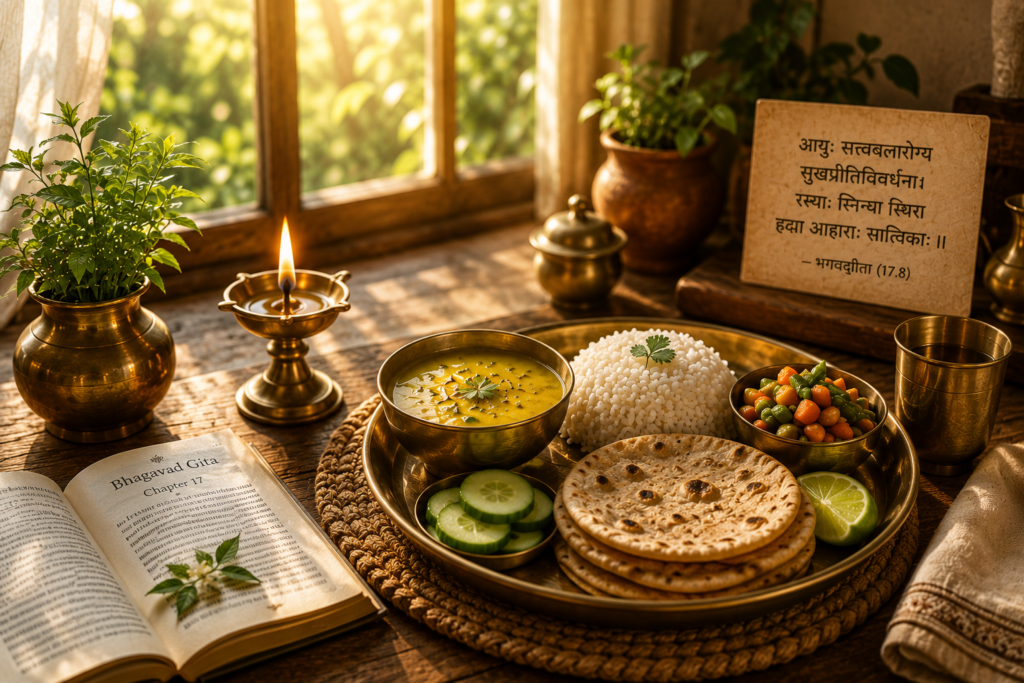
Satvik eating is deeply connected with yoga, meditation, Ayurveda, and spiritual discipline.
Many practitioners believe lighter and cleaner foods help support:
- meditation
- emotional calmness
- mindful awareness
- better concentration
- disciplined living
“When food is pure, the mind becomes pure.
— Chandogya Upanishad
For this reason, many yogis and spiritual practitioners prefer simpler meals that create less physical heaviness and mental distraction.
Why Satvik Food Feels Emotionally Different
Many people who begin eating more Satvik meals describe subtle emotional changes that go beyond physical digestion.
Meals often feel:
- calmer
- lighter
- emotionally grounding
- less overstimulating
- more comforting
Unlike highly processed or overly stimulating foods, Satvik meals are traditionally associated with steadiness and simplicity.
For many families, Satvik cooking is connected with slower mornings, fresh ingredients, gratitude before meals, devotional music, temple visits, or peaceful evening routines.
“Food carries not only nourishment, but also emotional atmosphere.
— Sanatan Reflection
This emotional softness is one reason many people feel naturally drawn toward Satvik eating during spiritually reflective periods.
Can Satvik Food Help Mental Calmness?
Many people today feel emotionally overstimulated from:
- constant screen exposure
- fast-paced lifestyles
- irregular eating habits
- processed food consumption
- mental clutter and stress
In this environment, Satvik eating often feels less like a restrictive diet and more like a return to simplicity.
Some people describe feeling:
- lighter mentally
- calmer emotionally
- more mindful while eating
- less impulsive around food
- more connected to routine and discipline
Satvik food is not only about what is eaten, but also about how consciously and peacefully food is prepared and consumed.
What Does a Simple Satvik Meal Look Like?
A Satvik meal is often balanced, comforting, and uncomplicated.
Example of a Simple Satvik Meal
- Fresh fruits
- Khichdi or light rice dishes
- Seasonal vegetables
- Homemade curd
- Ghee in moderation
- Herbal tea
- Nuts or dry fruits
Meals are often prepared fresh and eaten mindfully without excess stimulation.
The experience of eating Satvik food is often as important as the ingredients themselves. A peaceful environment, slower eating, gratitude, and emotional calmness are all traditionally considered part of mindful nourishment.
Is Onion and Garlic Allowed in Satvik Food?
This is one of the most common questions people ask.
Different traditions follow different approaches.
Some spiritual and yogic traditions avoid onion and garlic because they are believed to stimulate restlessness or excessive sensory activity.
However, many households include them as part of a balanced everyday diet.
The larger principle of Satvik eating is conscious nourishment rather than rigid judgment.
Satvik Food and Seasonal Living
Traditional Indian food culture has long emphasized seasonal eating.
Satvik meals often naturally align with:
- seasonal produce
- local ingredients
- digestive balance
- mindful eating rhythms
This is one reason Satvik eating feels deeply grounding during changing seasons and emotionally stressful periods.
Many people rediscover Satvik eating during spiritually reflective periods because simpler food often creates a quieter mental atmosphere.
How to Start Eating More Satvik
You do not need to transform your lifestyle overnight.
Many people gradually move toward Satvik eating through small mindful changes.
Prioritize freshly prepared meals over packaged or heavily processed foods.
Gradually reduce excessive sugar, fried foods, and overly spicy meals.
Eat slowly and without constant distraction from screens or stress.
Traditional practices often emphasize preparing food peacefully and with gratitude.
Notice how different foods affect your energy, emotions, and mental clarity.
Is Satvik Food Only for Spiritual People?
Not at all.
Many people are drawn toward Satvik eating simply because it encourages:
- mindful consumption
- healthier routines
- emotional balance
- lighter eating habits
- reduced overstimulation
Even people with no formal spiritual practice often appreciate the simplicity and grounding nature of Satvik meals.
The Quiet Spiritual Atmosphere of Satvik Living
Many people associate Satvik living with a noticeably calmer emotional environment.
Homes centered around simple meals, mindful routines, devotional practices, and conscious consumption often carry a softer and more grounded rhythm.
The atmosphere may include:
- morning prayers
- fresh homemade meals
- peaceful cooking
- reduced overstimulation
- mindful eating
- devotional music or mantra chanting
Satvik living is often less about achieving perfection and more about creating small moments of peace within everyday life.
For many people, even preparing food more slowly and consciously begins changing the emotional energy of daily routines.
Why Satvik Living Feels Relevant Today
Modern life constantly pushes people toward excess, speed, noise, stimulation, and unconscious consumption.
Satvik living moves in the opposite direction.
It encourages:
- slowing down
- mindful eating
- emotional clarity
- balanced routines
- intentional living
- greater awareness
“Peace begins where excess ends.
— Sanatan Reflection
For many people, Satvik food becomes less about dietary rules and more about creating inner calmness through everyday choices.
The Emotional Experience of Satvik Eating
Many people describe Satvik meals as emotionally different from highly stimulating foods.
The experience often feels:
- lighter
- calmer
- cleaner
- grounding
- emotionally peaceful
A simple homemade meal eaten slowly, with gratitude and minimal distraction, can itself become a mindful spiritual practice.
In a world constantly encouraging speed, stimulation, and excess, Satvik food gently moves in the opposite direction, toward simplicity, awareness, and inner calmness.
In many traditions, nourishment is considered sacred because food carries both physical energy and emotional atmosphere.
Frequently Asked Questions About Satvik Food
What is Satvik food?+
Is Satvik food vegetarian?+
Why do yogis prefer Satvik food?+
Are onion and garlic allowed in Satvik food?+
Can beginners follow a Satvik diet?+
Why Is Rice Avoided on Ekadashi? Spiritual Meaning, Traditions & Scientific Perspective
One of the most common questions people ask during Ekadashi fasting is why rice is traditionally avoided. Across many Hindu households, devotees observing Ekadashi refrain from eating rice, grains, and certain heavy foods as part of the fasting discipline dedicated to Lord Vishnu.
For many people, this practice may initially seem unusual or symbolic. However, the tradition carries deep spiritual, cultural, and lifestyle significance within Sanatan Dharma.
Ekadashi fasting is not only about food restriction. It is traditionally viewed as a practice of awareness, simplicity, self-restraint, and inner purification.
For many devotees, Ekadashi carries a noticeably different atmosphere from ordinary days. Meals become simpler, homes feel quieter, diyas glow a little longer, and the mind gradually turns inward.
What may appear externally as avoiding certain foods is often understood spiritually as reducing inner noise.
- What Is the Spiritual Meaning of Ekadashi?
- Why Is Rice Avoided on Ekadashi?
- What Do Hindu Scriptures Say About Rice on Ekadashi?
- Is There an Ayurvedic Perspective Behind Avoiding Rice?
- Is There a Scientific Explanation for Avoiding Rice During Fasting?
- What Foods Are Allowed on Ekadashi?
- What Is the Difference Between Satvik and Tamasic Foods?
- Can Beginners Eat Rice on Ekadashi?
- Common Misconceptions About Ekadashi Fasting
- The Quiet Spiritual Atmosphere of Ekadashi
- Why This Tradition Still Matters Today
- Simple Vishnu Mantras for Ekadashi
- Frequently Asked Questions About Rice and Ekadashi
What Is the Spiritual Meaning of Ekadashi?
Ekadashi is the eleventh lunar day observed twice every month in the Hindu calendar. It is considered spiritually important for prayer, fasting, mantra chanting, and mindful living.
Many devotees believe that Ekadashi is an ideal time to reduce distractions, calm the senses, and focus more deeply on spiritual practices.
Why Is Rice Avoided on Ekadashi?
Rice is traditionally avoided on Ekadashi because many spiritual traditions consider grains to be heavier and more tamasic during periods intended for fasting and inward focus.
The larger purpose behind avoiding rice is not punishment or fear. It is conscious simplification.
In many spiritual traditions, lighter meals are believed to help the body feel calmer and the mind more receptive to prayer, mantra chanting, and quiet reflection.
For this reason, avoiding rice gradually became associated with creating inner stillness rather than merely following a restriction.
By reducing heavier foods, devotees aim to:
- Cultivate mindfulness
- Reduce lethargy
- Practice discipline
- Simplify eating habits
- Create more mental clarity
- Focus more deeply on prayer and devotion
What Do Hindu Scriptures Say About Rice on Ekadashi?
Several traditional texts and regional spiritual traditions mention avoiding grains during Ekadashi fasting.
Some scriptural stories symbolically associate grain consumption on Ekadashi with reduced spiritual alertness and increased tamasic tendencies such as inertia or dullness.
“Among all vows, Ekadashi is considered especially sacred.
— Padma Purana
While interpretations vary across lineages and regions, the central idea remains consistent, Ekadashi is meant to encourage lighter living and inward awareness.
Is There an Ayurvedic Perspective Behind Avoiding Rice?
Ayurveda places strong emphasis on digestion, balance, and mindful eating.
According to some Ayurvedic interpretations, lighter food intake during Ekadashi may help reduce digestive burden and support a calmer state of mind.
Foods commonly preferred during Ekadashi are usually:
- Light
- Satvik
- Easy to digest
- Minimally processed
Is There a Scientific Explanation for Avoiding Rice During Fasting?
Modern wellness discussions sometimes compare Ekadashi fasting with mindful eating and intermittent fasting practices.
Some people feel that reducing grains periodically may help them:
- Become more conscious of eating habits
- Reduce overeating
- Develop food discipline
- Improve awareness around consumption
However, spiritual traditions primarily emphasize devotional discipline and inner awareness rather than only physical outcomes.
What Foods Are Allowed on Ekadashi?
While traditions vary slightly, many devotees follow a satvik fasting diet.
The intention is usually to keep meals simple, light, and spiritually mindful.
What Is the Difference Between Satvik and Tamasic Foods?
In many Hindu and yogic traditions, foods are often categorized according to their energetic qualities.
Satvik Foods
Satvik foods are associated with:
- clarity
- calmness
- purity
- balance
Examples include fruits, milk, nuts, and lightly prepared natural foods.
Tamasic Foods
Tamasic foods are traditionally associated with:
- heaviness
- lethargy
- dullness
- overindulgence
This is one reason many devotees choose simpler foods during Ekadashi.
Can Beginners Eat Rice on Ekadashi?
Many beginners feel unsure about how strictly they should observe Ekadashi fasting.
The tradition is generally approached gradually and sincerely.
Beginners may start by:
- Avoiding grains only
- Eating lighter meals
- Chanting Vishnu mantras
- Reducing distractions
- Practicing mindful eating
The sincerity of intention matters far more than rigid perfection.
Common Misconceptions About Ekadashi Fasting
Common Misunderstandings
- Treating fasting as punishment
- Focusing only on food restrictions
- Ignoring prayer and mindfulness
- Overeating vrat foods
- Becoming excessively rigid
The spiritual essence of Ekadashi lies in conscious simplicity.
The Quiet Spiritual Atmosphere of Ekadashi
Many devotees describe Ekadashi as carrying a softer emotional rhythm than ordinary days.
Homes may feel calmer. Prayer spaces become more active. Families often prepare lighter meals, chant Vishnu mantras, visit temples, or spend more time in reflection.
For some people, even the act of eating more simply creates a subtle sense of clarity and emotional grounding.
“When the senses become quieter, inner awareness becomes easier to hear.
— Sanatan Reflection
In this way, Ekadashi becomes less about denial and more about creating sacred space within everyday life.
Why This Tradition Still Matters Today
In modern life filled with constant stimulation and consumption, practices like Ekadashi create intentional pauses.
In a world driven by constant stimulation, endless scrolling, emotional overload, and unconscious consumption, practices like Ekadashi offer something increasingly rare, intentional pause.
They encourage people to:
- Slow down mentally
- Eat more consciously
- Practice self-restraint
- Reconnect with devotion
- Develop healthier rhythms
For many families, Ekadashi becomes a recurring opportunity to create spiritual grounding and mindful living.
“The mind alone is the friend of the self, and the mind alone is the enemy of the self.
— Bhagavad Gita 6.5
Simple Vishnu Mantras for Ekadashi
Popular mantras associated with Ekadashi include:
- Om Namo Narayanaya
- Om Namo Bhagavate Vasudevaya
- Vishnu Gayatri Mantra
- Hare Krishna Maha Mantra
Even a few minutes of mantra chanting can help create a calmer and more devotional atmosphere.
For many devotees, these moments of simplicity become the most meaningful part of Ekadashi, a quieter meal, a softly lit diya, a peaceful mantra, and a temporary pause from mental clutter.
Frequently Asked Questions About Rice and Ekadashi
Why is rice avoided on Ekadashi?+
Can beginners eat rice on Ekadashi?+
What foods are allowed during Ekadashi fasting?+
Is avoiding rice on Ekadashi scientific?+
Which deity is worshipped during Ekadashi?+
What Is Ekadashi? Meaning, Benefits, Fasting Rules & Spiritual Significance
Ekadashi is one of the most spiritually significant observances in Sanatan Dharma. Observed twice every lunar month, it is traditionally dedicated to Lord Vishnu and is associated with fasting, prayer, self-discipline, and inner purification.
For millions of devotees, Ekadashi is not merely about avoiding food. It is considered a sacred opportunity to quiet the mind, regulate the senses, deepen spiritual awareness, and reconnect with devotion.
Even in modern life, many people observe Ekadashi as a way to create mental clarity, emotional balance, and mindful discipline amidst constant distractions.
- What Is Ekadashi?
- Why Is Ekadashi Important in Hinduism?
- Which God Is Worshipped on Ekadashi?
- Why Do People Fast on Ekadashi?
- What Are the Different Types of Ekadashi?
- Ekadashi Fasting Rules for Beginners
- What Foods Are Allowed During Ekadashi?
- Why Is Rice Avoided on Ekadashi?
- How Ekadashi Fasting Relates to Mindfulness and Discipline
- Spiritual Benefits of Observing Ekadashi
- Is There Scientific Logic Behind Ekadashi Fasting?
- Can Beginners Observe Ekadashi?
- Common Mistakes People Make During Ekadashi
- Simple Vishnu Mantras for Ekadashi
- Explore Upcoming Ekadashi Dates and Observances
- Why Ekadashi Still Matters in Modern Life
- Frequently Asked Questions About Ekadashi
What Is Ekadashi?
Ekadashi refers to the eleventh day of the lunar cycle in the Hindu calendar. The word itself comes from Sanskrit:
There are two Ekadashis every month:
- Shukla Paksha Ekadashi, during the waxing moon
- Krishna Paksha Ekadashi, during the waning moon
Why Is Ekadashi Important in Hinduism?
Ekadashi is deeply connected with Lord Vishnu, who represents preservation, balance, and cosmic order in Hindu philosophy.
Devotees believe that observing Ekadashi with sincerity helps purify the mind and reduce excessive attachment to material distractions.
Many scriptures including the Padma Purana, Skanda Purana, and Bhagavata Purana describe the spiritual importance of Ekadashi fasting.
“Among all vows, Ekadashi is considered especially sacred.
— Padma Purana
Which God Is Worshipped on Ekadashi?
🪷Vishnuविष्णुLord Vishnu is the primary deity worshipped on Ekadashi.
Many devotees chant Vishnu mantras, recite the Vishnu Sahasranama, read the Bhagavad Gita, or visit Vishnu temples during this sacred observance.
You can also deepen your Ekadashi practice through dedicated Vishnu mantras, satvik living practices, and mindful devotional routines that help create a more spiritually focused atmosphere at home.
Popular forms of Vishnu worshipped on Ekadashi include:
- Krishna
- Narayana
- Vithoba
- Rama
- Jagannath
Why Do People Fast on Ekadashi?
One of the most common questions people ask is why fasting is associated with Ekadashi.
Traditionally, fasting on Ekadashi is believed to:
- Support spiritual discipline
- Reduce sensory distractions
- Encourage mindfulness
- Promote sattvic living
- Create time for prayer and reflection
Many spiritual traditions also believe that the mind becomes calmer and more inward-focused during Ekadashi.
Ekadashi fasting is traditionally viewed as a practice of discipline, awareness, simplicity, and devotion.What Are the Different Types of Ekadashi?
There are 24 major Ekadashis in a traditional Hindu lunar year, though an additional two may occur during leap lunar cycles.
Some of the most widely observed Ekadashis include:
Each Ekadashi carries its own stories, rituals, and regional traditions.
Ekadashi Fasting Rules for Beginners
Many beginners feel uncertain about how to properly observe Ekadashi.
The good news is that Ekadashi can be practiced gradually and sincerely according to one’s health, age, and spiritual comfort level.
Begin the day with cleanliness, prayer, and a calm mindset.
Many devotees avoid grains, rice, onion, garlic, and processed foods during Ekadashi.
Fruits, milk, nuts, sabudana, and vrat-friendly foods are commonly consumed.
Reading sacred texts and chanting Vishnu mantras are considered spiritually beneficial.
The fast is traditionally concluded the next day during Parana timings.
What Foods Are Allowed During Ekadashi?
Food traditions vary slightly across regions and lineages, but many devotees follow a simple satvik diet.
Commonly Allowed Foods
- Fruits
- Milk
- Yogurt
- Nuts
- Sabudana
- Singhara flour
- Potatoes
- Rock salt
Foods Commonly Avoided
- Rice
- Wheat
- Lentils
- Onion
- Garlic
- Processed food
Why Is Rice Avoided on Ekadashi?
This is one of the most searched questions related to Ekadashi fasting.
According to traditional beliefs, rice is considered energetically heavy during Ekadashi and may increase tamasic tendencies such as dullness and inertia.
Some scriptural stories also symbolically connect rice consumption on Ekadashi with reduced spiritual focus.
While interpretations vary, the larger intention behind avoiding grains is to simplify consumption and support mindful living.
How Ekadashi Fasting Relates to Mindfulness and Discipline
Modern wellness practices often speak about mindful eating, emotional regulation, and intentional living. Interestingly, many traditional Ekadashi practices naturally encourage similar forms of awareness.
By simplifying food intake and reducing distractions, Ekadashi creates space for:
- More conscious eating habits
- Reduced impulsive consumption
- Mental stillness and reflection
- Greater emotional awareness
- Improved self-discipline
While spiritual traditions focus primarily on devotion and purification, many people today also experience Ekadashi as a recurring reset for the mind and lifestyle.
Spiritual Benefits of Observing Ekadashi
Many devotees believe that observing Ekadashi regularly helps cultivate inner balance and spiritual awareness.
People often describe benefits such as:
- Greater emotional calmness
- Improved discipline
- More mindful eating habits
- Reduced mental restlessness
- Stronger devotional connection
- Better spiritual consistency
Is There Scientific Logic Behind Ekadashi Fasting?
Modern wellness discussions often compare Ekadashi fasting with intermittent fasting and mindful eating practices.
Some people feel that periodic fasting helps them:
- Reset eating patterns
- Improve digestive awareness
- Reduce overeating
- Develop greater food discipline
However, spiritual traditions primarily emphasize the mental and devotional aspects of fasting rather than only physical benefits.
In Sanatan traditions, fasting is often viewed as a way to discipline the senses and redirect awareness inward.Can Beginners Observe Ekadashi?
Yes. Ekadashi can be observed gently and gradually.
Beginners often start by:
- Avoiding grains only
- Eating light satvik meals
- Chanting a simple Vishnu mantra
- Spending a few minutes in prayer
- Reducing distractions and negativity
The sincerity of intention matters far more than rigid perfection.
Common Mistakes People Make During Ekadashi
Common Mistakes
- Treating fasting as punishment
- Overeating vrat foods
- Ignoring hydration
- Becoming excessively ritualistic
- Focusing only on food restrictions
- Neglecting prayer and mindfulness
The spiritual essence of Ekadashi lies in conscious living.
Simple Vishnu Mantras for Ekadashi
Popular mantras chanted during Ekadashi include:
- Om Namo Bhagavate Vasudevaya
- Om Namo Narayanaya
- Vishnu Gayatri Mantra
- Hare Krishna Maha Mantra
Even a few minutes of sincere chanting can create a calming devotional atmosphere.
Explore Upcoming Ekadashi Dates and Observances
Different Ekadashis throughout the year carry unique spiritual stories, fasting traditions, and devotional significance.
Many devotees follow annual observances such as:
- Vaikuntha Ekadashi
- Nirjala Ekadashi
- Devshayani Ekadashi
- Devutthana Ekadashi
- Mohini Ekadashi
Exploring the yearly Ekadashi calendar can help devotees prepare spiritually and observe each occasion more mindfully.
Why Ekadashi Still Matters in Modern Life
In today’s fast-moving world, Ekadashi offers something increasingly rare, intentional pause.
It encourages people to:
- Slow down mentally
- Simplify consumption
- Become more mindful
- Practice self-restraint
- Reconnect with spiritual values
For many families, Ekadashi becomes a recurring rhythm of reflection and inner grounding.
“The mind alone is the friend of the self, and the mind alone is the enemy of the self.
— Bhagavad Gita 6.5
Frequently Asked Questions About Ekadashi
Can we drink water during Ekadashi fasting?+
Why is rice avoided on Ekadashi?+
Can beginners observe Ekadashi?+
Which deity is worshipped on Ekadashi?+
How many Ekadashis occur in a year?+
How to Set Up a Sacred Home Puja Mandir, The Complete Guide
A home mandir is more than a decorative spiritual corner. In Sanatan Dharma, it becomes the energetic heart of the house, a sacred space where prayer, stillness, gratitude, and divine connection quietly shape daily life.
Whether you live in a large family home or a small apartment, creating a spiritually balanced puja mandir can transform the atmosphere of your living space. A thoughtfully arranged mandir brings discipline, emotional grounding, positivity, and a sense of sacred rhythm to everyday living.
- Why a Home Mandir Holds Deep Spiritual Importance
- Which Direction Should a Home Mandir Face?
- Choosing the Ideal Location for Your Home Mandir
- Deciding Between a Small or Large Mandir Setup
- How to Create a Small Mandir in an Apartment
- Essential Items Every Sacred Home Mandir Should Have
- Which Deities Are Commonly Worshipped in Home Mandirs
- How to Arrange Idols and Pictures Correctly
- Best Materials for a Home Mandir
- Lighting Ideas for a Peaceful Spiritual Atmosphere
- Daily Rituals to Maintain Sacred Energy
- What Should Never Be Kept Inside a Home Mandir?
- Common Mistakes to Avoid While Setting Up a Mandir
- Creating a Mandir That Feels Personally Sacred
- How to Make Your Mandir Feel Peaceful Every Day
- Frequently Asked Questions About Home Puja Mandirs
- FAQs
Why a Home Mandir Holds Deep Spiritual Importance
Many people searching for how to set up a mandir at home are not only looking for design inspiration, they are also trying to create a peaceful spiritual environment that supports daily prayer, mindfulness, and emotional balance.
In many Hindu traditions, the home mandir is considered the spiritual nucleus of the household, a place where intention, devotion, and energy align daily.
A sacred mandir creates a dedicated environment for prayer and reflection. It reminds the mind to pause, reconnect, and cultivate inner awareness amidst modern distractions.
Traditionally, daily puja practices are believed to:
- Create positive vibrations within the home
- Encourage discipline and mindfulness
- Strengthen family bonding through shared rituals
- Support emotional calmness and mental clarity
- Establish a spiritually uplifting environment
Even a simple setup done with sincerity carries spiritual value.
Which Direction Should a Home Mandir Face?
One of the most searched questions about home temple setup is choosing the correct direction for the mandir.
According to traditional Vastu principles, the northeast direction is considered especially auspicious because it is associated with spiritual clarity and divine energy.
Choosing the Ideal Location for Your Home Mandir
One of the most important aspects of creating a sacred puja space is choosing the right location.
Why the Northeast Direction Is Preferred
According to Vastu traditions, the northeast direction, often called the Ishanya corner, is associated with spiritual energy and clarity.
However, if your home layout does not allow this placement, choose the cleanest and calmest available area. Devotion matters more than perfection.
Many traditional Hindu homes light a diya at sunrise and sunset to symbolically invite divine light into the household.
Deciding Between a Small or Large Mandir Setup
Your mandir should suit your lifestyle, available space, and daily spiritual routine.
How to Create a Small Mandir in an Apartment
Many modern homes and apartments do not have space for a dedicated puja room. Fortunately, even a compact spiritual corner can become deeply sacred when maintained with sincerity.
Small Apartment Mandir Ideas
For apartments and compact homes:
- Use a wall-mounted wooden mandir
- Keep only essential idols and items
- Use concealed storage for puja accessories
- Add warm lighting for a calming atmosphere
Dedicated Mandir Room Setup
If you have additional space, a dedicated prayer room allows:
- Daily meditation
- Chanting practices
- Festival rituals
- Family prayer gatherings
- Spiritual reading and contemplation
A sacred mandir does not need to be large. Cleanliness, devotion, and consistency matter far more than size.
Essential Items Every Sacred Home Mandir Should Have
People often wonder what should actually be included inside a home mandir. While traditions vary across households, most sacred spaces include a few spiritually important essentials.
Select the deity or divine form you feel spiritually connected to, such as Shiva, Krishna, Durga, Lakshmi, Ganesha, or Rama.
Keep idols clean, elevated, and properly positioned. Avoid overcrowding the mandir with too many deities.
Lighting a diya symbolizes the removal of darkness and ignorance.
Natural fragrance and flowers enhance the spiritual atmosphere.
Maintain organized storage for incense, camphor, matchboxes, bells, malas, and sacred books.
Which Deities Are Commonly Worshipped in Home Mandirs
🐘GaneshaगणेशLord Ganesha is often placed first in many home mandirs as the remover of obstacles and the deity associated with wisdom and auspicious beginnings.
Other commonly worshipped deities include:
- Shiva for inner stillness and transformation
- Lakshmi for prosperity and abundance
- Vishnu for preservation and balance
- Durga for protection and strength
- Krishna for devotion and divine love
- Hanuman for courage and devotion
“Where there is righteousness, there is victory.
— Mahabharata
How to Arrange Idols and Pictures Correctly
The placement of idols and deity images influences both the visual harmony and spiritual atmosphere of the mandir.
Proper arrangement creates visual harmony and spiritual focus.
Important Placement Tips
- Keep idols slightly elevated
- Avoid broken or damaged idols
- Maintain symmetry where possible
- Avoid placing idols directly on the floor
- Do not overcrowd the altar space
A minimal and uncluttered mandir often feels more spiritually calming than a crowded setup.
Best Materials for a Home Mandir
Different materials create different visual and energetic impressions.
Wooden mandirs remain the most popular because they combine warmth, tradition, and versatility.
Lighting Ideas for a Peaceful Spiritual Atmosphere
Lighting strongly influences the emotional energy of a mandir.
Recommended lighting elements include:
- Warm LED lighting
- Brass diyas
- Soft backlighting behind deity frames
- Himalayan salt lamps nearby
- Candle-style ambient lighting
Avoid harsh white lighting that feels clinical or distracting.
Soft golden lighting naturally enhances the sacred and calming atmosphere of a puja mandir.
Daily Rituals to Maintain Sacred Energy
Consistency matters more than complexity.
Simple Daily Practices
- Light a diya morning and evening
- Offer fresh flowers or water
- Chant a short mantra daily
- Keep the mandir dust-free
- Sit quietly for a few minutes in gratitude
Even a five-minute daily practice can gradually create a sense of spiritual grounding.
What Should Never Be Kept Inside a Home Mandir?
A sacred space should feel peaceful, clean, and spiritually uplifting. Certain habits and objects can disturb the calm atmosphere of the mandir.
Common Mistakes to Avoid While Setting Up a Mandir
Avoid treating the mandir as purely decorative furniture. A sacred space should be maintained with cleanliness, reverence, and intentionality.
Common Errors
- Placing the mandir near clutter
- Using the space for storage
- Keeping broken idols
- Neglecting regular cleaning
- Overcrowding with too many objects
- Using flashing decorative lights excessively
A peaceful and spiritually calming mandir usually follows a simple and intentional design approach.
Creating a Mandir That Feels Personally Sacred
Every spiritual journey is unique.
Some people prefer traditional temple aesthetics with brass bells and incense, while others create a minimal meditation-focused altar with soft lighting and sacred books.
Your mandir should reflect:
- Your spiritual rhythm
- Your emotional connection
- Your devotional practices
- Your lifestyle and home environment
“The soul is neither born, and nor does it die.
— Bhagavad Gita 2.20
How to Make Your Mandir Feel Peaceful Every Day
The most beautiful mandirs are not always the most expensive. They are the ones that feel spiritually alive through sincere daily devotion.
A clean diya, a softly chanted mantra, a moment of gratitude before beginning the day, these small practices slowly turn an ordinary corner of the home into a deeply sacred space.
Frequently Asked Questions About Home Puja Mandirs
These are some of the most common questions people ask while creating a sacred home temple or puja room.