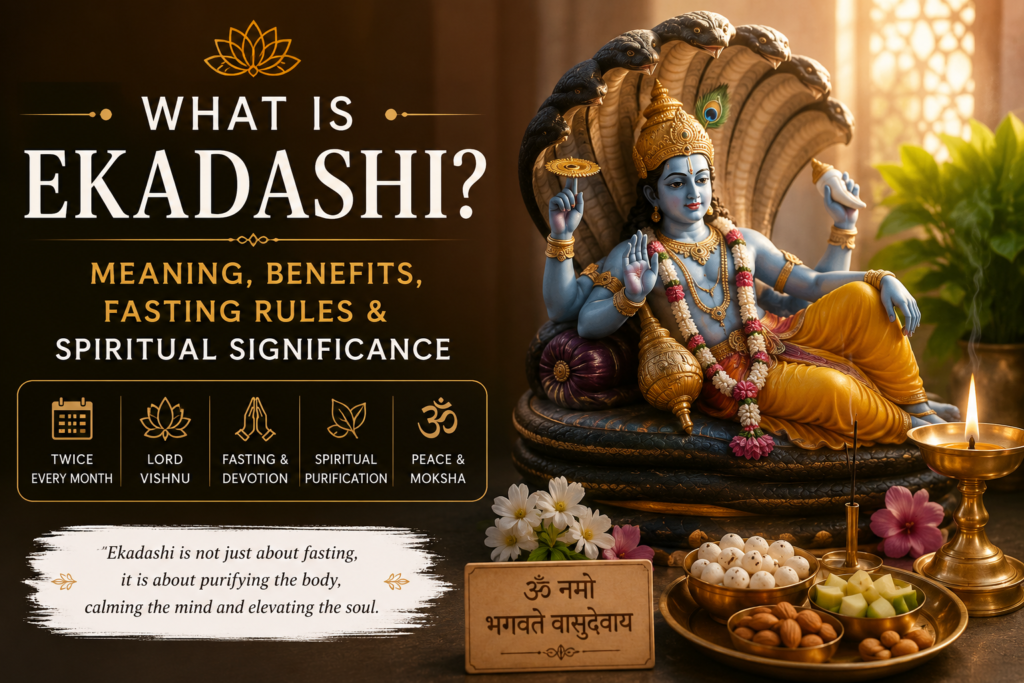
Ekadashi is one of the most spiritually significant observances in Sanatan Dharma. Observed twice every lunar month, it is traditionally dedicated to Lord Vishnu and is associated with fasting, prayer, self-discipline, and inner purification.
For millions of devotees, Ekadashi is not merely about avoiding food. It is considered a sacred opportunity to quiet the mind, regulate the senses, deepen spiritual awareness, and reconnect with devotion.
Even in modern life, many people observe Ekadashi as a way to create mental clarity, emotional balance, and mindful discipline amidst constant distractions.
- What Is Ekadashi?
- Why Is Ekadashi Important in Hinduism?
- Which God Is Worshipped on Ekadashi?
- Why Do People Fast on Ekadashi?
- What Are the Different Types of Ekadashi?
- Ekadashi Fasting Rules for Beginners
- What Foods Are Allowed During Ekadashi?
- Why Is Rice Avoided on Ekadashi?
- How Ekadashi Fasting Relates to Mindfulness and Discipline
- Spiritual Benefits of Observing Ekadashi
- Is There Scientific Logic Behind Ekadashi Fasting?
- Can Beginners Observe Ekadashi?
- Common Mistakes People Make During Ekadashi
- Simple Vishnu Mantras for Ekadashi
- Explore Upcoming Ekadashi Dates and Observances
- Why Ekadashi Still Matters in Modern Life
- Frequently Asked Questions About Ekadashi
What Is Ekadashi?
Ekadashi refers to the eleventh day of the lunar cycle in the Hindu calendar. The word itself comes from Sanskrit:
There are two Ekadashis every month:
- Shukla Paksha Ekadashi, during the waxing moon
- Krishna Paksha Ekadashi, during the waning moon
Why Is Ekadashi Important in Hinduism?
Ekadashi is deeply connected with Lord Vishnu, who represents preservation, balance, and cosmic order in Hindu philosophy.
Devotees believe that observing Ekadashi with sincerity helps purify the mind and reduce excessive attachment to material distractions.
Many scriptures including the Padma Purana, Skanda Purana, and Bhagavata Purana describe the spiritual importance of Ekadashi fasting.
“Among all vows, Ekadashi is considered especially sacred.
— Padma Purana
Which God Is Worshipped on Ekadashi?
🪷Vishnuविष्णुLord Vishnu is the primary deity worshipped on Ekadashi.
Many devotees chant Vishnu mantras, recite the Vishnu Sahasranama, read the Bhagavad Gita, or visit Vishnu temples during this sacred observance.
You can also deepen your Ekadashi practice through dedicated Vishnu mantras, satvik living practices, and mindful devotional routines that help create a more spiritually focused atmosphere at home.
Popular forms of Vishnu worshipped on Ekadashi include:
- Krishna
- Narayana
- Vithoba
- Rama
- Jagannath
Why Do People Fast on Ekadashi?
One of the most common questions people ask is why fasting is associated with Ekadashi.
Traditionally, fasting on Ekadashi is believed to:
- Support spiritual discipline
- Reduce sensory distractions
- Encourage mindfulness
- Promote sattvic living
- Create time for prayer and reflection
Many spiritual traditions also believe that the mind becomes calmer and more inward-focused during Ekadashi.
Ekadashi fasting is traditionally viewed as a practice of discipline, awareness, simplicity, and devotion.What Are the Different Types of Ekadashi?
There are 24 major Ekadashis in a traditional Hindu lunar year, though an additional two may occur during leap lunar cycles.
Some of the most widely observed Ekadashis include:
Each Ekadashi carries its own stories, rituals, and regional traditions.
Ekadashi Fasting Rules for Beginners
Many beginners feel uncertain about how to properly observe Ekadashi.
The good news is that Ekadashi can be practiced gradually and sincerely according to one’s health, age, and spiritual comfort level.
Begin the day with cleanliness, prayer, and a calm mindset.
Many devotees avoid grains, rice, onion, garlic, and processed foods during Ekadashi.
Fruits, milk, nuts, sabudana, and vrat-friendly foods are commonly consumed.
Reading sacred texts and chanting Vishnu mantras are considered spiritually beneficial.
The fast is traditionally concluded the next day during Parana timings.
What Foods Are Allowed During Ekadashi?
Food traditions vary slightly across regions and lineages, but many devotees follow a simple satvik diet.
Commonly Allowed Foods
- Fruits
- Milk
- Yogurt
- Nuts
- Sabudana
- Singhara flour
- Potatoes
- Rock salt
Foods Commonly Avoided
- Rice
- Wheat
- Lentils
- Onion
- Garlic
- Processed food
Why Is Rice Avoided on Ekadashi?
This is one of the most searched questions related to Ekadashi fasting.
According to traditional beliefs, rice is considered energetically heavy during Ekadashi and may increase tamasic tendencies such as dullness and inertia.
Some scriptural stories also symbolically connect rice consumption on Ekadashi with reduced spiritual focus.
While interpretations vary, the larger intention behind avoiding grains is to simplify consumption and support mindful living.
How Ekadashi Fasting Relates to Mindfulness and Discipline
Modern wellness practices often speak about mindful eating, emotional regulation, and intentional living. Interestingly, many traditional Ekadashi practices naturally encourage similar forms of awareness.
By simplifying food intake and reducing distractions, Ekadashi creates space for:
- More conscious eating habits
- Reduced impulsive consumption
- Mental stillness and reflection
- Greater emotional awareness
- Improved self-discipline
While spiritual traditions focus primarily on devotion and purification, many people today also experience Ekadashi as a recurring reset for the mind and lifestyle.
Spiritual Benefits of Observing Ekadashi
Many devotees believe that observing Ekadashi regularly helps cultivate inner balance and spiritual awareness.
People often describe benefits such as:
- Greater emotional calmness
- Improved discipline
- More mindful eating habits
- Reduced mental restlessness
- Stronger devotional connection
- Better spiritual consistency
Is There Scientific Logic Behind Ekadashi Fasting?
Modern wellness discussions often compare Ekadashi fasting with intermittent fasting and mindful eating practices.
Some people feel that periodic fasting helps them:
- Reset eating patterns
- Improve digestive awareness
- Reduce overeating
- Develop greater food discipline
However, spiritual traditions primarily emphasize the mental and devotional aspects of fasting rather than only physical benefits.
In Sanatan traditions, fasting is often viewed as a way to discipline the senses and redirect awareness inward.Can Beginners Observe Ekadashi?
Yes. Ekadashi can be observed gently and gradually.
Beginners often start by:
- Avoiding grains only
- Eating light satvik meals
- Chanting a simple Vishnu mantra
- Spending a few minutes in prayer
- Reducing distractions and negativity
The sincerity of intention matters far more than rigid perfection.
Common Mistakes People Make During Ekadashi
Common Mistakes
- Treating fasting as punishment
- Overeating vrat foods
- Ignoring hydration
- Becoming excessively ritualistic
- Focusing only on food restrictions
- Neglecting prayer and mindfulness
The spiritual essence of Ekadashi lies in conscious living.
Simple Vishnu Mantras for Ekadashi
Popular mantras chanted during Ekadashi include:
- Om Namo Bhagavate Vasudevaya
- Om Namo Narayanaya
- Vishnu Gayatri Mantra
- Hare Krishna Maha Mantra
Even a few minutes of sincere chanting can create a calming devotional atmosphere.
Explore Upcoming Ekadashi Dates and Observances
Different Ekadashis throughout the year carry unique spiritual stories, fasting traditions, and devotional significance.
Many devotees follow annual observances such as:
- Vaikuntha Ekadashi
- Nirjala Ekadashi
- Devshayani Ekadashi
- Devutthana Ekadashi
- Mohini Ekadashi
Exploring the yearly Ekadashi calendar can help devotees prepare spiritually and observe each occasion more mindfully.
Why Ekadashi Still Matters in Modern Life
In today’s fast-moving world, Ekadashi offers something increasingly rare, intentional pause.
It encourages people to:
- Slow down mentally
- Simplify consumption
- Become more mindful
- Practice self-restraint
- Reconnect with spiritual values
For many families, Ekadashi becomes a recurring rhythm of reflection and inner grounding.
“The mind alone is the friend of the self, and the mind alone is the enemy of the self.
— Bhagavad Gita 6.5