
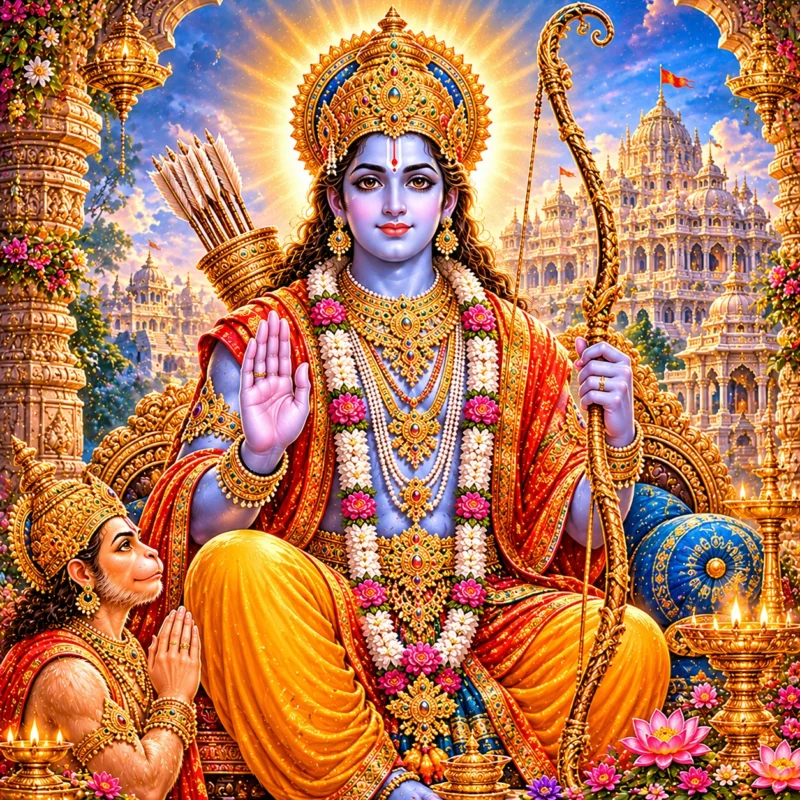
Shri Ramchandra Kripalu Bhaju Man by Tulsidas — full text in Hindi with Roman transliteration and the meaning of every stanza in English and Hindi.
नव कंज लोचन कंज मुख, कर कंज पद कंजारुणं॥
nav kanj lochan kanj mukh, kar kanj pad kanjarunam.
O mind, worship the merciful Shri Ramachandra, who removes the terrible fear of worldly existence. His eyes are like fresh lotuses, his face, hands and feet are lotuses, red like the lotus.
हे मन, कृपालु श्री रामचन्द्र का भजन कर, जो संसार के भयंकर भय को हरते हैं। उनके नेत्र नए कमल जैसे हैं, और मुख, हाथ और चरण लाल कमल जैसे हैं।
पट पीत मानहुँ तड़ित रुचि, शुचि नौमि जनक सुतावरं॥
pat peet manahun tadit ruchi, shuchi naumi Janak sutavaram.
His beauty surpasses countless Kamadevas; he is lovely like a fresh dark-blue cloud. His yellow garment shines like lightning. I bow to the pure one, the husband of Janaka’s daughter.
उनकी छवि अनगिनत कामदेवों से बढ़कर है; वे नए नीले बादल जैसे सुंदर हैं। उनका पीला वस्त्र बिजली जैसा चमकता है। मैं जनकसुता के पति, उन पवित्र प्रभु को नमन करता हूँ।
रघुनन्द आनन्द कन्द कोशल, चन्द दशरथ नन्दनं॥
Raghunand anand kand Koshal, chand Dashrath nandanam.
Worship the friend of the humble, radiant like the sun, who uproots the race of demons — the joy of the Raghus, the source of bliss, the moon of Kosala, the son of Dasharatha.
दीनों के बंधु, सूर्य जैसे तेजस्वी, दानवों और दैत्यों के वंश का नाश करने वाले का भजन कर — जो रघुकुल को आनंद देने वाले, आनंद के मूल, कोशल के चंद्रमा और दशरथ के पुत्र हैं।
आजानु भुज शर चाप धर, सङ्ग्राम जित खरदूषणं॥
aajanu bhuj shar chap dhar, sangram jit Khar-Dushanam.
He wears a crown on his head, earrings, a beautiful tilak and ornaments on his noble limbs. His arms reach his knees, he holds the bow and arrow, and he defeated Khara and Dushana in battle.
उनके सिर पर मुकुट, कानों में कुण्डल, सुंदर तिलक और सुडौल अंगों पर आभूषण हैं। उनकी भुजाएँ घुटनों तक लंबी हैं, वे धनुष-बाण धारण करते हैं, और उन्होंने युद्ध में खर-दूषण को जीता।
मम हृदय कञ्ज निवास कुरु, कामादि खलदल गञ्जनं॥
mam hriday kanj nivas kuru, kamadi khaldal ganjanam.
So says Tulsidas: O delight of the hearts of Shankara, Shesha and the sages, dwell in the lotus of my heart and destroy the wicked band of desire and the other vices.
तुलसीदास कहते हैं: हे शंकर, शेष और मुनियों के मन को आनंद देने वाले, मेरे हृदय-कमल में निवास करो और काम आदि दुष्टों के दल का नाश करो।
करुना निधान सुजान सीलु, सनेहु जानत रावरो॥
karuna nidhan sujan seelu, sanehu janat ravaro.
Chhand from the Ramcharitmanas (Bal Kand) — Goddess Gauri blesses Sita: “The naturally handsome, dark-complexioned groom on whom your heart is set will be yours. He is an ocean of compassion and all-knowing, and he knows your nature and your love.”
रामचरितमानस (बालकाण्ड) का छंद — माँ गौरी सीता को आशीर्वाद देती हैं: “जिस स्वभाव से सुंदर, साँवले वर पर तुम्हारा मन रचा है, वही तुम्हें मिलेगा। वे करुणा के भंडार और सब जानने वाले हैं, और तुम्हारे शील और स्नेह को जानते हैं।”
तुलसी भवानिहि पूजि पुनि पुनि, मुदित मन मंदिर चली॥
Tulsi Bhavanihi pooji puni puni, mudit man mandir chali.
Hearing Gauri’s blessing in this way, Sita and her companions rejoiced in their hearts. Tulsidas says: worshipping Bhavani again and again, Sita returned with a joyful heart.
इस प्रकार गौरी का आशीर्वाद सुनकर सीता और उनकी सखियाँ मन में हर्षित हुईं। तुलसीदास कहते हैं: भवानी की बार-बार पूजा करके सीता प्रसन्न मन से लौट चलीं।
मंजुल मंगल मूल, बाम अंग फरकन लगे॥
manjul mangal mool, bam ang pharkan lage.
Sortha — knowing that Gauri was pleased, Sita’s joy could not be described, and her left limbs began to throb — a lovely sign of good fortune.
सोरठा — गौरी को प्रसन्न जानकर सीता के हृदय का हर्ष कहा नहीं जा सकता था, और उनके बाएँ अंग फड़कने लगे — जो सुंदर मंगल का संकेत है।
❓ Frequently Asked Questions
What is Shri Ramchandra Kripalu Bhaju Man?
Shri Ramchandra Kripalu Bhaju Man by Tulsidas — full text in Hindi with Roman transliteration and the meaning of every stanza in English and Hindi.
When should Shri Ramchandra Kripalu Bhaju Man be recited?
Shri Ramchandra Kripalu Bhaju Man is ideally recited during Ram Navami, Vivah Panchami, Diwali and any evening Ram aarti.
Who composed Shri Ramchandra Kripalu Bhaju Man?
Shri Ramchandra Kripalu Bhaju Man was composed by Goswami Tulsidas (Vinay Patrika).
What are the benefits of Shri Ramchandra Kripalu Bhaju Man?
Composed by Goswami Tulsidas in the Vinay Patrika, “Shri Ramchandra Kripalu” is the best-loved stuti of Shri Rama and is sung as an aarti in temples and homes. Its five stanzas describe Rama’s lotus-like eyes and dark-cloud complexion and end with Tulsidas asking him to live in his heart. As is common in temples, it is followed here by the chhand and sortha from the Bal Kand of the Ramcharitmanas, where Goddess Gauri blesses Sita.