Diwali Wishes 2026 in Hindi and English: For Family, Friends, Clients and WhatsApp
Diwali 2026 is on Sunday, 8 November. Below are original Diwali wishes in English and Hindi — for family, friends, clients and WhatsApp — plus Sanskrit lines and a wish for each day of the festival week. Copy freely. Lakshmi Puja muhurat →
दीपावली 2026 रविवार, 8 नवंबर को है। नीचे परिवार, दोस्तों, ग्राहकों और व्हाट्सऐप के लिए हिंदी और अंग्रेज़ी में मौलिक शुभकामनाएँ हैं — साथ में संस्कृत पंक्तियाँ और पर्व सप्ताह के हर दिन की शुभकामना। बेझिझक कॉपी करें। लक्ष्मी पूजा मुहूर्त →
Diwali wishes for familyपरिवार के लिए दीपावली शुभकामनाएँ
- May the light of every diya you light tonight find its way into every corner of your year. Happy Diwali to you and the whole family.
- Maa Lakshmi’s grace in your home, Ganesha’s wisdom in your choices, and the warmth of family around you — Shubh Deepavali.
- Wherever we are this year, the same lamps light our hearts. Missing you, and wishing you a joyful Diwali.
- Thank you for being the light of this house all year. Happy Diwali, Maa and Papa.
- आज रात जलाया हर दीया आपके पूरे साल के हर कोने को रोशन करे। आपको और पूरे परिवार को दीपावली की हार्दिक शुभकामनाएँ।
- घर में माँ लक्ष्मी की कृपा, हर निर्णय में गणेश जी की बुद्धि और चारों ओर परिवार का स्नेह — शुभ दीपावली।
- इस साल हम जहाँ भी हों, वही दीये हमारे दिलों को रोशन करते हैं। आपकी याद के साथ, दीपावली की ढेरों शुभकामनाएँ।
- साल भर इस घर की रोशनी बने रहने के लिए धन्यवाद। माँ-पापा, दीपावली की शुभकामनाएँ।
Diwali wishes for friendsदोस्तों के लिए दिवाली शुभकामनाएँ
- More laddoos, fewer worries, and crackers only in the laughter — Happy Diwali, my friend!
- Here’s to old friendships that shine brighter every year. Have a glowing Diwali.
- May your rangoli be colourful, your sweets be endless and your phone full of good news. Happy Diwali!
- लड्डू ज़्यादा, चिंताएँ कम, और पटाखे सिर्फ़ हँसी में — दोस्त, हैप्पी दिवाली!
- उन पुरानी दोस्तियों के नाम जो हर साल और चमकती हैं। रोशन दिवाली मुबारक।
- रंगोली रंग-बिरंगी हो, मिठाई कभी ख़त्म न हो और फ़ोन अच्छी ख़बरों से भरा रहे। दिवाली मुबारक!
Diwali wishes for clients and colleaguesग्राहकों और सहकर्मियों के लिए शुभकामनाएँ
- Wishing you and your team a prosperous Diwali and a new year of growth. Thank you for your trust and partnership.
- May Shubh and Labh walk into your business this Diwali and stay all year. Warm wishes from all of us.
- Season’s greetings and a happy Diwali to you and your family. We look forward to working together in the year ahead.
- आपको और आपकी टीम को समृद्ध दीपावली और प्रगति भरे नए वर्ष की शुभकामनाएँ। आपके विश्वास और साथ के लिए धन्यवाद।
- इस दीपावली शुभ और लाभ आपके व्यापार में पधारें और पूरे वर्ष रहें। हम सबकी ओर से हार्दिक शुभकामनाएँ।
- आपको और आपके परिवार को दीपावली की शुभकामनाएँ। आने वाले वर्ष में साथ काम करने की प्रतीक्षा है।
Short wishes for WhatsApp and statusव्हाट्सऐप और स्टेटस के लिए छोटे संदेश
- Happy Diwali! ✨🪔
- Light, love and Lakshmi — Happy Diwali 🪔
- Diyas lit, hearts lighter. Happy Diwali!
- Shubh Deepavali from our home to yours 🏡🪔
- शुभ दीपावली! ✨🪔
- रोशनी, प्यार और लक्ष्मी — दिवाली मुबारक 🪔
- दीये जले, मन हल्का हुआ। हैप्पी दिवाली!
- हमारे घर से आपके घर तक शुभ दीपावली 🏡🪔
Sanskrit lines for a cardकार्ड के लिए संस्कृत पंक्तियाँ
शत्रुबुद्धिविनाशाय दीपज्योतिर्नमोऽस्तु ते॥
The first verse is the traditional deep-jyoti prayer said while lighting the evening lamp — a meaningful line to put on a Diwali card.
पहला श्लोक संध्या दीप जलाते समय बोली जाने वाली पारंपरिक दीप-ज्योति प्रार्थना है — दीपावली कार्ड के लिए सार्थक पंक्ति।
A wish for every day of Diwali weekदीपावली सप्ताह के हर दिन की शुभकामना
| Day (2026) | English | हिंदी |
|---|---|---|
| Dhanteras · 6 Nov | May Dhanvantari bless you with health, and Kuber with wealth. Happy Dhanteras! | धन्वंतरि आरोग्य दें और कुबेर धन। धनतेरस की शुभकामनाएँ! |
| Choti Diwali · 8 Nov | May every darkness in your life be gone before the lamps of Diwali are lit. Happy Choti Diwali! | दीपावली के दीये जलने से पहले जीवन का हर अँधेरा दूर हो। छोटी दीपावली की शुभकामनाएँ! |
| Govardhan Puja · 10 Nov | May Shri Krishna, who lifted a mountain for his people, carry your burdens too. Happy Govardhan Puja! | जिन श्रीकृष्ण ने अपने लोगों के लिए पर्वत उठाया, वे आपका भार भी उठाएँ। गोवर्धन पूजा की शुभकामनाएँ! |
| Gujarati New Year · 10 Nov | Saal Mubarak! May Vikram Samvat 2083 bring health, prosperity and peace to your family. | साल मुबारक! विक्रम संवत 2083 आपके परिवार के लिए आरोग्य, समृद्धि और शांति लाए। |
| Bhai Dooj · 11 Nov | To the brother who is my first friend — may Yamraj bless you with a long and happy life. Happy Bhai Dooj! | मेरे पहले दोस्त, मेरे भाई को — यमराज लंबी और सुखी आयु दें। भाई दूज की शुभकामनाएँ! |
Tips for a wish that feels personalशुभकामना को आत्मीय बनाने के सुझाव
- Add the person’s name and one memory from this year.
- Send a voice note to elders — it means more than a forward.
- For clients, keep it short, thank them for something specific, and avoid sales lines.
- Send on the day itself — after Lakshmi Puja is a lovely time.
- व्यक्ति का नाम और इस साल की एक याद जोड़ें।
- बड़ों को वॉइस नोट भेजें — फ़ॉरवर्ड से कहीं ज़्यादा अर्थ रखता है।
- ग्राहकों के लिए संदेश छोटा रखें, किसी ख़ास बात के लिए धन्यवाद दें और बिक्री की बात न करें।
- उसी दिन भेजें — लक्ष्मी पूजा के बाद का समय सबसे सुंदर है।
Annakut 2026: Chappan Bhog List (56 Dishes), Meaning and How to Offer at Home
Annakut and Govardhan Puja 2026 are on Tuesday, 10 November (pratahkal muhurat 6:39–8:49 AM, New Delhi). Below: why Krishna is offered 56 dishes, a complete 56 bhog list grouped by type, and how to offer Annakut at home with fewer dishes. Govardhan Puja page →
अन्नकूट और गोवर्धन पूजा 2026 मंगलवार, 10 नवंबर को है (प्रातःकाल मुहूर्त 6:39–8:49, नई दिल्ली)। नीचे: श्रीकृष्ण को 56 व्यंजन क्यों, प्रकार अनुसार पूरी छप्पन भोग सूची, और कम व्यंजनों में घर पर अन्नकूट कैसे लगाएँ। गोवर्धन पूजा पृष्ठ →
Why 56 bhog?छप्पन भोग क्यों?
When Indra flooded Braj, little Krishna held Govardhan hill on one finger for seven days and nights, and in all that time he did not eat. Krishna used to eat eight times a day, so when the rain stopped, Yashoda and the Braj families made up 7 × 8 = 56 dishes for him — the chappan bhog.
Annakut means “a mountain of food”: the dishes are heaped before the deity like Govardhan itself, a thanksgiving for the harvest and the protecting hill.
जब इंद्र ने ब्रज में मूसलाधार वर्षा की, बाल कृष्ण ने सात दिन-रात गोवर्धन पर्वत को एक उँगली पर उठाए रखा, और इस बीच कुछ नहीं खाया। कृष्ण दिन में आठ बार भोजन करते थे, इसलिए वर्षा थमने पर यशोदा और ब्रजवासियों ने 7 × 8 = 56 व्यंजन बनाए — छप्पन भोग।
अन्नकूट का अर्थ है “अन्न का पर्वत”: व्यंजन गोवर्धन की तरह भगवान के सामने ढेर कर सजाए जाते हैं — फ़सल और रक्षक पर्वत के प्रति कृतज्ञता।
The 56 bhog listछप्पन भोग सूची
Temples differ in the exact 56; this is a common household version, grouped so you can plan the cooking.
Grains and breads (8)
- Rice (bhaat)
- Jeera rice
- Khichdi
- Puri
- Kachori
- Bajra roti
- Paratha
- Malpua
Dals and kadhi (4)
- Dal
- Kadhi
- Chana dal
- Moong dal halwa
Vegetables (Annakut sabzi) (8)
- Mixed Annakut sabzi
- Aloo sabzi
- Kaddu (pumpkin)
- Saag
- Baingan
- Arbi
- Gobhi
- Bhindi
Milk sweets (9)
- Makhan-mishri
- Kheer
- Rabri
- Basundi
- Peda
- Barfi
- Rasgulla
- Shrikhand
- Malai
Other sweets (8)
- Besan laddoo
- Motichoor laddoo
- Jalebi
- Ghevar
- Mohanthal
- Gulab jamun
- Sooji halwa
- Gud (jaggery)
Fruits and dry fruits (8)
- Banana
- Apple
- Pomegranate
- Guava
- Grapes
- Almonds
- Cashews
- Raisins
Savouries and pickles (7)
- Mathri
- Namak para
- Papad
- Pakode
- Chutney
- Achaar
- Raita
Drinks and others (4)
- Lassi
- Milk
- Panchamrit
- Paan (beeda)
मंदिरों में 56 व्यंजन अलग-अलग होते हैं; यह घरों में प्रचलित एक सूची है, प्रकार अनुसार ताकि बनाने की योजना बन सके।
अन्न और रोटियाँ (8)
- भात
- जीरा चावल
- खिचड़ी
- पूरी
- कचौरी
- बाजरे की रोटी
- पराठा
- मालपुआ
दाल और कढ़ी (4)
- दाल
- कढ़ी
- चना दाल
- मूँग दाल हलवा
सब्ज़ियाँ (अन्नकूट की सब्ज़ी) (8)
- मिक्स अन्नकूट सब्ज़ी
- आलू की सब्ज़ी
- कद्दू
- साग
- बैंगन
- अरबी
- गोभी
- भिंडी
दूध की मिठाइयाँ (9)
- माखन-मिश्री
- खीर
- रबड़ी
- बासुंदी
- पेड़ा
- बर्फ़ी
- रसगुल्ला
- श्रीखंड
- मलाई
अन्य मिठाइयाँ (8)
- बेसन लड्डू
- मोतीचूर लड्डू
- जलेबी
- घेवर
- मोहनथाल
- गुलाब जामुन
- सूजी हलवा
- गुड़
फल और मेवे (8)
- केला
- सेब
- अनार
- अमरूद
- अंगूर
- बादाम
- काजू
- किशमिश
नमकीन और अचार (7)
- मठरी
- नमक पारे
- पापड़
- पकौड़े
- चटनी
- अचार
- रायता
पेय और अन्य (4)
- लस्सी
- दूध
- पंचामृत
- पान का बीड़ा
Annakut at home with fewer dishesकम व्यंजनों में घर पर अन्नकूट
- Make the Annakut sabzi. The heart of the offering is one mixed vegetable of everything in season — cooked without onion and garlic.
- Add kadhi-chawal and puri. Kadhi, rice, puri and a dal complete the meal.
- Add makhan-mishri and one sweet. Butter with rock sugar is Krishna’s favourite; add kheer or laddoo.
- Heap and offer. Arrange the dishes around a small mound of rice or a cow-dung Govardhan, add tulsi leaves on every dish, offer, do aarti and share.
- अन्नकूट सब्ज़ी बनाएँ। भोग का मूल मौसम की सब सब्ज़ियों से बनी एक मिली-जुली सब्ज़ी है — बिना प्याज़-लहसुन।
- कढ़ी-चावल और पूरी जोड़ें। कढ़ी, चावल, पूरी और दाल से भोजन पूरा होता है।
- माखन-मिश्री और एक मिठाई। माखन-मिश्री श्रीकृष्ण को सबसे प्रिय है; खीर या लड्डू जोड़ें।
- सजाएँ और अर्पित करें। चावल के छोटे ढेर या गोबर के गोवर्धन के चारों ओर व्यंजन सजाएँ, हर व्यंजन पर तुलसी दल रखें, भोग लगाएँ, आरती करें और बाँटें।
Rules for bhogभोग के नियम
Do
- Cook in a clean kitchen after bathing; keep a tulsi leaf on every dish
- Offer first, then taste
- Share the prasad widely — the Annakut is meant for the whole community
Don’t
- No onion, garlic or non-vegetarian food
- Don’t offer food that has been tasted or kept overnight
- Don’t waste the prasad
करें
- स्नान के बाद स्वच्छ रसोई में बनाएँ; हर व्यंजन पर तुलसी दल रखें
- पहले भोग लगाएँ, फिर चखें
- प्रसाद खुलकर बाँटें — अन्नकूट पूरे समाज के लिए है
न करें
- प्याज़, लहसुन या मांसाहार नहीं
- चखा हुआ या बासी भोजन अर्पित न करें
- प्रसाद व्यर्थ न करें
Questionsप्रश्न
Is Annakut the same as Govardhan Puja?क्या अन्नकूट और गोवर्धन पूजा एक हैं?
They are the same day (Kartika Shukla Pratipada). Govardhan Puja is the worship of the hill; Annakut is the mountain of food offered to Krishna.
दोनों एक ही दिन (कार्तिक शुक्ल प्रतिपदा) हैं। गोवर्धन पूजा पर्वत की पूजा है; अन्नकूट श्रीकृष्ण को अर्पित अन्न का पर्वत।
Is the 56 bhog also offered on other days?क्या छप्पन भोग अन्य दिनों भी लगता है?
Yes — on Janmashtami, at weddings and in temple festivals; Annakut is its best-known occasion.
हाँ — जन्माष्टमी, विवाह और मंदिर उत्सवों में; अन्नकूट इसका सबसे प्रसिद्ध अवसर है।
Dev Deepawali 2026 in Varanasi: Date, Deepdaan Time, Best Ghats and Visitor Guide
Dev Deepawali 2026 is on Tuesday, 24 November (Kartika Purnima; Purnima 23 Nov 11:43 PM → 24 Nov 8:24 PM). Deepdaan in Pradosh Kaal: 5:24 PM – 8:06 PM (New Delhi; Varanasi sunset is about 15 minutes earlier). Guru Nanak Jayanti falls on the same day. Dev Deepawali page →
देव दीपावली 2026 मंगलवार, 24 नवंबर को है (कार्तिक पूर्णिमा; पूर्णिमा 23 नवंबर रात 11:43 → 24 नवंबर रात 8:24)। प्रदोष काल में दीपदान: शाम 5:24 – 8:06 (नई दिल्ली; वाराणसी में सूर्यास्त लगभग 15 मिनट पहले)। इसी दिन गुरु नानक जयंती भी है। देव दीपावली पृष्ठ →
Why the gods come to Kashiदेवता काशी क्यों आते हैं
On Kartika Purnima Lord Shiva destroyed the three flying cities of the demon Tripurasura with a single arrow, and is worshipped as Tripurari. The gods, freed from fear, came down to Kashi — Shiva’s own city — to celebrate on the banks of the Ganga with lamps. So the people of Varanasi light the ghats for the gods: the Diwali of the devas, fifteen days after the Diwali of humans.
कार्तिक पूर्णिमा को भगवान शिव ने एक ही बाण से असुर त्रिपुरासुर के तीनों उड़ते नगरों का नाश किया और त्रिपुरारी कहलाए। भय से मुक्त देवता शिव की अपनी नगरी काशी में उतरे और गंगा तट पर दीपों से उत्सव मनाया। इसलिए वाराणसी के लोग देवताओं के लिए घाट रोशन करते हैं: मनुष्यों की दीपावली के पंद्रह दिन बाद देवों की दीपावली।
Which ghats to seeकौन-से घाट देखें
| Ghat | Why go | Tip |
|---|---|---|
| Dashashwamedh | The main Ganga aarti, the densest crowd and decoration | Arrive by 3 PM or watch from a boat |
| Assi | Southern end, lamps along the steps, easier access by road | Good starting point for a boat ride north |
| Rajendra Prasad & Ahilyabai | Next to Dashashwamedh, rows of lamps on the old stairs | Good for photos of the long lines of diyas |
| Panchganga | The great hazara deep (thousand-lamp tower) is lit here | Best seen from the water |
| Raj Ghat / Namo Ghat | Northern ghats with wide steps and newer lighting | Less crowded; road access from Raj Ghat |
| घाट | क्यों जाएँ | सुझाव |
|---|---|---|
| दशाश्वमेध | मुख्य गंगा आरती, सबसे अधिक भीड़ और सजावट | दोपहर 3 बजे तक पहुँचें या नाव से देखें |
| अस्सी | दक्षिणी छोर, सीढ़ियों पर दीपों की कतारें, सड़क से आसान पहुँच | उत्तर की ओर नाव यात्रा के लिए अच्छा आरंभ |
| राजेंद्र प्रसाद व अहिल्याबाई | दशाश्वमेध के पास, पुरानी सीढ़ियों पर दीपों की पंक्तियाँ | दीपों की लंबी कतारों की तस्वीरों के लिए अच्छा |
| पंचगंगा | यहाँ विशाल हज़ारा दीप (हज़ार दीयों का स्तंभ) जलता है | पानी से सबसे अच्छा दिखता है |
| राजघाट / नमो घाट | उत्तरी घाट, चौड़ी सीढ़ियाँ और नई रोशनी | कम भीड़; राजघाट से सड़क पहुँच |
Plan your eveningशाम की योजना
- Morning: Kartik snan. Take a dip in the Ganga at sunrise and give daan — the last and holiest bath of the Kartik month.
- Afternoon: reach early. Roads to the ghats close to vehicles in the afternoon; plan to walk the last stretch and be at your ghat 2–3 hours before sunset.
- Dusk: diyas and aarti. Lamps are lit on all the ghats at sunset, followed by the Ganga aarti at Dashashwamedh.
- Evening: by boat. A boat ride from Assi to Raj Ghat shows the whole crescent of lamps. Book well ahead through your hotel or a registered boatman and confirm life jackets.
- Light your own lamp. Float a leaf-cup diya (no plastic) or light lamps on the steps; even at home, light lamps at the door and before Shiva.
- सुबह: कार्तिक स्नान। सूर्योदय पर गंगा स्नान करें और दान दें — कार्तिक मास का अंतिम और सबसे पवित्र स्नान।
- दोपहर: जल्दी पहुँचें। दोपहर में घाटों की सड़कें वाहनों के लिए बंद हो जाती हैं; अंतिम हिस्सा पैदल चलने की योजना बनाएँ और सूर्यास्त से 2–3 घंटे पहले घाट पर हों।
- संध्या: दीप और आरती। सूर्यास्त पर सभी घाटों पर दीप जलते हैं, फिर दशाश्वमेध पर गंगा आरती होती है।
- शाम: नाव से। अस्सी से राजघाट तक नाव यात्रा में दीपों का पूरा अर्धचंद्र दिखता है। होटल या पंजीकृत नाविक से पहले बुक करें और लाइफ़ जैकेट सुनिश्चित करें।
- अपना दीप जलाएँ। पत्तों के दोने में दीया प्रवाहित करें (प्लास्टिक नहीं) या सीढ़ियों पर दीप जलाएँ; घर पर भी द्वार और शिव जी के सामने दीप जलाएँ।
Crowd and safety tipsभीड़ और सुरक्षा के सुझाव
Do
- Keep children and elders close; fix a meeting point
- Carry little — a small bag, phone, ID and cash
- Wear shoes with grip; ghat steps get wet and oily from lamps
Don’t
- Don’t overload boats or stand up in them
- Don’t float plastic or thermocol lamps
- Don’t plan to drive close to the ghats on the day
करें
- बच्चों और बुज़ुर्गों को पास रखें; मिलने का स्थान तय करें
- कम सामान रखें — छोटा बैग, फ़ोन, पहचान पत्र और नकद
- पकड़ वाले जूते पहनें; दीपों से सीढ़ियाँ गीली और चिकनी हो जाती हैं
न करें
- नावों में क्षमता से अधिक न बैठें, न खड़े हों
- प्लास्टिक या थर्मोकोल के दीये न बहाएँ
- उस दिन घाटों तक गाड़ी ले जाने की योजना न बनाएँ
Questionsप्रश्न
Is Dev Deepawali the same as Kartik Purnima?क्या देव दीपावली और कार्तिक पूर्णिमा एक हैं?
Usually yes. Dev Deepawali needs Purnima in the evening (Pradosh); in years when Purnima ends before dusk, Varanasi celebrates it a day earlier.
प्रायः हाँ। देव दीपावली के लिए शाम (प्रदोष) में पूर्णिमा चाहिए; जिन वर्षों में पूर्णिमा संध्या से पहले समाप्त हो, वाराणसी इसे एक दिन पहले मनाता है।
Can I celebrate at home?क्या घर पर मना सकते हैं?
Yes — bathe early, light lamps at dusk at the door, tulsi and before Shiva, and offer a lamp in a river or tank if one is near.
हाँ — जल्दी स्नान करें, संध्या को द्वार, तुलसी और शिव जी के सामने दीप जलाएँ, और पास में नदी या कुंड हो तो दीपदान करें।
Choti Diwali and Diwali on the Same Day in 2026: Why, and What to Do When
Yes — in 2026 Choti Diwali (Narak Chaturdashi) and Diwali fall on the same day, Sunday 8 November. Take the Abhyang Snan (oil bath) before sunrise, 5:36–6:38 AM in New Delhi, and do Lakshmi Puja the same evening, 5:54–7:50 PM. Kali Chaudas night worship is on Saturday 7 November.
हाँ — 2026 में छोटी दीपावली (नरक चतुर्दशी) और दीपावली एक ही दिन, रविवार 8 नवंबर को हैं। अभ्यंग स्नान सूर्योदय से पहले, नई दिल्ली में सुबह 5:36–6:38, और लक्ष्मी पूजा उसी शाम 5:54–7:50 करें। काली चौदस की रात्रि पूजा शनिवार 7 नवंबर को है।
Why both are on the 8thदोनों 8 तारीख़ को क्यों
Hindu festivals follow the tithi (lunar day), and each festival has a rule about when the tithi must be present. In 2026 the tithis fall like this (New Delhi):
हिंदू पर्व तिथि के अनुसार चलते हैं, और हर पर्व का नियम है कि तिथि कब उपस्थित हो। 2026 में तिथियाँ इस प्रकार हैं (नई दिल्ली):
| Tithi | Begins | Ends |
|---|---|---|
| Krishna Chaturdashi | 7 Nov, 10:48 AM | 8 Nov, 11:28 AM |
| Amavasya | 8 Nov, 11:27 AM | 9 Nov, 12:31 PM |
| तिथि | आरंभ | समाप्ति |
|---|---|---|
| कृष्ण चतुर्दशी | 7 नवंबर, सुबह 10:48 | 8 नवंबर, सुबह 11:28 |
| अमावस्या | 8 नवंबर, सुबह 11:27 | 9 नवंबर, दोपहर 12:31 |
- Narak Chaturdashi is kept on the day Chaturdashi is present before sunrise (for the Abhyang Snan). On 7 Nov it had not begun at dawn; on 8 Nov it had — so 8 Nov.
- Kali Chaudas needs Chaturdashi at midnight — that is the night of 7 Nov.
- Lakshmi Puja needs Amavasya during Pradosh Kaal after sunset. Amavasya begins at 11:27 AM on 8 Nov and lasts the whole evening — so 8 Nov.
- On 9 Nov Amavasya is still present at sunrise (it is Somvati Amavasya, a Monday), but it ends at 12:31 PM, before evening — so Diwali cannot be on the 9th.
- नरक चतुर्दशी उस दिन होती है जब सूर्योदय से पहले चतुर्दशी हो (अभ्यंग स्नान के लिए)। 7 नवंबर को भोर में यह शुरू नहीं हुई थी; 8 को थी — इसलिए 8 नवंबर।
- काली चौदस के लिए आधी रात में चतुर्दशी चाहिए — यह 7 नवंबर की रात है।
- लक्ष्मी पूजा के लिए सूर्यास्त के बाद प्रदोष काल में अमावस्या चाहिए। अमावस्या 8 नवंबर सुबह 11:27 से पूरी शाम रहती है — इसलिए 8 नवंबर।
- 9 नवंबर को सूर्योदय पर अमावस्या है (सोमवती अमावस्या), पर दोपहर 12:31 पर समाप्त हो जाती है, शाम से पहले — इसलिए दीपावली 9 को नहीं हो सकती।
Your plan for 7–8 November7–8 नवंबर की योजना
| When | What |
|---|---|
| Sat 7 Nov, evening | Light the first diyas (Chhoti Diwali lamps) — 14 lamps are traditional; Hanuman puja in some homes |
| Sat 7 Nov, 11:38 PM–12:31 AM | Kali Chaudas / Kali puja at midnight (Gujarat, Bengal tantric tradition) |
| Sun 8 Nov, 5:36–6:38 AM | Abhyang Snan with ubtan and oil before sunrise; Narak Chaturdashi |
| Sun 8 Nov, 5:54–7:50 PM | Lakshmi–Ganesh puja (New Delhi) |
| Sun 8 Nov, 11:38 PM–12:31 AM | Mahanishita Kaal — Kali Puja in Bengal |
| कब | क्या |
|---|---|
| शनिवार 7 नवंबर, शाम | पहले दीये (छोटी दीपावली) जलाएँ — 14 दीपक पारंपरिक; कुछ घरों में हनुमान पूजा |
| शनिवार 7 नवंबर, रात 11:38–12:31 | आधी रात काली चौदस / काली पूजा (गुजरात, बंगाल की तांत्रिक परंपरा) |
| रविवार 8 नवंबर, सुबह 5:36–6:38 | सूर्योदय से पहले उबटन और तेल से अभ्यंग स्नान; नरक चतुर्दशी |
| रविवार 8 नवंबर, शाम 5:54–7:50 | लक्ष्मी–गणेश पूजा (नई दिल्ली) |
| रविवार 8 नवंबर, रात 11:38–12:31 | महानिशीथ काल — बंगाल में काली पूजा |
Living outside India? Tithis change at the same moment worldwide, but sunrise and sunset differ, so in the USA, Canada and the UK Narak Chaturdashi falls on Saturday 7 November and Diwali on Sunday 8 November.
भारत से बाहर रहते हैं? तिथि पूरे विश्व में एक ही क्षण बदलती है, पर सूर्योदय-सूर्यास्त अलग होते हैं, इसलिए अमेरिका, कनाडा और ब्रिटेन में नरक चतुर्दशी शनिवार 7 नवंबर और दीपावली रविवार 8 नवंबर को है।
Govardhan Puja and Bhai Dooj 2026: 10 and 11 November in India — Here’s Why
In India, Govardhan Puja is on Tuesday 10 November 2026 and Bhai Dooj on Wednesday 11 November 2026. Monday 9 November is Somvati Amavasya — the day after Diwali is not Govardhan this year. (In the USA, Canada and the UK they fall a day earlier: 9 and 10 November.)
भारत में गोवर्धन पूजा मंगलवार 10 नवंबर 2026 और भाई दूज बुधवार 11 नवंबर 2026 को है। सोमवार 9 नवंबर को सोमवती अमावस्या है — इस वर्ष दीपावली के अगले दिन गोवर्धन नहीं है। (अमेरिका, कनाडा और ब्रिटेन में ये एक दिन पहले, 9 और 10 नवंबर को हैं।)
Why not 9 and 10 November?9 और 10 नवंबर क्यों नहीं?
Many calendars simply count “the day after Diwali”. But Govardhan Puja is done on Kartika Shukla Pratipada in the morning, and Bhai Dooj on Dwitiya in the afternoon (aparahna). In 2026 (New Delhi):
कई कैलेंडर बस “दीपावली का अगला दिन” गिन लेते हैं। पर गोवर्धन पूजा कार्तिक शुक्ल प्रतिपदा की सुबह होती है, और भाई दूज द्वितीया के अपराह्न में। 2026 में (नई दिल्ली):
| Tithi | Begins | Ends |
|---|---|---|
| Amavasya | 8 Nov, 11:27 AM | 9 Nov, 12:31 PM |
| Shukla Pratipada | 9 Nov, 12:32 PM | 10 Nov, 2:00 PM |
| Shukla Dwitiya | 10 Nov, 2:00 PM | 11 Nov, 3:53 PM |
| तिथि | आरंभ | समाप्ति |
|---|---|---|
| अमावस्या | 8 नवंबर, सुबह 11:27 | 9 नवंबर, दोपहर 12:31 |
| शुक्ल प्रतिपदा | 9 नवंबर, दोपहर 12:32 | 10 नवंबर, दोपहर 2:00 |
| शुक्ल द्वितीया | 10 नवंबर, दोपहर 2:00 | 11 नवंबर, दोपहर 3:53 |
- On the morning of 9 Nov it is still Amavasya — so 9 Nov is Somvati Amavasya, a day for snan and daan.
- Pratipada is present on the morning of 10 Nov → Govardhan Puja and Annakut, pratahkal 6:39–8:49 AM. It is also the Gujarati New Year (Bestu Varas) and Bali Pratipada.
- Dwitiya covers the afternoon of 11 Nov → Bhai Dooj, tilak in aparahna 1:10–3:20 PM. On 10 Nov Dwitiya starts only at 2:01 PM, too late for most of the afternoon window.
- 9 नवंबर की सुबह अभी अमावस्या है — इसलिए 9 नवंबर सोमवती अमावस्या है, स्नान-दान का दिन।
- 10 नवंबर की सुबह प्रतिपदा है → गोवर्धन पूजा और अन्नकूट, प्रातःकाल 6:39–8:49। यही गुजराती नववर्ष (बेस्तु वरस) और बलि प्रतिपदा है।
- 11 नवंबर का अपराह्न द्वितीया में है → भाई दूज, तिलक अपराह्न 1:10–3:20। 10 नवंबर को द्वितीया दोपहर 2:01 से ही शुरू होती है, अपराह्न के अधिकांश भाग के लिए देर।
Diwali week 2026 at a glance (India)दीपावली सप्ताह 2026 एक नज़र में (भारत)
| Day | Festival | Key time (New Delhi) |
|---|---|---|
| Fri 6 Nov | Dhanteras | Puja 6:02–7:58 PM |
| Sat 7 Nov (night) | Kali Chaudas | 11:38 PM–12:31 AM |
| Sun 8 Nov | Narak Chaturdashi + Diwali | Snan 5:36–6:38 AM · Lakshmi Puja 5:54–7:50 PM |
| Mon 9 Nov | Somvati Amavasya | Snan-daan in the morning |
| Tue 10 Nov | Govardhan Puja, Annakut, Gujarati New Year | 6:39–8:49 AM |
| Wed 11 Nov | Bhai Dooj, Chitragupta Puja | Tilak and kalam-dawat puja 1:10–3:20 PM |
| दिन | पर्व | मुख्य समय (नई दिल्ली) |
|---|---|---|
| शुक्र 6 नवंबर | धनतेरस | पूजा शाम 6:02–7:58 |
| शनि 7 नवंबर (रात) | काली चौदस | रात 11:38–12:31 |
| रवि 8 नवंबर | नरक चतुर्दशी + दीपावली | स्नान 5:36–6:38 · लक्ष्मी पूजा शाम 5:54–7:50 |
| सोम 9 नवंबर | सोमवती अमावस्या | सुबह स्नान-दान |
| मंगल 10 नवंबर | गोवर्धन पूजा, अन्नकूट, गुजराती नववर्ष | सुबह 6:39–8:49 |
| बुध 11 नवंबर | भाई दूज, चित्रगुप्त पूजा | तिलक और कलम-दवात पूजा दोपहर 1:10–3:20 |
Why do some websites say 9 and 10 November? They either count days without checking the tithi, or show times for the USA/UK, where sunrise comes about 10 hours later in Indian time and the tithis fall a day earlier on the local calendar. For India, follow 10 and 11 November.
कुछ वेबसाइटें 9 और 10 नवंबर क्यों बताती हैं? या तो वे तिथि देखे बिना दिन गिनती हैं, या अमेरिका/ब्रिटेन के समय दिखाती हैं, जहाँ सूर्योदय भारतीय समय से लगभग 10 घंटे बाद होता है और स्थानीय कैलेंडर में तिथियाँ एक दिन पहले पड़ती हैं। भारत के लिए 10 और 11 नवंबर मानें।
Questionsप्रश्न
Is Govardhan Puja on 9 or 10 November 2026?गोवर्धन पूजा 9 या 10 नवंबर 2026?
In India, Tuesday 10 November — Pratipada is present that morning. 9 November is Somvati Amavasya.
भारत में मंगलवार 10 नवंबर — उस सुबह प्रतिपदा है। 9 नवंबर सोमवती अमावस्या है।
Is Bhai Dooj on 10 or 11 November 2026?भाई दूज 10 या 11 नवंबर 2026?
In India, Wednesday 11 November; tilak time 1:10–3:20 PM (New Delhi).
भारत में बुधवार 11 नवंबर; तिलक का समय दोपहर 1:10–3:20 (नई दिल्ली)।
When is the Gujarati New Year 2026?गुजराती नववर्ष 2026 कब है?
Bestu Varas is on Tuesday 10 November 2026, with Govardhan Puja and Annakut.
बेस्तु वरस मंगलवार 10 नवंबर 2026 को है, गोवर्धन पूजा और अन्नकूट के साथ।
Dhanteras 2026: What to Buy, What Not to Buy, Puja Time and Yama Deepam
Dhanteras 2026 is on Friday, 6 November. Trayodashi tithi runs from 10:31 AM on 6 Nov to 10:48 AM on 7 Nov, so shopping is auspicious all of Friday from late morning. Dhanteras puja: 6:02–7:58 PM in New Delhi; Yama Deepam in Pradosh Kaal, 5:32–8:09 PM. Puja time for your city →
धनतेरस 2026 शुक्रवार, 6 नवंबर को है। त्रयोदशी तिथि 6 नवंबर सुबह 10:31 से 7 नवंबर सुबह 10:48 तक है, इसलिए शुक्रवार को देर सुबह से पूरे दिन खरीदारी शुभ है। धनतेरस पूजा: नई दिल्ली में शाम 6:02–7:58; यम दीपदान प्रदोष काल में, शाम 5:32–8:09। अपने शहर का पूजा समय →
What to buy on Dhanterasधनतेरस पर क्या खरीदें
| Buy | Why |
|---|---|
| Gold or silver (a coin is enough) | Lasting wealth; many buy a silver coin with Lakshmi–Ganesha. |
| Brass, copper or steel utensils | Dhanvantari rose from the ocean holding a pot of nectar — a new pot or vessel is the classic buy. |
| A new broom | Sweeps away poverty; used from the next day, never kicked. |
| Whole dhaniya (coriander) seeds | Offered to Lakshmi and later sown or kept with savings. |
| Clay diyas, Lakshmi–Ganesha idols, account books | Everything you need for Diwali puja two days later. |
| Gomti chakra, kauri, Shri Yantra | Traditional symbols of Lakshmi kept in the puja or safe. |
| खरीदें | क्यों |
|---|---|
| सोना या चाँदी (एक सिक्का भी पर्याप्त) | स्थायी धन; कई लोग लक्ष्मी–गणेश वाला चाँदी का सिक्का लेते हैं। |
| पीतल, तांबे या स्टील के बर्तन | धन्वंतरि अमृत कलश लेकर प्रकट हुए — नया बर्तन सबसे पारंपरिक खरीद है। |
| नई झाड़ू | दरिद्रता को बुहारती है; अगले दिन से उपयोग करें, पैर न लगाएँ। |
| साबुत धनिया | लक्ष्मी को अर्पित कर बाद में बोया या धन के साथ रखा जाता है। |
| मिट्टी के दीये, लक्ष्मी–गणेश प्रतिमा, बही-खाते | दो दिन बाद की दीपावली पूजा के लिए सब कुछ। |
| गोमती चक्र, कौड़ी, श्री यंत्र | लक्ष्मी के पारंपरिक प्रतीक, पूजा या तिजोरी में रखे जाते हैं। |
What not to buy, by traditionपरंपरा से क्या न खरीदें
- Sharp iron objects, knives and scissors
- Glass and anything already broken or chipped
- Black clothes or items
- Oil and ghee bought on the day (many families buy them earlier)
- Buying on loan beyond your means — Lakshmi stays where money is honest
- लोहे की नुकीली वस्तुएँ, चाकू, कैंची
- काँच और टूटी-फूटी चीज़ें
- काले वस्त्र या वस्तुएँ
- उसी दिन खरीदा तेल-घी (कई परिवार पहले खरीदते हैं)
- हैसियत से अधिक कर्ज़ पर खरीदारी — लक्ष्मी वहीं रहती हैं जहाँ धन ईमानदार हो
Dhanteras evening: puja and Yama Deepamधनतेरस की शाम: पूजा और यम दीपदान
- Dhanvantari and Lakshmi–Kuber puja. In the puja muhurat, worship Lord Dhanvantari (for health), Lakshmi and Kuber with flowers, roli, akshat, a ghee lamp and sweets; place the new purchase before them.
- Yama Deepam. At dusk light a four-wick clay lamp with mustard oil and place it outside the main door facing south — for Yama, so no untimely death touches the family.
- Kuber mantra. Chant the Kuber mantra below 108 times, then the Lakshmi aarti.
- धन्वंतरि और लक्ष्मी–कुबेर पूजा। पूजा मुहूर्त में भगवान धन्वंतरि (स्वास्थ्य के लिए), लक्ष्मी और कुबेर की फूल, रोली, अक्षत, घी के दीपक और मिठाई से पूजा करें; नई खरीदी वस्तु उनके सामने रखें।
- यम दीपदान। संध्या में सरसों के तेल का चौमुखा मिट्टी का दीपक जलाकर मुख्य द्वार के बाहर दक्षिण दिशा की ओर रखें — यमराज के लिए, ताकि परिवार में अकाल मृत्यु न हो।
- कुबेर मंत्र। नीचे दिया कुबेर मंत्र 108 बार जपें, फिर लक्ष्मी आरती करें।
Why Dhanteras is celebratedधनतेरस क्यों मनाते हैं
Dhanteras (Dhan Trayodashi) is the first day of Diwali. At the churning of the ocean, Lord Dhanvantari, physician of the gods, rose on this day carrying a pot of amrit — so it is also Dhanvantari Jayanti, observed in India as National Ayurveda Day. A popular story tells of King Hima’s son, fated to die of snakebite on the fourth night of his marriage: his young wife lit lamps and piled gold at the door and kept him awake with stories, and Yama, dazzled, turned back. Hence lamps for Yama and buying metal on this day.
धनतेरस (धन त्रयोदशी) दीपावली का पहला दिन है। समुद्र मंथन में देवताओं के वैद्य भगवान धन्वंतरि इसी दिन अमृत कलश लेकर प्रकट हुए — इसलिए यह धन्वंतरि जयंती भी है, जिसे भारत में राष्ट्रीय आयुर्वेद दिवस के रूप में मनाया जाता है। एक लोकप्रिय कथा राजा हिम के पुत्र की है, जिसकी विवाह की चौथी रात सर्पदंश से मृत्यु निश्चित थी: उसकी पत्नी ने द्वार पर दीपक जलाए, सोना-चाँदी का ढेर लगाया और कथाएँ सुनाकर उसे जगाए रखा, और चकाचौंध यमराज लौट गए। इसीलिए यम के लिए दीपक और इस दिन धातु की खरीद।
Full guide: Dhanteras 2026 — date, muhurat, katha and vidhi · Next: Choti Diwali and Diwali fall on the same day this year
पूरी जानकारी: धनतेरस 2026 — तिथि, मुहूर्त, कथा और विधि · आगे: इस वर्ष छोटी दीपावली और दीपावली एक ही दिन
Questionsप्रश्न
Can I buy gold on Dhanteras morning?क्या धनतेरस की सुबह सोना खरीद सकते हैं?
Trayodashi begins at 10:31 AM on 6 November, so buy after that; the evening, especially during the puja muhurat, is considered best.
त्रयोदशी 6 नवंबर सुबह 10:31 से शुरू होती है, इसलिए उसके बाद खरीदें; शाम, विशेषकर पूजा मुहूर्त, सबसे श्रेष्ठ मानी जाती है।
Is buying a broom on Dhanteras really lucky?क्या धनतेरस पर झाड़ू खरीदना शुभ है?
Yes, by tradition the broom is Lakshmi’s helper that sweeps out poverty. Start using it the next morning and keep it out of sight and away from feet.
हाँ, परंपरा में झाड़ू लक्ष्मी की सहायक है जो दरिद्रता बुहारती है। अगली सुबह से उपयोग करें और उसे पैरों से दूर व नज़रों से ओझल रखें।
Is Dhanteras a fasting day?क्या धनतेरस पर व्रत रखते हैं?
Some keep a fast until the evening puja; it is optional.
कुछ लोग शाम की पूजा तक व्रत रखते हैं; यह वैकल्पिक है।
Parama Ekadashi: The Sacred Fast of Faith, Discipline & Divine Grace
Some sacred days invite celebration.
Others invite transformation.
Parama Ekadashi belongs to the latter.
Observed during the Krishna Paksha of Purushottam Maas, also known as Adhik Maas, Parama Ekadashi is regarded as one of the most spiritually significant Ekadashis in the Hindu calendar. Dedicated to Lord Vishnu, this sacred observance is not merely about fasting from food. It is an opportunity to cultivate devotion, strengthen self-discipline, purify the mind, and reconnect with deeper spiritual values.
Parama Ekadashi is observed during the Krishna Paksha of Purushottam Maas (Adhik Maas). Dedicated to Lord Vishnu, it is traditionally observed through fasting, prayer, mantra chanting, charity, and spiritual reflection.
For centuries, devotees have observed Parama Ekadashi through fasting, prayer, mantra chanting, charity, and reflection. Yet its deeper message remains remarkably relevant today. In a world filled with constant noise, endless distractions, and emotional overload, Parama Ekadashi offers something increasingly rare: a chance to pause, simplify, and return to what truly matters.
- What Is Parama Ekadashi?
- Why Parama Ekadashi Is Considered So Powerful
- The Sacred Significance of Purushottam Maas
- The Spiritual Meaning of Parama Ekadashi
- Lord Vishnu and the Energy of Preservation
- The Power of Self-Discipline
- The Sacred Story Behind Parama Ekadashi
- Lessons from the Parama Ekadashi Vrat Katha
- Spiritual Benefits of Observing Parama Ekadashi
- Preparing Your Mind for Parama Ekadashi
- Why Parama Ekadashi Matters in Modern Life
- Common Mistakes People Make While Observing Ekadashi
- Frequently Asked Questions About Parama Ekadashi
- A Sacred Invitation to Inner Transformation
Quick Answer
Parama Ekadashi is observed during the Krishna Paksha of Purushottam Maas (Adhik Maas) and is dedicated to Lord Vishnu. It is considered one of the most spiritually powerful Ekadashis and is traditionally observed through fasting, Vishnu worship, mantra chanting, charity, and self-discipline.
What Is Parama Ekadashi?
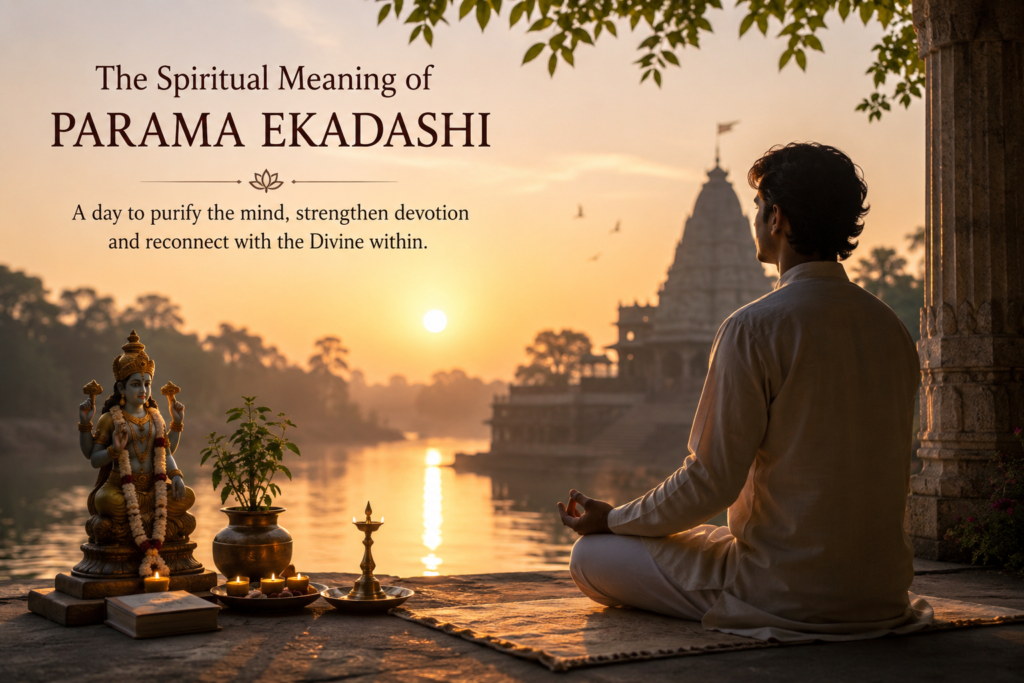
Parama Ekadashi falls on the eleventh lunar day of the waning phase of the Moon during Purushottam Maas, the sacred extra month periodically added to the Hindu lunar calendar.
The word Parama means supreme, highest, or ultimate. The observance is considered especially auspicious because it occurs during a month that Hindu traditions dedicate entirely to Lord Vishnu.
Unlike many religious observances that focus primarily on external rituals, Parama Ekadashi encourages both outward worship and inward transformation. The day serves as an invitation to examine one’s thoughts, habits, intentions, and relationship with Dharma.
Many devotees use this sacred occasion to deepen their spiritual practice through prayer, mantra chanting, scriptural study, acts of charity, and conscious self-discipline.
Parama Ekadashi occurs during Purushottam Maas, the sacred month dedicated entirely to Lord Vishnu, making it one of the most spiritually significant Ekadashis in the Hindu calendar.
Why Parama Ekadashi Is Considered So Powerful
Every Ekadashi holds spiritual significance within Sanatan Dharma, but Parama Ekadashi is often regarded as especially powerful because it combines the sanctity of Ekadashi with the sacred energy of Purushottam Maas.
Ekadashi itself is traditionally associated with purification, devotion, self-restraint, and spiritual awareness. When these practices are observed during the month dedicated to Lord Vishnu, many devotees believe their spiritual impact becomes even more meaningful.
The observance encourages people to temporarily step away from routine distractions and create space for prayer, reflection, and conscious living. Rather than focusing solely on worldly concerns, Parama Ekadashi invites devotees to strengthen their connection with Dharma and cultivate greater awareness of their inner life.
For many people, this day becomes a spiritual reset, an opportunity to slow down, reconnect with faith, and bring greater intention into everyday living.
The Sacred Significance of Purushottam Maas
To understand Parama Ekadashi fully, it is important to understand the sacred nature of Purushottam Maas.
Adhik Maas occurs approximately every thirty-two months to harmonize the lunar and solar calendars. While this additional month serves an astronomical purpose, Hindu tradition views it as far more than a calendrical adjustment.
According to sacred traditions, this month was blessed by Lord Vishnu and became known as Purushottam Maas, the month of the Supreme Being.
Because of this association, Purushottam Maas is regarded as a highly favorable period for spiritual growth. Many devotees intensify their spiritual practices during this month by increasing prayer, meditation, scripture reading, charity, pilgrimage, and devotional observances.
Purushottam Maas reminds us that spiritual growth is not always about doing more. Sometimes growth begins by slowing down, becoming aware of our habits, and consciously choosing a higher path.
For this reason, Parama Ekadashi is often seen as one of the most meaningful opportunities within the entire Purushottam Maas period.
The Spiritual Meaning of Parama Ekadashi
The deeper significance of Parama Ekadashi extends far beyond fasting.
At its heart, this observance is about purification of consciousness.
Modern life often leaves little room for stillness. People move from one task to another, constantly connected to information, notifications, responsibilities, and expectations. Over time, this continuous stimulation can leave the mind exhausted and disconnected from deeper spiritual awareness.
Parama Ekadashi creates a sacred pause.
It encourages devotees to temporarily step away from habitual patterns and become more aware of their thoughts, actions, and intentions. Fasting becomes more than avoiding food. It becomes an exercise in mindfulness and self-observation.
The observance gently invites devotees to examine:
- What truly nourishes them
- Which habits create suffering
- Where attachment has become excessive
- How faith can provide inner stability
The deepest fast is not always from food. Sometimes it is from anger, negativity, gossip, distraction, excessive consumption, and unconscious habits.
This is where the transformative power of Parama Ekadashi begins.
Lord Vishnu and the Energy of Preservation
Parama Ekadashi is dedicated to Lord Vishnu, the divine preserver who sustains balance, harmony, and order within creation.
🪷Vishnuविष्णुIn Sanatan Dharma, Lord Vishnu represents stability amidst change, wisdom amidst confusion, and Dharma amidst chaos.
When devotees worship Lord Vishnu on Parama Ekadashi, they seek to cultivate those same qualities within themselves.
Through prayer, mantra chanting, and remembrance, devotees aspire to strengthen:
- Inner balance
- Emotional stability
- Spiritual wisdom
- Compassion
- Faith
- Commitment to Dharma
The observance reminds us that outer harmony often begins with inner alignment.
The Power of Self-Discipline
One of the most enduring teachings of Ekadashi is self-mastery.
In a culture that often celebrates instant gratification, fasting teaches patience, restraint, and awareness. It demonstrates that true freedom does not necessarily come from satisfying every desire, but from learning to govern those desires wisely.
This discipline extends beyond food.
Parama Ekadashi encourages devotees to become mindful of their words, actions, emotions, and reactions. The self-control cultivated during the observance often influences many other aspects of life, including relationships, decision-making, emotional wellbeing, and spiritual growth.
✓ Awareness before action
✓ Discipline before desire
✓ Faith during uncertainty
✓ Gratitude during abundance
✓ Dharma over impulse
✓ Devotion over distraction
The Sacred Story Behind Parama Ekadashi
The spiritual significance of Parama Ekadashi becomes even more meaningful when understood through the traditional Vrat Katha associated with this observance.
Preserved within Hindu tradition for generations, this story is far more than a tale about divine blessings. It is a powerful lesson in faith, patience, humility, perseverance, and the transformative power of sincere devotion.
The Parama Ekadashi Vrat Katha is not merely a story about the removal of hardship. It is a story about maintaining faith when circumstances seem difficult and trusting that sincere devotion never goes unnoticed.
A Life Marked by Hardship
In ancient times, there lived a learned Brahmin named Sumedha in the city of Kampilya.
Although Sumedha was virtuous, knowledgeable, and deeply devoted to Dharma, he suffered from extreme poverty. Daily life was filled with hardship, and even basic necessities were often difficult to obtain.
Yet despite these challenges, his wife remained unwavering in her faith.
She never complained about their circumstances.
She never abandoned Dharma.
She continued serving her husband, guests, and spiritual duties with humility and gratitude.
Her character reflected one of the most important teachings of Sanatan Dharma: external wealth may come and go, but inner virtue remains a person’s greatest treasure.
The Arrival of Sage Kaundinya
As years passed, Sumedha became increasingly distressed by their difficult circumstances and considered leaving home in search of a better life elsewhere.
His wife, however, reminded him that faith, patience, and righteous conduct often produce results that cannot be measured immediately.
One day, the revered Sage Kaundinya arrived at their humble home.
Despite possessing very little, the couple welcomed the sage with sincerity, hospitality, and respect.
Moved by their devotion and character, Sage Kaundinya accepted their service and offered to guide them.
A Sacred Path Is Revealed
When asked about their greatest concern, Sumedha’s wife explained the hardships they faced.
Rather than asking for wealth directly, she sought spiritual guidance.
She wished to know whether there existed a sacred observance capable of helping them overcome suffering while remaining aligned with Dharma.
Sage Kaundinya advised them to observe Parama Ekadashi during Purushottam Maas.
He explained that this sacred observance possessed immense spiritual merit and could help purify karmas, remove obstacles, strengthen devotion, and attract divine grace.
He instructed them to observe the fast with sincerity, worship Lord Vishnu, chant sacred mantras, remain disciplined, and continue performing acts of charity whenever possible.
Faith, Devotion and Transformation
Following the sage’s guidance, Sumedha and his wife observed Parama Ekadashi with complete sincerity.
Their focus was not solely on material gain.
Instead, they dedicated themselves wholeheartedly to devotion, prayer, discipline, and spiritual practice.
They trusted the process.
They remained patient.
They continued walking the path of Dharma.
Over time, their circumstances gradually improved. Prosperity entered their lives, and their hardships began to ease.
Yet the greatest blessing was not material wealth.
It was inner transformation.
Faith became stronger.
Awareness deepened.
Character became refined.
Their connection with the Divine grew more profound.
“The greatest miracle in the Parama Ekadashi story is not the arrival of wealth. It is the unwavering faith that survived hardship.
— Sanatan Reflection
Lessons from the Parama Ekadashi Vrat Katha
Ancient spiritual stories continue to resonate because they speak to universal human experiences. The Parama Ekadashi Vrat Katha is not merely a tale about overcoming poverty. It is a reflection on how faith, patience, and righteous conduct can guide us through life’s uncertainties.
Faith During Difficult Times
Anyone can remain hopeful when circumstances are favorable. The true test of faith often appears when life becomes challenging.
The story of Sumedha and his wife reminds us that spiritual strength is not measured by how we act during comfort, but by how we respond during hardship. Their unwavering devotion demonstrates that faith is not passive optimism. It is the courage to continue walking the path of Dharma even when immediate results are not visible.
The Power of Contentment
Contentment does not mean abandoning ambition or refusing to improve one’s circumstances.
Instead, it means maintaining inner balance while continuing to make sincere efforts. Sumedha’s wife exemplifies this beautifully. Despite facing hardship, she remained grateful, devoted, and grounded in her values.
Her example teaches that gratitude and aspiration can coexist. We can work toward a better future without losing appreciation for what we already possess.
Why Spiritual Discipline Matters
Meaningful transformation rarely happens overnight.
Parama Ekadashi reminds us that lasting change often emerges through consistent effort, self-discipline, and devotion. Whether one seeks spiritual growth, emotional balance, or personal improvement, progress is usually built through small actions repeated with sincerity.
The Importance of Right Guidance
The arrival of Sage Kaundinya symbolizes the role of wisdom in spiritual growth.
Throughout life, guidance may come through scriptures, teachers, mentors, life experiences, or moments of deep reflection. Remaining open to wisdom often becomes the first step toward transformation.
The deeper message of the Parama Ekadashi Vrat Katha is not the removal of hardship. It is the reminder that sincere effort, faith, and devotion can transform how we experience life’s challenges.
Spiritual Benefits of Observing Parama Ekadashi
For centuries, devotees have observed Parama Ekadashi not merely because of tradition, but because of the profound inner transformation it encourages.
While sacred texts describe various spiritual merits associated with the observance, the greatest benefits often emerge through the qualities it helps cultivate within the devotee.
Strengthening Devotion
Parama Ekadashi creates dedicated time for prayer, mantra chanting, and remembrance of Lord Vishnu.
In daily life, spiritual practices are often postponed due to responsibilities and distractions. This sacred observance encourages devotees to intentionally reconnect with devotion and spiritual awareness.
Cultivating Self-Discipline
The discipline required to observe Ekadashi extends beyond food.
It encourages mindfulness in speech, actions, habits, and emotional reactions. Over time, this conscious self-regulation strengthens character and promotes greater inner stability.
Developing Mental Clarity
Periods of intentional simplicity often create space for reflection.
By reducing distractions and focusing on spiritual practices, many devotees experience a greater sense of calmness, clarity, and emotional balance.
Encouraging Gratitude
Parama Ekadashi reminds devotees to appreciate blessings that are often taken for granted.
The observance shifts attention away from constant acquisition and toward appreciation, contentment, and mindful living.
✓ To deepen devotion to Lord Vishnu
✓ To strengthen self-discipline
✓ To cultivate gratitude
✓ To reduce distraction
✓ To develop spiritual awareness
✓ To align more closely with Dharma
Preparing Your Mind for Parama Ekadashi
While fasting is one of the most visible aspects of Parama Ekadashi, the true observance begins within.
Ancient traditions emphasize that the quality of our thoughts and intentions matters just as much as the rituals we perform. A peaceful and receptive mindset allows devotees to experience the deeper purpose of the vrat.
Begin with a Sankalp
A Sankalp is a conscious spiritual intention.
Before Parama Ekadashi begins, take a moment to reflect upon why you are observing the vrat. Your intention may be to strengthen devotion, cultivate self-discipline, seek inner peace, express gratitude, or deepen spiritual awareness.
A clear intention gives purpose and meaning to every practice performed throughout the day.
Practice Gratitude
Parama Ekadashi offers a powerful opportunity to focus on abundance rather than lack.
Instead of dwelling on what is missing, reflect upon the blessings, relationships, opportunities, and lessons that have shaped your life. Gratitude naturally creates a more peaceful and devotional state of mind.
Let Go of Mental Burdens
Many spiritual traditions teach that emotional burdens can be heavier than physical ones.
Parama Ekadashi invites devotees to release anger, resentment, excessive worry, and negativity. Forgiveness does not mean approving harmful actions. It means freeing yourself from carrying unnecessary emotional weight.
Simplify Your Day
The spirit of Ekadashi encourages simplicity.
Reducing excessive screen time, unnecessary entertainment, negative conversations, and mental clutter helps create space for prayer, reflection, and spiritual insight.
The deepest preparation for Ekadashi is not deciding what you will avoid eating.
It is deciding what you will avoid feeding within the mind.
Consider fasting from anger, gossip, complaining, negativity, excessive consumption, and constant digital stimulation.
Why Parama Ekadashi Matters in Modern Life
At first glance, an ancient fasting observance may appear disconnected from contemporary challenges.
Yet Parama Ekadashi remains remarkably relevant.
Today’s world is filled with constant notifications, information overload, endless consumption, digital distractions, stress, and mental fatigue. Many people spend their days moving rapidly from one task to another without experiencing moments of stillness.
The principles behind Parama Ekadashi offer a meaningful response to these challenges.
The observance encourages individuals to slow down, become more mindful, reduce unnecessary distractions, and reconnect with spiritual values.
This is one reason millions of people continue observing Ekadashi today.
Its wisdom transcends time.
“Parama Ekadashi is not simply a fast from food. It is an invitation to fast from distraction and reconnect with what truly matters.
— Sanatan Reflection
Common Mistakes People Make While Observing Ekadashi
Observing Parama Ekadashi is not about achieving perfection. However, understanding common mistakes can help devotees experience the deeper purpose of the vrat.
Focusing Only on Food Restrictions
Many people think of Ekadashi purely as a dietary observance.
While fasting is important, the day is equally about prayer, devotion, reflection, self-discipline, and spiritual growth.
Ignoring Prayer and Mantra Chanting
Avoiding certain foods without engaging in spiritual practices can reduce the observance to a routine exercise.
Prayer, mantra chanting, and remembrance of Lord Vishnu remain central to the spirit of Ekadashi.
Treating the Fast as a Weight-Loss Program
The purpose of Parama Ekadashi is spiritual growth.
Any physical benefits should be viewed as secondary rather than the primary goal.
Remaining Emotionally Reactive
A person may avoid grains while still feeding anger, resentment, criticism, or negativity.
The deeper practice of Ekadashi involves purification of thoughts as well as habits.
The most successful Ekadashi observance is not necessarily the strictest one.
It is the one that brings you closer to awareness, gratitude, devotion, and Dharma.
Frequently Asked Questions About Parama Ekadashi
What is the significance of Parama Ekadashi?+
Which deity is worshipped on Parama Ekadashi?+
Why is Parama Ekadashi observed during Adhik Maas?+
What is the story behind Parama Ekadashi?+
Can fruits be eaten during Parama Ekadashi?+
What foods are traditionally avoided on Parama Ekadashi?+
Which mantra is commonly chanted on Parama Ekadashi?+
Can beginners observe Parama Ekadashi?+
When should the Parama Ekadashi fast be broken?+
A Sacred Invitation to Inner Transformation
Parama Ekadashi continues to inspire devotees because its message transcends time.
It reminds us that true transformation rarely happens through dramatic events. More often, it begins quietly, through a sincere prayer, a moment of awareness, an act of discipline, or a conscious decision to move closer to Dharma.
The observance teaches that devotion is not merely ritual. It is a way of living with greater awareness, gratitude, humility, and purpose.
In a world filled with noise, urgency, and endless distraction, Parama Ekadashi offers something increasingly rare:
the opportunity to pause, reflect, and return to what truly matters.
Parama Ekadashi reminds us that spiritual growth is rarely sudden. It emerges through small acts of awareness, sincere devotion, patient discipline, and a willingness to walk the path of Dharma, even when the destination is not yet visible.
What is Parama Ekadashi?+
Why is Parama Ekadashi considered so important?+
Which deity is worshipped on Parama Ekadashi?+
What is the story of Parama Ekadashi?+
Can beginners observe Parama Ekadashi?+
What foods are allowed on Parama Ekadashi?+
What foods should be avoided on Parama Ekadashi?+
Which mantra is best for Parama Ekadashi?+
What are the benefits of observing Parama Ekadashi?+
When is the Parama Ekadashi fast broken?+
How to Observe Nirjala Ekadashi: Fasting Rules, Satvik Preparation & Beginner Guidance
While the spiritual essence of Nirjala Ekadashi lies in awareness, discipline, and devotion, many devotees also seek practical guidance on how to observe the fast meaningfully and mindfully.
For some people, Nirjala Ekadashi becomes a deeply devotional experience filled with prayer, mantra chanting, silence, and reflection. For others, especially beginners, it may feel physically and emotionally intense at first.
What matters most within Sanatan traditions is not harsh perfection, but sincerity, awareness, and genuine spiritual intention.
- How Devotees Traditionally Observe Nirjala Ekadashi
- What Makes Nirjala Ekadashi Different From Other Ekadashi Fasts?
- Can Beginners Observe Nirjala Ekadashi?
- How to Prepare for Nirjala Ekadashi
- Satvik Food Before Nirjala Ekadashi
- What Devotees Often Avoid During Nirjala Ekadashi
- Vishnu Puja During Nirjala Ekadashi
- Sacred Vishnu Mantras for Nirjala Ekadashi
- The Emotional Experience of Ekadashi Silence
- Breaking the Nirjala Ekadashi Fast
- Important Health and Mindful Considerations
- Why Nirjala Ekadashi Continues to Inspire Devotees
- Frequently Asked Questions About Nirjala Ekadashi
How Devotees Traditionally Observe Nirjala Ekadashi
Nirjala Ekadashi is traditionally observed through fasting, Vishnu devotion, prayer, mantra chanting, simplicity, and reduced worldly distraction.
Many devotees spend the day:
- praying quietly
- chanting Vishnu mantras
- reading sacred scriptures
- visiting temples
- listening to bhajans
- practicing silence and reflection
The atmosphere of the day often feels calmer and more inward compared to ordinary routines. Many people intentionally reduce noise, overstimulation, and unnecessary activity to cultivate a more devotional state of mind.
For many devotees, Nirjala Ekadashi becomes less about restriction and more about creating spiritual stillness through simplicity and conscious awareness.
What Makes Nirjala Ekadashi Different From Other Ekadashi Fasts?
Unlike many other Ekadashi observances where fruits, milk, or water may be consumed, Nirjala Ekadashi is traditionally observed without food or water for the duration of the fast.
This is one reason it is considered among the most disciplined Ekadashi observances.
However, spiritual traditions also emphasize mindfulness and sincerity rather than rigid extremism. Not every devotee observes the fast in the exact same way, especially depending on age, health, physical condition, and spiritual capacity.
The deeper spiritual purpose remains:
- awareness
- devotion
- restraint
- simplicity
- conscious living
The essence of Nirjala Ekadashi lies not in physical hardship alone, but in cultivating sincerity, mindfulness, and spiritual focus.
Can Beginners Observe Nirjala Ekadashi?
Yes, absolutely.
Many beginners gradually approach Nirjala Ekadashi in a way that feels mindful and manageable for their health and experience level.
Some devotees begin by:
- reducing heavy foods beforehand
- eating simpler satvik meals
- increasing prayer and mantra chanting
- avoiding distraction and indulgence
- observing partial fasting if needed
Over time, individuals may deepen their observance naturally according to their spiritual comfort and physical well-being.
In spiritual practice, sincerity and awareness are often considered more meaningful than forcing the body beyond its limits.
How to Prepare for Nirjala Ekadashi
Preparation often begins the day before the fast.
Many devotees prefer lighter and more satvik meals to help create a calmer physical and mental state. Oily, overly spicy, or heavy foods are often reduced beforehand.
The emotional atmosphere surrounding preparation is also important.
Many people try to:
- reduce mental clutter
- avoid unnecessary conflict
- sleep earlier
- create a quieter devotional environment
- spend more time in prayer or reflection
This gradual slowing down helps the transition into Ekadashi feel more peaceful and spiritually focused.
Satvik Food Before Nirjala Ekadashi
Since Nirjala Ekadashi is traditionally intense, many devotees choose nourishing satvik foods before beginning the fast.
Common preparations may include:
- fruits
- milk
- curd
- simple khichdi
- light vegetables
- nuts
- herbal drinks
The intention is usually not indulgence, but mindful nourishment and simplicity.
“Satvik eating supports not only physical balance, but also a calmer and more mindful inner state.
— Sanatan Reflection
Many devotees also avoid overeating before the fast, as excessive consumption can make the observance feel physically heavier.
What Devotees Often Avoid During Nirjala Ekadashi
Beyond food restrictions, many spiritual traditions also encourage reducing:
- anger
- excessive talking
- distraction
- unnecessary entertainment
- arguments
- mental restlessness
The observance is often viewed as a full spiritual discipline involving both body and mind.
For many devotees, the quieter emotional atmosphere of Ekadashi becomes just as important as the fast itself.
Vishnu Puja During Nirjala Ekadashi
Lord Vishnu worship holds central importance during Nirjala Ekadashi.
🪷Vishnuविष्णुMany devotees light a diya, offer flowers, chant Vishnu mantras, read sacred texts, or spend quiet time in prayer before an image or murti of Lord Vishnu.
The atmosphere is usually simple, calm, and devotional rather than elaborate.
Even a few moments of sincere prayer can create a powerful feeling of emotional grounding during the day.
Sacred Vishnu Mantras for Nirjala Ekadashi
Mantra chanting is one of the most accessible and emotionally calming practices during Ekadashi.
Many devotees softly chant:
- Om Namo Bhagavate Vasudevaya
- Om Namo Narayanaya
- Hare Krishna Maha Mantra
- Vishnu Sahasranama
Some people chant quietly during meditation, while others play soft bhajans or devotional music throughout the day to maintain a peaceful atmosphere at home.
The Emotional Experience of Ekadashi Silence
One aspect of Nirjala Ekadashi that many devotees remember deeply is the emotional stillness it creates.
Without constant eating, stimulation, scrolling, or distraction, the mind gradually begins to slow down.
People often become more aware of:
- thought patterns
- emotional reactions
- mental restlessness
- unconscious habits
At the same time, many devotees also experience:
- calmness
- gratitude
- clarity
- softness
- inward reflection
“Spiritual silence often reveals how much peace already exists beneath the noise of everyday life.
— Sanatan Reflection
For many people, this inner quietness becomes the most meaningful part of the observance.
Breaking the Nirjala Ekadashi Fast
The fast is traditionally broken during the designated paran time on the following day after Ekadashi.
Many devotees begin gently with:
- water
- fruits
- light satvik food
- simple meals
The transition out of fasting is usually approached slowly and mindfully rather than through heavy eating.
For many people, the simplicity maintained during Ekadashi naturally continues into the following day as well.
Important Health and Mindful Considerations
Nirjala Ekadashi is traditionally regarded as an intense observance, and individual health conditions should always be respected.
Elderly devotees, children, pregnant women, or individuals with medical conditions often adapt the observance according to their well-being and personal guidance.
Sanatan traditions have historically emphasized both discipline and wisdom.
True spiritual practice should cultivate awareness, humility, and balance rather than physical harm or rigid self-punishment.
For many devotees, mindful observance with sincerity becomes more spiritually meaningful than extreme rigidity.
Why Nirjala Ekadashi Continues to Inspire Devotees
For centuries, Nirjala Ekadashi has reminded devotees that spiritual strength is not always built through outward achievement.
Sometimes it emerges quietly through:
- discipline
- simplicity
- restraint
- mindfulness
- silence
- devotion
In a world filled with endless stimulation and compulsive distraction, even one intentional day of conscious living can feel deeply transformative.
“The purpose of spiritual discipline is not to harden the heart, but to bring the mind closer to awareness, gratitude, and inner peace.
— Sanatan Reflection
Frequently Asked Questions About Nirjala Ekadashi
What is Nirjala Ekadashi?+
Why is Nirjala Ekadashi called Bhimsen Ekadashi?+
Can beginners observe Nirjala Ekadashi?+
Can water be consumed during Nirjala Ekadashi?+
What food is eaten before Nirjala Ekadashi?+
Why is Nirjala Ekadashi considered spiritually powerful?+
How to Observe Nirjala Ekadashi: Fasting Rules, Satvik Preparation & Beginner Guidance
While the spiritual essence of Nirjala Ekadashi lies in awareness, devotion, and inner discipline, many devotees also seek practical guidance on how to observe the fast meaningfully and mindfully.
For some people, Nirjala Ekadashi becomes a deeply devotional experience centered around silence, mantra chanting, prayer, and reflection. For others, especially beginners, it may feel physically and emotionally intense at first. Within Sanatan traditions, however, the heart of the observance has never been rigid perfection. What matters most is sincerity, mindfulness, humility, and genuine spiritual intention.
- How Devotees Traditionally Observe Nirjala Ekadashi
- What Makes Nirjala Ekadashi Different From Other Ekadashi Fasts?
- Can Beginners Observe Nirjala Ekadashi?
- How to Prepare for Nirjala Ekadashi
- Satvik Food Before Nirjala Ekadashi
- What Devotees Often Avoid During Nirjala Ekadashi
- Vishnu Puja During Nirjala Ekadashi
- Sacred Vishnu Mantras for Nirjala Ekadashi
- The Emotional Experience of Ekadashi Silence
- Breaking the Nirjala Ekadashi Fast
- Important Health and Mindful Considerations
- Why Nirjala Ekadashi Continues to Inspire Devotees
- Frequently Asked Questions About Nirjala Ekadashi
How Devotees Traditionally Observe Nirjala Ekadashi
Nirjala Ekadashi is traditionally observed through fasting, Vishnu devotion, prayer, mantra chanting, simplicity, and reduced worldly distraction. The atmosphere surrounding the day often feels noticeably calmer and more inward compared to ordinary routines.
Many devotees wake early before sunrise, light a diya, chant Vishnu mantras, and spend more time reading sacred texts such as the Bhagavad Gita or Vishnu Sahasranama. Some visit temples, while others prefer quieter observance at home through meditation, bhajans, and reflective silence.
For many devotees, the simplicity of the day itself gradually creates emotional stillness and mental clarity.
Nirjala Ekadashi is often experienced not as a day of harsh restriction, but as a sacred opportunity to slow down, simplify life, and reconnect with spiritual awareness.
What Makes Nirjala Ekadashi Different From Other Ekadashi Fasts?
Unlike many other Ekadashi observances where fruits, milk, or water may be consumed, Nirjala Ekadashi is traditionally observed without food or water for the duration of the fast. This is one reason it is considered among the most disciplined and spiritually intense Ekadashi observances.
Yet spiritual traditions also emphasize wisdom and sincerity rather than rigid extremism. Not every devotee observes the fast in exactly the same way, especially depending on age, health, physical condition, and spiritual capacity.
The deeper purpose of the observance remains centered around awareness, devotion, simplicity, restraint, and conscious living.
The essence of Nirjala Ekadashi lies not in physical hardship alone, but in cultivating mindfulness, sincerity, and spiritual focus.
Can Beginners Observe Nirjala Ekadashi?
Yes, absolutely.
Many beginners gradually approach Nirjala Ekadashi according to their physical comfort and spiritual readiness. Some devotees begin by simplifying meals beforehand, reducing distraction, increasing mantra chanting, and practicing partial fasting before attempting a stricter observance later.
Within Sanatan traditions, spiritual practice is often viewed as a gradual inner journey rather than forced perfection.
In spiritual discipline, sincerity and awareness are often considered far more meaningful than pushing the body beyond its limits.
Even small efforts made with devotion and mindfulness can become spiritually meaningful.
How to Prepare for Nirjala Ekadashi
Preparation for Nirjala Ekadashi often begins a day earlier.
Many devotees prefer lighter and more satvik meals before the fast to create a calmer physical and mental state. Heavy, oily, excessively spicy, or overly stimulating foods are often reduced naturally beforehand.
The emotional preparation is equally important.
Some people intentionally reduce unnecessary distraction, avoid conflict, sleep earlier, spend more time in prayer, or create a quieter devotional atmosphere at home. This gradual slowing down often helps the transition into Ekadashi feel more peaceful and spiritually centered.
Satvik Food Before Nirjala Ekadashi
Because Nirjala Ekadashi is traditionally intense, many devotees choose simple and nourishing satvik food before beginning the fast.
Meals are often kept light, calming, and easy to digest. Fruits, milk, curd, nuts, simple khichdi, and lightly prepared vegetables are commonly preferred in many households.
The focus is usually not indulgence, but mindful nourishment and simplicity.
“Satvik eating supports not only physical balance, but also a calmer and more mindful inner state.
— Sanatan Reflection
Many devotees also avoid overeating before the fast, as excessive consumption can make the observance feel physically heavier and mentally restless.
What Devotees Often Avoid During Nirjala Ekadashi
The observance of Ekadashi traditionally extends beyond food alone.
Many spiritual traditions also encourage reducing unnecessary distraction, excessive talking, emotional conflict, anger, entertainment overload, and mental restlessness during the day. The intention is to create greater inward awareness and emotional quietness.
For many devotees, this calmer mental atmosphere becomes one of the most meaningful aspects of Ekadashi itself.
Vishnu Puja During Nirjala Ekadashi
Lord Vishnu worship holds central importance during Nirjala Ekadashi.
🪷Vishnuविष्णुMany devotees light a diya, offer flowers, chant Vishnu mantras, read sacred verses, or spend quiet time in prayer before an image or murti of Lord Vishnu. The devotional atmosphere is usually kept simple, peaceful, and emotionally grounding rather than elaborate.
Even a few sincere moments of prayer often create a deep sense of calmness and spiritual connection during the observance.
Sacred Vishnu Mantras for Nirjala Ekadashi
Mantra chanting is one of the most emotionally calming practices associated with Nirjala Ekadashi.
Many devotees softly chant mantras such as Om Namo Bhagavate Vasudevaya, Om Namo Narayanaya, Vishnu Sahasranama, or the Hare Krishna Maha Mantra throughout the day. Some chant during meditation, while others play soft devotional bhajans at home to maintain a peaceful atmosphere.
Even a few minutes of sincere chanting can help quiet the mind and deepen devotional awareness.
The Emotional Experience of Ekadashi Silence
One aspect of Nirjala Ekadashi that many devotees remember deeply is the emotional stillness it creates.
Without constant eating, scrolling, stimulation, or distraction, the mind gradually begins to slow down. Many people become more aware of thought patterns, emotional restlessness, cravings, and unconscious habits that usually remain hidden beneath everyday activity.
At the same time, many devotees also experience moments of:
- calmness
- gratitude
- inward reflection
- emotional softness
- spiritual clarity
“Spiritual silence often reveals how much peace already exists beneath the noise of everyday life.
— Sanatan Reflection
For many people, this quieter inner atmosphere becomes more transformative than the ritual itself.
Breaking the Nirjala Ekadashi Fast
The fast is traditionally broken during the designated paran time on the following day after Ekadashi.
Many devotees gently begin with water, fruits, or light satvik meals rather than immediately returning to heavy eating. The transition out of fasting is usually approached slowly and mindfully.
For many people, the simplicity cultivated during Ekadashi naturally continues into the following day as well.
Important Health and Mindful Considerations
Nirjala Ekadashi is traditionally regarded as an intense observance, and personal health should always be respected.
Children, elderly devotees, pregnant women, or individuals with medical conditions often adapt the observance according to their well-being, guidance, and physical capacity. Sanatan traditions have historically emphasized both discipline and wisdom together.
True spiritual discipline should cultivate awareness, humility, balance, and devotion rather than physical harm or rigid self-punishment.
For many devotees, mindful observance with sincerity becomes far more spiritually meaningful than extreme rigidity.
Why Nirjala Ekadashi Continues to Inspire Devotees
For centuries, Nirjala Ekadashi has reminded devotees that spiritual strength is not always built through outward achievement or constant activity.
Sometimes transformation emerges quietly through simplicity, restraint, mindfulness, silence, devotion, and conscious living.
In a world filled with endless stimulation and compulsive distraction, even one intentional day of spiritual awareness can feel deeply renewing.
“The purpose of spiritual discipline is not to harden the heart, but to bring the mind closer to awareness, gratitude, and inner peace.
— Sanatan Reflection
Frequently Asked Questions About Nirjala Ekadashi
What is Nirjala Ekadashi?+
Why is Nirjala Ekadashi called Bhimsen Ekadashi?+
Can beginners observe Nirjala Ekadashi?+
Can water be consumed during Nirjala Ekadashi?+
What food is eaten before Nirjala Ekadashi?+
Why is Nirjala Ekadashi considered spiritually powerful?+
Adhik Maas: The Sacred Month of Pause, Reflection & Spiritual Renewal
In a world constantly asking people to move faster, achieve more, consume endlessly, and remain mentally occupied at all times, Adhik Maas carries a very different spiritual message.
Pause.
Slow down.
Reconnect.
Known traditionally as Purushottam Maas, Adhik Maas is considered one of the most spiritually significant periods in Sanatan Dharma. For centuries, devotees have viewed this sacred month not as an interruption in the calendar, but as a rare opportunity for inner cleansing, devotion, simplicity, and spiritual renewal.
Unlike many festivals centered around celebration and activity, Adhik Maas carries a softer emotional atmosphere. It encourages silence over noise, reflection over distraction, and spiritual grounding over constant worldly movement. For many devotees, this sacred month becomes a time to simplify life, deepen prayer, practice mindful living, and reconnect with inner calmness.
- What Is Adhik Maas?
- Why Does Adhik Maas Happen?
- Why Is Adhik Maas Called Purushottam Maas?
- Why Is Adhik Maas Considered Spiritually Powerful?
- The Spiritual Meaning of Sacred Pauses
- How Devotees Traditionally Observe Adhik Maas
- Why Many Traditions Avoid Major New Beginnings During Adhik Maas
- How Adhik Maas Feels Emotionally Different
- Why Adhik Maas Feels So Relevant Today
- Simple Ways to Observe Adhik Maas at Home
- Sacred Mantras for Adhik Maas
- Why Adhik Maas Continues to Inspire Devotees
- Spiritual Practices During Adhik Maas: Simple Rituals, Mantras & Mindful Living
- What Do People Traditionally Do During Adhik Maas?
- Why Simplicity Becomes Important During Purushottam Maas
- Reading Sacred Texts During Adhik Maas
- Why Vishnu Worship Is Central to Adhik Maas
- Sacred Mantras for Adhik Maas
- Fasting During Adhik Maas
- Why Charity Holds Special Importance During Adhik Maas
- How Adhik Maas Changes the Emotional Atmosphere of Daily Life
- Can Beginners Observe Adhik Maas?
- Why Adhik Maas Feels So Relevant in Modern Life
- Bringing the Spirit of Purushottam Maas Beyond One Month
- Frequently Asked Questions About Adhik Maas
What Is Adhik Maas?
Adhik Maas is an additional lunar month that appears periodically in the Hindu calendar to help align the lunar and solar cycles. It is also widely known as Purushottam Maas and is deeply associated with devotion to Lord Vishnu.
While many people initially understand Adhik Maas as a calendar adjustment, spiritual traditions give it much deeper meaning. Devotees often see this sacred month as a rare spiritual pause intentionally woven into time itself, an opportunity to step back from constant activity and reconnect with inner awareness.
Adhik Maas is traditionally viewed not as an ordinary extra month, but as a sacred period of spiritual realignment and emotional renewal.
Why Does Adhik Maas Happen?
The Hindu calendar primarily follows lunar cycles, while the solar calendar follows the movement of the Sun. Since lunar months are slightly shorter than the solar year, an imbalance gradually develops over time. To restore this balance, an additional month is periodically added, which becomes Adhik Maas.
Spiritually, however, this extra month is viewed very differently.
What appears astronomically as a calendar correction is often understood devotionally as a sacred opportunity for slowing down, reflecting inwardly, and deepening spiritual practice.
This symbolic meaning is what gives Adhik Maas its emotional and spiritual depth.
Why Is Adhik Maas Called Purushottam Maas?
One of the most beautiful aspects of Adhik Maas is its connection with Lord Vishnu.
According to spiritual traditions, this month was once considered spiritually neglected because it did not belong to the regular lunar cycle in the same way as other months. Lord Vishnu, known as Purushottam, the Supreme Divine Being, is believed to have blessed this sacred month and accepted it as his own.
From that moment onward, Adhik Maas became known as Purushottam Maas.
🪷Vishnuविष्णुThe story carries a deeply emotional message. It reminds devotees that even what feels overlooked or insignificant can become sacred through divine grace.
“What the world may overlook, the Divine can transform into something deeply sacred.
— Sanatan Reflection
Why Is Adhik Maas Considered Spiritually Powerful?
Many devotees believe Adhik Maas carries especially powerful spiritual energy because it encourages inward living rather than outward distraction.
The month is traditionally associated with:
- simplicity
- devotion
- prayer
- chanting
- reflection
- mindful living
Rather than focusing heavily on worldly expansion or celebration, devotees often use this period to create emotional stillness and spiritual clarity.
Adhik Maas reminds devotees that spiritual growth often happens not during constant activity, but during periods of silence, reflection, and inner awareness.
For many people, this slower rhythm itself feels deeply healing.
The Spiritual Meaning of Sacred Pauses
One of the deepest symbolic meanings of Adhik Maas is the importance of sacred pauses.
Nature itself moves through cycles:
day and night, seasons, tides, growth, rest, movement, and stillness. Spiritual traditions have long recognized that human beings also need intentional periods of slowing down and reflection.
Modern life rarely allows space for:
- silence
- emotional processing
- mindful awareness
- spiritual stillness
Adhik Maas symbolically restores that space.
“Sometimes spiritual clarity emerges not from doing more, but from becoming still enough to listen inwardly.
— Sanatan Reflection
In many ways, Purushottam Maas feels especially relevant today because modern minds often need sacred pauses more than ever before.
How Devotees Traditionally Observe Adhik Maas
Many devotees observe Adhik Maas through simple spiritual practices centered around devotion, discipline, and mindful living.
Some people chant Vishnu mantras daily. Others spend more time reading sacred texts like the Bhagavad Gita or Vishnu Sahasranama. Many households choose simpler meals, quieter routines, acts of charity, and reduced indulgence during this period.
The intention is usually not harsh restriction, but conscious spiritual alignment.
Why Many Traditions Avoid Major New Beginnings During Adhik Maas
One of the most searched questions about Adhik Maas is whether important worldly activities should be avoided during this period.
In many traditions, ceremonies such as marriages, griha pravesh, large celebrations, or major purchases are often postponed during Adhik Maas. However, this does not mean the month is considered negative or unlucky.
Instead, Purushottam Maas is traditionally viewed as more suitable for inward focus, devotion, reflection, simplicity, and spiritual practices rather than worldly expansion.
Adhik Maas is traditionally understood as a spiritually inward month focused on reflection and devotion rather than material activity.
This distinction is important because many people misunderstand the deeper purpose of the month.
How Adhik Maas Feels Emotionally Different
Many devotees describe Adhik Maas as carrying a noticeably calmer emotional atmosphere.
The energy of the month often feels quieter, slower, more reflective, and spiritually grounding. Small daily practices such as waking early, lighting a diya, chanting softly, eating mindfully, reducing distractions, or spending time in prayer gradually create a softer inner rhythm.
For many people, this simplicity itself becomes emotionally healing.
The beauty of Adhik Maas often lies not in elaborate rituals, but in the quiet transformation created through simplicity, stillness, and mindful devotion.
Why Adhik Maas Feels So Relevant Today
Modern life constantly pushes people toward speed, comparison, productivity, stimulation, and endless consumption.
Adhik Maas gently moves in the opposite direction.
It encourages people to slow down mentally, simplify emotionally, reconnect with spiritual practices, and create intentional moments of peace within everyday life.
For many devotees, this sacred month becomes less about ritual obligation and more about emotional and spiritual reset.
“Sacred pauses often become the moments where the soul remembers what truly matters.
— Sanatan Reflection
In a world filled with constant movement and mental noise, Adhik Maas continues to offer something increasingly rare, stillness.
Simple Ways to Observe Adhik Maas at Home
You do not need elaborate rituals to connect with the spirit of Adhik Maas.
Even small mindful practices can become deeply meaningful during this sacred month.
Reduce unnecessary distractions and create more intentional quiet moments during the day.
Spend a few minutes daily chanting Vishnu mantras with sincerity and calmness.
Many devotees read the Bhagavad Gita, Vishnu Sahasranama, or devotional stories during Purushottam Maas.
Eat mindfully, reduce excess consumption, and cultivate emotional balance.
Acts of generosity and kindness are considered spiritually meaningful during Adhik Maas.
Sacred Mantras for Adhik Maas
Popular mantras associated with Purushottam Maas include Om Namo Bhagavate Vasudevaya, Om Namo Narayanaya, Vishnu Sahasranama, and the Hare Krishna Maha Mantra.
Many devotees chant these mantras during morning prayer, meditation, fasting, evening diya rituals, or quiet moments of reflection. Even a few minutes of sincere chanting can help create a calmer and more devotional atmosphere.
Why Adhik Maas Continues to Inspire Devotees
For centuries, Adhik Maas has reminded devotees that spiritual life is not only about rituals or festivals. It is also about creating space for reflection, releasing inner clutter, simplifying the mind, and reconnecting with what truly matters.
Purushottam Maas gently reminds devotees that sometimes the most meaningful spiritual transformation happens quietly, through stillness, awareness, and sincere devotion.
In a world that constantly encourages more noise, more urgency, and more distraction, Adhik Maas continues to offer something profoundly sacred, the opportunity to pause, breathe, reflect, and return inwardly to peace.
Spiritual Practices During Adhik Maas: Simple Rituals, Mantras & Mindful Living
Adhik Maas, also known as Purushottam Maas, is traditionally regarded as a sacred period for spiritual reflection, simplicity, devotion, and inner cleansing. While the previous part explored the deeper meaning and symbolism of this sacred month, many devotees also seek practical ways to observe it meaningfully in daily life.
What makes Adhik Maas unique is that its practices are often rooted not in grand celebration, but in quieter forms of devotion. A softly lit diya, a calmer daily rhythm, a few moments of mantra chanting, or reading sacred scriptures with sincerity can all become deeply spiritual during this time.
For many devotees, Purushottam Maas becomes less about external ritual and more about creating inner stillness.
- What Is Adhik Maas?
- Why Does Adhik Maas Happen?
- Why Is Adhik Maas Called Purushottam Maas?
- Why Is Adhik Maas Considered Spiritually Powerful?
- The Spiritual Meaning of Sacred Pauses
- How Devotees Traditionally Observe Adhik Maas
- Why Many Traditions Avoid Major New Beginnings During Adhik Maas
- How Adhik Maas Feels Emotionally Different
- Why Adhik Maas Feels So Relevant Today
- Simple Ways to Observe Adhik Maas at Home
- Sacred Mantras for Adhik Maas
- Why Adhik Maas Continues to Inspire Devotees
- Spiritual Practices During Adhik Maas: Simple Rituals, Mantras & Mindful Living
- What Do People Traditionally Do During Adhik Maas?
- Why Simplicity Becomes Important During Purushottam Maas
- Reading Sacred Texts During Adhik Maas
- Why Vishnu Worship Is Central to Adhik Maas
- Sacred Mantras for Adhik Maas
- Fasting During Adhik Maas
- Why Charity Holds Special Importance During Adhik Maas
- How Adhik Maas Changes the Emotional Atmosphere of Daily Life
- Can Beginners Observe Adhik Maas?
- Why Adhik Maas Feels So Relevant in Modern Life
- Bringing the Spirit of Purushottam Maas Beyond One Month
- Frequently Asked Questions About Adhik Maas
What Do People Traditionally Do During Adhik Maas?
Across different regions and traditions, devotees observe Adhik Maas through practices connected with Lord Vishnu, prayer, charity, simplicity, and mindful living.
Some households increase their spiritual activities during this period by:
- chanting Vishnu mantras daily
- reading sacred texts
- practicing fasting
- reducing excess consumption
- donating food or clothing
- visiting temples
- spending more time in silence and prayer
The atmosphere of the month often feels quieter and more inward compared to highly celebratory festival periods.
Many devotees experience Adhik Maas not as a month of restriction, but as a sacred opportunity to simplify life and reconnect with spiritual awareness.
Why Simplicity Becomes Important During Purushottam Maas
One of the deepest themes associated with Adhik Maas is simplicity.
Modern life often creates constant mental stimulation through:
- endless information
- digital distraction
- emotional overwhelm
- hurried routines
- unconscious consumption
Purushottam Maas gently encourages the opposite.
It invites devotees to slow down, reduce excess, and create more intentional space for:
- prayer
- reflection
- mindful eating
- spiritual reading
- emotional clarity
- devotional practices
“Simplicity often creates the silence where spiritual awareness becomes easier to hear.
— Sanatan Reflection
For many people, even small changes during Adhik Maas, such as eating lighter meals, waking earlier, or reducing unnecessary distractions, gradually create a calmer inner atmosphere.
Reading Sacred Texts During Adhik Maas
Reading spiritual scriptures is considered especially meaningful during Purushottam Maas.
Many devotees spend time with:
- Bhagavad Gita
- Vishnu Sahasranama
- Srimad Bhagavatam
- Ramayana
- devotional stories of Lord Vishnu
Rather than rushing through verses, devotees often approach sacred reading slowly and reflectively.
In many spiritual traditions, sacred reading is not viewed as gathering information alone, but as a practice of inner reflection and emotional grounding.
For some people, even reading a few verses daily creates a sense of peace and steadiness throughout the month.
Why Vishnu Worship Is Central to Adhik Maas
Purushottam Maas is deeply associated with Lord Vishnu because spiritual traditions describe this sacred month as especially blessed by him.
🪷Vishnuविष्णुMany devotees therefore dedicate additional time during Adhik Maas to:
- Vishnu puja
- mantra chanting
- temple visits
- devotional bhajans
- quiet meditation
The energy of Vishnu worship during this month is often associated with:
- preservation
- emotional balance
- compassion
- discipline
- spiritual stability
This calmer devotional rhythm naturally aligns with the reflective atmosphere of Adhik Maas.
Sacred Mantras for Adhik Maas
Mantra chanting is one of the simplest and most accessible spiritual practices during Purushottam Maas.
Popular mantras include:
- Om Namo Bhagavate Vasudevaya
- Om Namo Narayanaya
- Hare Krishna Maha Mantra
- Vishnu Gayatri Mantra
Many devotees chant these mantras:
- during sunrise
- after lighting a diya
- before meditation
- while reading scriptures
- during quiet evening prayer
Even a few sincere minutes of chanting can gradually create emotional calmness and devotional focus.
Fasting During Adhik Maas
Some devotees also observe fasting practices during Adhik Maas as a form of discipline and spiritual awareness.
However, the deeper purpose of fasting is traditionally understood as:
- simplifying the senses
- reducing distraction
- cultivating mindfulness
- strengthening devotion
For many people, fasting during Purushottam Maas is approached gently and consciously rather than rigidly.
The spiritual purpose of fasting is not punishment, but creating greater awareness, simplicity, and inner clarity.
Many devotees prefer:
- lighter meals
- sattvic food
- mindful eating
- reduced indulgence
during this sacred month.
Why Charity Holds Special Importance During Adhik Maas
Acts of compassion and generosity are considered highly meaningful during Purushottam Maas.
Many devotees offer:
- food donations
- water donations
- clothing
- support to temples or ashrams
- service to those in need
This emphasis on giving reflects an important spiritual principle within Sanatan traditions, true devotion naturally expresses itself through compassion.
“Spiritual growth becomes meaningful when it also softens the heart toward others.
— Sanatan Reflection
For many devotees, even small acts of kindness during Adhik Maas feel deeply spiritually fulfilling.
How Adhik Maas Changes the Emotional Atmosphere of Daily Life
One reason many devotees feel emotionally connected to Adhik Maas is because the month subtly changes the rhythm of daily life.
Homes may feel:
- quieter
- slower
- more devotional
- emotionally softer
Morning prayers become calmer. Meals become simpler. Even ordinary routines begin carrying more mindfulness and awareness.
For many people, the true beauty of Adhik Maas lies in the quieter emotional transformation it creates within everyday life.
This softer spiritual rhythm often becomes more memorable than elaborate rituals.
Can Beginners Observe Adhik Maas?
Absolutely.
Purushottam Maas does not require perfection or complicated ritual knowledge.
Beginners can observe the month meaningfully through simple practices such as:
- chanting Vishnu mantras
- reading a few verses from the Bhagavad Gita
- practicing gratitude
- reducing distractions
- lighting a diya daily
- eating more mindfully
- spending quiet time in reflection
What matters most is sincerity and awareness.
Why Adhik Maas Feels So Relevant in Modern Life
Modern life constantly pushes people toward speed, comparison, stimulation, and emotional overload.
Adhik Maas offers a completely different spiritual rhythm.
It encourages:
- slowing down mentally
- simplifying emotionally
- reconnecting with devotion
- creating sacred pauses
- becoming more inwardly aware
For many people, this sacred month becomes a rare opportunity to breathe more consciously and reconnect with emotional stillness.
“In a noisy world, sacred pauses often become deeply healing.
— Sanatan Reflection
Bringing the Spirit of Purushottam Maas Beyond One Month
The deeper wisdom of Adhik Maas extends far beyond a single period in the calendar.
Its teachings gently remind devotees that spiritual peace is often found through:
- simplicity
- mindful living
- devotion
- compassion
- reflection
- emotional clarity
Even after Purushottam Maas ends, many people continue carrying its softer rhythms into daily life through calmer routines, spiritual awareness, and more intentional living.
The true purpose of Adhik Maas is not simply observing a sacred month, but rediscovering inner balance through conscious and devotional living.
Frequently Asked Questions About Adhik Maas
What is Adhik Maas?+
Why is Adhik Maas called Purushottam Maas?+
What do devotees do during Adhik Maas?+
Can beginners observe Adhik Maas?+
Why are marriages often avoided during Adhik Maas?+
Ganga Dussehra: The Sacred Descent of Maa Ganga and Its Spiritual Meaning
For centuries, devotees across India have looked toward the flowing waters of Maa Ganga not merely as a river, but as a living symbol of purification, compassion, surrender, and divine grace.
To stand beside the Ganga at sunrise, hear temple bells echo through the mist, watch diyas float gently across the water, and feel the quiet movement of the river is, for many people, an experience that goes beyond ritual. It feels deeply emotional, calming, and spiritually grounding.
Ganga Dussehra is the sacred festival that commemorates the descent of Maa Ganga from the heavens to Earth. But beyond mythology, the festival carries a deeper spiritual message about inner cleansing, emotional release, humility, and learning to flow through life with greater awareness.
Even today, in a world filled with noise, overstimulation, and emotional exhaustion, the symbolism of Maa Ganga continues to feel profoundly relevant.
- What Is Ganga Dussehra?
- Why Ganga Dussehra Is Spiritually Important
- The Story of Maa Ganga’s Descent to Earth
- Why Lord Shiva Is Deeply Connected to Maa Ganga
- The Spiritual Meaning of Maa Ganga
- Why Water Is Sacred in Sanatan Dharma
- How Sacred Rivers Shape Spiritual Consciousness
- The Emotional Experience of Standing Near the Ganga
- Why Ganga Dussehra Still Feels Spiritually Relevant Today
- Sacred Ganga Mantras for Devotion and Inner Calm
- Simple Ways to Spiritually Observe Ganga Dussehra
- How Devotees Traditionally Celebrate Ganga Dussehra
- The Spiritual Meaning of Ganga Snan
- Can You Celebrate Ganga Dussehra at Home?
- A Simple Ganga Dussehra Puja at Home
- Best Flowers, Diyas & Offerings for Maa Ganga
- Sacred Ganga Mantras for Prayer and Inner Calm
- Why Charity and Donation Are Important on Ganga Dussehra
- The Emotional Experience of Evening Diya Offerings
- Why Ganga Dussehra Feels So Emotionally Healing
- How to Bring the Spirit of Maa Ganga Into Everyday Life
- Frequently Asked Questions About Ganga Dussehra
What Is Ganga Dussehra?
Ganga Dussehra is a sacred Hindu festival that celebrates the divine descent of Maa Ganga to Earth. It is traditionally observed during the Shukla Paksha Dashami of the Jyeshtha month in the Hindu calendar.
The word “Dussehra” here is associated with the removal of ten kinds of sins or impurities through devotion, prayer, and spiritual awareness.
Across India, especially in places like Haridwar, Varanasi, Rishikesh, Prayagraj, and Gangotri, devotees gather near sacred ghats to perform Ganga snan, offer diyas, chant mantras, sing bhajans, and seek spiritual cleansing.
For many devotees, Ganga Dussehra is not only a celebration of a sacred river, but also a reminder that healing and renewal begin when the mind learns to let go and flow peacefully.
Why Ganga Dussehra Is Spiritually Important
Ganga Dussehra carries deep spiritual significance because Maa Ganga is traditionally viewed as a divine purifier in Sanatan Dharma.
Her flowing waters symbolize:
- cleansing
- compassion
- surrender
- grace
- spiritual movement
- emotional release
Unlike rigid spiritual symbolism, Maa Ganga represents flow. She reminds devotees that life constantly moves, changes, purifies, and renews itself.
The spiritual essence of Ganga Dussehra lies not only in outer purification, but also in emotional and inner cleansing.
Many devotees believe that this sacred day is especially powerful for:
- prayer
- reflection
- gratitude
- spiritual discipline
- releasing emotional heaviness
- reconnecting with devotion
The Story of Maa Ganga’s Descent to Earth
The story behind Ganga Dussehra is one of the most emotionally powerful narratives in Hindu tradition.
It is a story of devotion, tapasya, compassion, and divine intervention.
Raja Bhagirath’s Tapasya and Devotion
According to ancient Hindu scriptures, Raja Bhagirath performed intense tapasya for years to bring Maa Ganga from the heavens to Earth.
His purpose was not personal gain or power.
Raja Bhagirath wished to liberate the souls of his ancestors and bring peace to them through the sacred waters of Maa Ganga.
“True devotion seeks upliftment not only for oneself, but for all beings connected to us.
— Sanatan Reflection
Bhagirath’s unwavering determination became a timeless symbol of spiritual perseverance, humility, and selfless devotion.
Even today, the phrase “Bhagirath Prayas” is often used in India to describe an extraordinary effort made with sincerity and dedication.
Why Maa Ganga Descended from Heaven
Moved by Raja Bhagirath’s tapasya, Maa Ganga agreed to descend from the heavens to Earth.
However, her divine force was considered so immense that the Earth itself could not withstand the impact of her descent.
This led to another sacred intervention.
How Lord Shiva Received Ganga in His Jata
To protect the Earth, Lord Shiva compassionately received Maa Ganga within his jata, his sacred matted locks.
Instead of allowing her powerful descent to overwhelm the world, Shiva gently released her flowing streams across the Earth.
🔱ShivaशिवThis imagery carries deep spiritual symbolism.
Lord Shiva represents:
- stillness
- stability
- cosmic balance
- spiritual containment
Maa Ganga represents:
- movement
- purification
- emotional flow
- divine grace
Together, they symbolize the harmony between stillness and movement, power and compassion.
The Sacred Journey of Ganga Across Earth
As Maa Ganga flowed across the Earth, her waters became associated with purification, healing, devotion, and moksha.
For centuries, pilgrims have traveled to sacred teerths, riverbanks, and ghats believing that the presence of Maa Ganga carries spiritual energy capable of calming the mind and uplifting the soul.
Why Lord Shiva Is Deeply Connected to Maa Ganga
The connection between Lord Shiva and Maa Ganga is one of the most sacred relationships in Hindu symbolism.
Maa Ganga flowing through Shiva’s jata represents the idea that divine power must be balanced with wisdom and stillness.
Without inner stillness, even sacred energy can become overwhelming. Shiva symbolizes the calmness needed to guide spiritual force peacefully into the world.
This symbolism continues to resonate deeply in modern life.
Many people today experience emotional overload, mental noise, and constant overstimulation. The imagery of Shiva and Ganga reminds devotees that peace arises when movement is guided by awareness.
The Spiritual Meaning of Maa Ganga
Beyond mythology, Maa Ganga carries profound spiritual symbolism.
She represents:
- purification
- surrender
- emotional healing
- renewal
- compassion
- spiritual flow
For many devotees, the flowing river becomes a reminder that life is meant to move, not remain emotionally stagnant.
“Like a sacred river, healing often begins when we stop resisting the flow of life.
— Sanatan Reflection
Maa Ganga is also associated with humility.
No matter how many people approach her, she continues to flow without judgment, offering nourishment, cleansing, and grace freely.
This is one reason why so many spiritual seekers feel emotionally connected to rivers and flowing water.
Why Water Is Sacred in Sanatan Dharma
Water holds deep spiritual importance throughout Sanatan traditions.
It is associated with:
- purification
- life force
- renewal
- spiritual cleansing
- emotional release
Rivers, rain, oceans, and sacred water rituals are woven into countless spiritual practices.
Many rituals involving water are not only symbolic acts, but also reminders to release emotional heaviness and reconnect with inner clarity.
How Sacred Rivers Shape Spiritual Consciousness
Across India, sacred rivers have historically shaped pilgrimage, meditation, prayer, and spiritual reflection.
Riverbanks naturally encourage:
- silence
- contemplation
- slower thinking
- devotional awareness
For many people, sitting quietly near flowing water creates a feeling of emotional release that is difficult to describe intellectually.
This is one reason sacred rivers continue to hold such profound emotional significance in spiritual traditions.
The Emotional Experience of Standing Near the Ganga
Many devotees describe the experience of standing beside Maa Ganga as emotionally transformative.
The atmosphere often includes:
- temple bells echoing through the air
- diyas floating gently across the water
- morning Ganga aarti chants
- cool river breeze
- soft bhajans
- mist rising above the ghats
For many people, Maa Ganga does not simply feel like a river. She feels alive with devotion, memory, silence, and spiritual presence.
In these moments, the constant mental noise of everyday life often begins to soften.
People pray.
Some cry quietly.
Others sit silently in reflection.
The emotional power of sacred spaces often lies in how deeply they help the mind slow down.
Why Ganga Dussehra Still Feels Spiritually Relevant Today
Modern life constantly pushes people toward:
- speed
- distraction
- emotional overload
- endless stimulation
- mental clutter
In this environment, festivals like Ganga Dussehra feel deeply grounding.
They remind people to:
- slow down
- reflect
- reconnect with devotion
- simplify the mind
- release emotional heaviness
The deeper message of Ganga Dussehra is not only purification of the body, but purification of the mind, emotions, and inner life.
For many people, even sitting quietly near water, lighting a diya, chanting softly, or offering gratitude becomes emotionally healing.
Sacred Ganga Mantras for Devotion and Inner Calm
Popular mantras associated with Maa Ganga include:
- Om Shri Gangayai Namah
- Ganga Stotram
- Ganga Gayatri Mantra
- Har Har Gange
Many devotees chant these mantras during:
- meditation
- Ganga snan
- evening prayers
- diya offerings
- Ganga Dussehra rituals
Even a few moments of sincere chanting can help create a calmer and more devotional atmosphere.
Simple Ways to Spiritually Observe Ganga Dussehra
Even if someone cannot visit the Ganga physically, the spiritual essence of the festival can still be honored meaningfully.
Simple practices include:
- lighting a diya
- offering gratitude near water
- chanting Ganga mantras
- practicing silence
- donating to those in need
- meditating near rivers or natural spaces
- reflecting on emotional cleansing and renewal
The heart of Ganga Dussehra lies not in elaborate ritual alone, but in cultivating humility, gratitude, purity, and emotional clarity.
“Like flowing water, spiritual healing often begins when the heart learns to release what it no longer needs to carry.
— Sanatan Reflection
Ganga Dussehra ultimately reminds devotees that purification is not only about sacred rivers or outer rituals. It is also about learning to release emotional heaviness, quiet the mind, and reconnect with a deeper sense of inner flow.
Whether through prayer, silence, mantra chanting, or simply sitting beside flowing water in gratitude, the spirit of Maa Ganga continues to inspire surrender, renewal, and spiritual calmness across generations.
In the next part, we explore how devotees traditionally celebrate Ganga Dussehra through rituals, home practices, mantras, diya offerings, charity, and mindful spiritual observances.
📜 Skanda PuranaHow to Celebrate Ganga Dussehra at Home: Rituals, Mantras & Spiritual Practices
Ganga Dussehra is not only a celebration of Maa Ganga’s sacred descent to Earth, it is also a deeply emotional and devotional occasion centered around purification, gratitude, prayer, and spiritual renewal.
For many devotees, the festival becomes a quiet pause from the noise of everyday life. Diyas glow beside flowing water, mantras echo softly through homes and temples, and people turn inward through prayer, reflection, and acts of compassion.
While many devotees visit sacred ghats and rivers on this day, Ganga Dussehra can also be observed meaningfully at home with sincerity and devotion.
- What Is Ganga Dussehra?
- Why Ganga Dussehra Is Spiritually Important
- The Story of Maa Ganga’s Descent to Earth
- Why Lord Shiva Is Deeply Connected to Maa Ganga
- The Spiritual Meaning of Maa Ganga
- Why Water Is Sacred in Sanatan Dharma
- How Sacred Rivers Shape Spiritual Consciousness
- The Emotional Experience of Standing Near the Ganga
- Why Ganga Dussehra Still Feels Spiritually Relevant Today
- Sacred Ganga Mantras for Devotion and Inner Calm
- Simple Ways to Spiritually Observe Ganga Dussehra
- How Devotees Traditionally Celebrate Ganga Dussehra
- The Spiritual Meaning of Ganga Snan
- Can You Celebrate Ganga Dussehra at Home?
- A Simple Ganga Dussehra Puja at Home
- Best Flowers, Diyas & Offerings for Maa Ganga
- Sacred Ganga Mantras for Prayer and Inner Calm
- Why Charity and Donation Are Important on Ganga Dussehra
- The Emotional Experience of Evening Diya Offerings
- Why Ganga Dussehra Feels So Emotionally Healing
- How to Bring the Spirit of Maa Ganga Into Everyday Life
- Frequently Asked Questions About Ganga Dussehra
How Devotees Traditionally Celebrate Ganga Dussehra
Across India, Ganga Dussehra is observed through rituals associated with purification, prayer, charity, and gratitude toward Maa Ganga.
In places like Haridwar, Varanasi, Prayagraj, Rishikesh, and Gangotri, devotees gather near sacred ghats before sunrise to perform Ganga snan and participate in evening Ganga aarti ceremonies.
The atmosphere often feels deeply emotional:
- temple bells ringing through the air
- floating diyas illuminating the river
- chants of “Har Har Gange”
- incense drifting through the breeze
- devotees standing silently in prayer
For many people, Ganga Dussehra feels less like a festival and more like a sacred emotional experience of surrender, gratitude, and inner cleansing.
The Spiritual Meaning of Ganga Snan
One of the most important rituals associated with Ganga Dussehra is Ganga snan, taking a holy dip in the river.
Traditionally, devotees believe this sacred act symbolizes:
- purification
- renewal
- release of emotional heaviness
- spiritual cleansing
- surrender to divine grace
The deeper meaning of Ganga snan is not only cleansing the body, but also letting go of mental and emotional burdens.
For many devotees, even touching sacred water or offering prayers beside flowing rivers becomes emotionally healing.
Can You Celebrate Ganga Dussehra at Home?
Absolutely.
While visiting the Ganga or sacred rivers is deeply meaningful, the spiritual essence of Ganga Dussehra can also be honored sincerely at home.
What matters most is:
- devotion
- gratitude
- mindfulness
- inner intention
Many devotees who cannot travel choose to create a peaceful devotional atmosphere at home through prayer, diya offerings, mantra chanting, and simple rituals.
In Sanatan traditions, sincerity of devotion is often considered more important than physical distance from sacred places.
A Simple Ganga Dussehra Puja at Home
You do not need elaborate arrangements to observe Ganga Dussehra meaningfully.
Even simple acts done with awareness can feel deeply spiritual.
Begin by cleaning your home mandir or prayer area. Many devotees also place a bowl or kalash of clean water near the altar as a symbolic representation of Maa Ganga.
Light a diya using ghee or sesame oil while offering gratitude and prayer.
White flowers, lotus flowers, and fresh water are commonly offered during Ganga prayers.
Spend a few quiet minutes chanting Maa Ganga mantras or listening to soft devotional bhajans.
Sit quietly for a few moments reflecting on emotional cleansing, gratitude, and renewal.
Best Flowers, Diyas & Offerings for Maa Ganga
Many devotees prefer simple and sattvic offerings during Ganga Dussehra.
The atmosphere of devotion often matters more than extravagance.
Simple offerings made with humility and sincerity are traditionally considered spiritually meaningful.
Sacred Ganga Mantras for Prayer and Inner Calm
Popular mantras associated with Maa Ganga include:
- Om Shri Gangayai Namah
- Har Har Gange
- Ganga Gayatri Mantra
- Ganga Stotram
Many devotees chant these mantras during:
- meditation
- evening diya rituals
- Ganga snan
- prayer and reflection
- Ganga Dussehra puja
Even a few minutes of calm chanting can help create a softer and more devotional emotional atmosphere.
Why Charity and Donation Are Important on Ganga Dussehra
Acts of compassion and charity hold special importance during Ganga Dussehra.
Many devotees offer:
- food donations
- water donations
- clothing
- support to temples or ashrams
- help to those in need
This tradition reflects the qualities associated with Maa Ganga herself:
- generosity
- nourishment
- compassion
- unconditional giving
“Like a flowing river, true spirituality nourishes others without expecting anything in return.
— Sanatan Reflection
The Emotional Experience of Evening Diya Offerings
One of the most beautiful moments during Ganga Dussehra is the evening diya ritual.
As the sun begins to set, devotees often light diyas and place them near rivers, water bodies, or home altars while softly chanting prayers.
The atmosphere often feels:
- peaceful
- reflective
- emotionally cleansing
- spiritually grounding
Watching a diya float gently across water often becomes a symbolic reminder to release fear, heaviness, and emotional burden into the flow of life.
For many devotees, these quiet moments become more meaningful than elaborate celebrations.
Why Ganga Dussehra Feels So Emotionally Healing
Many spiritual festivals focus on celebration and joy.
Ganga Dussehra carries something softer.
It often feels:
- reflective
- emotionally cleansing
- inward
- calming
- devotional
The symbolism of flowing water naturally encourages people to:
- let go
- slow down
- release emotional heaviness
- reconnect with gratitude
- become mentally quieter
In modern life filled with constant noise and overstimulation, this emotional stillness feels deeply valuable.
How to Bring the Spirit of Maa Ganga Into Everyday Life
The spiritual essence of Maa Ganga is not limited to one festival day.
Many devotees try to carry her symbolism into daily life through:
- mindfulness
- emotional softness
- compassion
- humility
- gratitude
- simplicity
- spiritual awareness
Maa Ganga reminds devotees that true purification often begins when the heart becomes lighter, calmer, and more compassionate.
Even small moments of silence, prayer, gratitude, or mindful living can become spiritual practices inspired by her flow.
Frequently Asked Questions About Ganga Dussehra
What is Ganga Dussehra?+
Why is Ganga snan important during Ganga Dussehra?+
Can Ganga Dussehra be celebrated at home?+
Which mantras are chanted during Ganga Dussehra?+
What offerings are made to Maa Ganga?+
Why is Lord Shiva connected to Maa Ganga?+
“Like sacred rivers, the deepest spiritual journeys often begin quietly, through surrender, reflection, and learning to flow with greater awareness.
— Sanatan Reflection
Ganga Dussehra ultimately reminds devotees that purification is not only an outer ritual, but also an inner process of releasing emotional heaviness, softening the mind, and reconnecting with spiritual stillness.
Whether through Ganga snan, mantra chanting, lighting a diya, offering charity, or simply sitting quietly in gratitude, the spirit of Maa Ganga continues to inspire peace, renewal, and sacred flow across generations.
📜 Skanda Purana